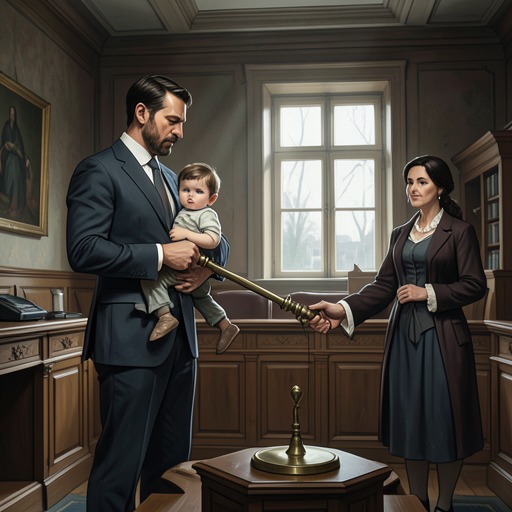
John Storrow
Bag of BonesJohn Storrow is a custody lawyer who becomes Michael Noonan’s chief legal ally in the fight to keep Kyra Elizabeth Devore with her mother, Mattie Devore, and later to secure Kyra’s care himself. His legal advice moves through a world in which court procedure, money, local loyalties, and a child’s expressed wishes do not always point in the same direction; his commitment survives the loss of Mattie and the violence that leaves him seriously injured.
Identity and Introduction
Storrow enters the story by telephone after Michael, expecting a call from Maxwell Devore or George Footman, answers a ringing cordless phone. He works for Avery, McLain, and Bernstein on Park Avenue and specializes in custody law. Michael initially imagines him as so young that he might have graduated from law school only the previous week, but trusts the recommendation of Henry Goldacre, who has vouched for his ability.
Once the introductions and background are finished, Storrow asks for an account of what is happening in the TR. His first questions establish the practical terms of the relationship: he is not simply advising Michael about his own position, but considering who needs representation most. He says he would choose to represent the young girl, a choice that makes Kyra’s welfare the center of his approach.
Strategy in the Custody Dispute
Storrow explains the significance of the court’s appointment of Elmer Durgin as guardian ad litem. The guardian is supposed to protect the child’s interests, and the court pays for the work, but a judge is not required to follow the appointee’s advice. In practice, Storrow says, judges usually do so: rejecting an appointed guardian can make a judge appear to have exercised poor judgment. The appointment therefore gives Durgin’s account unusual influence over Kyra’s case.
Storrow suspects that the appointment may offer an opening to investigate whether Maxwell Devore has placed Durgin in a compromising position. He does not present that suspicion as established fact; rather, he sees the possibility of financial temptation and proposes looking into whether Durgin has succumbed. His willingness to test the guardian’s impartiality turns the legal strategy toward the conduct surrounding the case, not only the formal custody claims.
Michael receives a subpoena requiring him to appear at Durgin’s Castle Rock office at ten on the morning of July 10, 1998, for a deposition about his knowledge of Kyra and her well-being. The notice identifies the deposition as being on behalf of Castle County Superior Court and Judge Noble Rancourt, with a stenographer present, and says it is not being taken for either plaintiff or defendant. Storrow’s advice is to make the deposition useful: set out what happened, emphasize that Kyra believed she was walking safely, and ensure that the unusual local term crossmock enters the record. He treats details from the child’s experience as evidence that must be clearly established rather than left to disappear into the competing parties’ accounts.
The risk, as Storrow explains it to Mattie, is not limited to what Maxwell’s lawyers may argue. Mattie reports that Storrow warned Maxwell would want her to be in the weakest possible position at the hearing, including answering that she was unemployed if asked about her work. When the Four Lakes Consolidated Library calls Mattie’s dismissal belt-tightening, Michael recognizes that the library has long counted Maxwell among its chief supporters and may continue to depend on his support. The threat to Mattie’s livelihood consequently bears directly on the custody struggle: an apparently ordinary employment decision could shape how she appears before the judge.
Advice, Trust, and Local Pressure
Mattie hires Storrow after Maxwell frightens her; she says she tried not to show her fear, but that people who frighten her make her angry. She calls her agent in New York and retains a lawyer who specializes in child-custody cases. Storrow’s involvement brings expertise into a dispute in which, as Mattie sees it, Durgin is close to her father-in-law and Richard Osgood is another of Maxwell’s associates. She alleges that Durgin and Osgood had drunk together at The Mellow Tiger and suggests they stopped when the connection began to look bad. These are Mattie’s suspicions, not a court’s findings, but they show why Storrow’s investigation of the guardian matters to her.
Storrow does not offer reassurance by pretending that the case is easy. Mattie tells Michael that Storrow’s analysis did not make her feel safe, even though she recognizes that he has said much the same things Michael has. Her distinction is personal: Michael makes her feel safe. Storrow’s role is therefore different from Michael’s. He supplies legal judgment and preparation, while Mattie experiences Michael as a source of immediate security amid the pressures of the case.
He also reads the local situation as a problem of information and exposure. He advises Michael and Mattie to assume that one or both telephone lines may be tapped, to meet in the market if they happen to see one another, and to use an ordinary visit to the local library as cover for Michael’s movements. His directions show how the custody fight has spilled beyond the courtroom into daily life, where even routine contact may require caution.
Storrow’s counsel also has to contend with the TR’s unwritten preference for keeping trouble contained. Bill Dean describes the community as a group sharing a cramped bed: if one person becomes restless, everyone loses sleep. He tells Michael that Mattie is not the only resident struggling to get by. The local ethic that people do not take charity, along with the community’s impulse to leave neighbors to themselves, makes public intervention costly. Storrow’s formal legal approach operates against that pressure, while Maxwell’s financial influence reaches institutions such as the library and people connected to the case.
Partnership with Michael and the Case’s Changing Stakes
Storrow and Michael build a practical working relationship through calls, planned meetings, and the collection of information. They arrange to meet at the Route 120 Diner at 9:15 on a Friday morning, with coffee and time to talk, while Storrow meets Mattie to learn as much as possible. Storrow even raises the possibility of hiring a private investigator. His plans combine direct client conversations with independent inquiry into the people and circumstances shaping the dispute.
The relationship is not confined to lawyerly exchanges. When Maxwell’s death and will alter the stakes, Storrow telephones Michael, sounding energized and impatient to hear the latest developments. He learns that Mattie has just completed a preliminary meeting with Maxwell’s attorneys about the will and that Maxwell has left her eighty million dollars. The inheritance changes Mattie’s financial position, but it does not erase the custody case or the need to protect Kyra; the legal work continues amid the consequences of Maxwell’s conditional bequest.
Michael sometimes turns to Storrow for moral confirmation as well as legal advice. After a desperate episode involving Maxwell and Rogette Whitmore, he calls because he wants Storrow to tell him he did the right thing and that the immediate danger to Kyra’s case has not changed. His need for reassurance sits uneasily beside the fact that the two assailants had appeared to enjoy themselves. Storrow is a trusted professional sounding board, even when Michael’s actions and the case have moved beyond the orderly boundaries of legal procedure.
At the Fryeburg Fair, Michael asks whether Mattie has called Storrow. The question places the lawyer within the ongoing pattern of coordination around Kyra, even in a setting far removed from hearings and depositions. When Storrow comes to the TR in person, Michael meets him at the airport. Storrow steps off a small twin-engine plane carrying both a briefcase and a Styrofoam cooler; Michael takes the cooler before Storrow drops it. The ordinary gesture of assistance gives the professional partnership a visible, companionable quality.
Injury, Continuing Counsel, and Narrative Role
During the attack at Mattie’s party, rapid gunfire breaks out. Mattie screams, and George Kennedy shouts for everyone to get down. Storrow cries out in pain. In the immediate aftermath, his concern is directed toward Mattie: he begs Michael to tell him she is all right. Later, Michael learns that Storrow nearly died from blood loss and that he never fully regained the use of his right arm. The violence does not make Storrow’s part in the custody story incidental; it marks the physical cost of the conflict around Mattie and Kyra.
After Mattie’s death, Michael tells Frank Arlen that he had assumed Storrow would be the person he could confide in about everything that had happened. But Storrow will discuss those events only insofar as they bear on the continuing legal business, which is now entirely about Kyra. Michael’s observation defines both the limit and the durability of their relationship: Storrow is not the recipient of every grief Michael carries, but he remains engaged in the work that may determine Kyra’s future.
Michael describes the proceedings as a long wait, invoking Bleak House and its bleak view of litigation. Storrow counsels patience and reminds him of the progress already made, despite the disadvantage of being an unmarried, middle-aged white man seeking care of a child with a complicated history. By then, Kyra has spent time in two foster homes since Mattie died, and she repeatedly tells judges and Department of Human Services workers that she wants to live with Michael. Storrow’s continuing role is to pursue the case through forms, hearings, and institutional delay, while Michael supplies the personal commitment and financial resources to keep going. His characterization rests on this pairing of brisk strategy with sustained allegiance: the lawyer who first votes for the child remains on her side after the case has outlasted her mother and his own physical recovery.