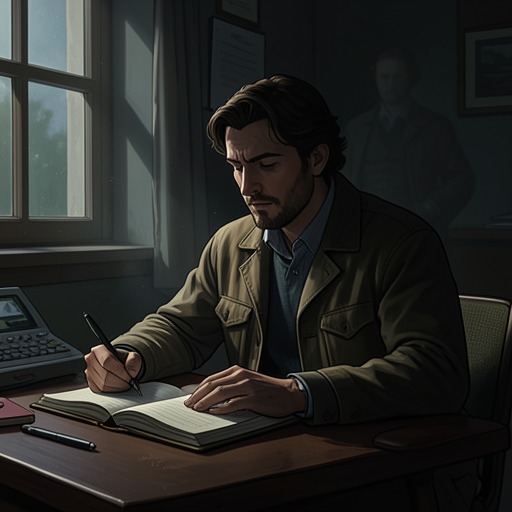
Manderley Dream Series
Bag of BonesThe Manderley Dream Series is Michael Noonan’s recurring autumn-and-winter dream sequence, in which he walks toward Sara Laughs under the shadow of a literary memory of Manderley. Its movement from suspended approach to a final, violent nightmare makes the lodge a landscape of grief: Michael’s dead wife Johanna is at once absent, remembered, and frighteningly present. The dreams expose the divide between his waking life and his sleeping imagination, and their last image—the empty coffin and the rushing white figure—turns that divide into a crisis he cannot dismiss as ordinary sorrow.
Origins and Repetition
The series takes its name from a line Michael recalls while struggling with panic, a sense of mental paralysis, and the fear that he will never write again. During the fall of 1997 and winter of 1998, he does not dream of Manderley itself; he dreams of Sara Laughs, the remote lodge that Johanna sometimes called the hideout. The literary allusion supplies a pattern for his own return to a place bound up with loss, but the dream’s setting is specifically the western Maine woods and the house he and Johanna had shared.
The dreams recur with a marked separation between sleeping and waking life. By day, Michael rarely thinks about Sara Laughs; at night, he wakes wanting to turn on the bedroom light and re-establish where he is. The dreams have a feverish stillness and heightened color, and they leave behind an unease that is not quite sickness. Their effect is double: Michael finds the recurring dream creepy, as though his subconscious were persistently digging at something, yet he also admits that part of him enjoys its breathless calm, sadness, and foreboding. That attraction matters: the dreams are not only an assault from which he recoils, but a vivid imaginative experience in a period when his waking writing life feels blocked.
The Walk to Sara Laughs
The dream’s fixed action is a walk up the unnamed lane to the lodge. The lane is a two-mile loop through the woods, with both ends opening onto Route 68; its number, Lane Forty-two, exists for reporting a fire, not as a name the couple ever gave it. In the dream Michael never drives. He walks, while timothy and witchgrass grow along the double ruts and the trees close in until the darkening sky is only a narrow slot overhead. Crickets, loons, and rustling animals make the familiar route feel watchful and increasingly separate from ordinary life.
The approach repeatedly stops short of entering the house. Sara Laughs first becomes a dark bulk below; Michael imagines threats inside and finds himself unable to move from the meeting of driveway and lane. The rustling behind him changes in meaning, from the sounds of small animals to the suggestion of approaching footsteps. He tries to turn, but cannot. The dream ends at this threshold often enough that the failure to enter becomes part of its structure: the house is both the destination and the place he cannot yet face.
The repetition also changes Michael’s sense of bodily control. After waking, he turns over to prove to himself that his body will again obey his mind. In one remembered episode, he wakes speaking into the dark, begging for protection from something in the woods; it is the panic in his voice, more than the words themselves, that frightens him. The dreams thus unsettle the boundary between imagined pursuit and waking behavior without making every detail certain: Michael later says he does not completely trust memories that, for so long, seemed not to exist at all.
The Culminating Nightmare
The final dream begins like the others, with Michael walking up the lane, but small alterations announce that this approach will go further. A radio-station sticker appears on the Sara Laughs sign, and Venus is visible overhead. As he continues toward the house, the familiar dread intensifies: the figure he fears behind him seems to move closer, the bushes clutch like hands, and a moon rises in a dream where it had never risen before. Michael sees the dark windows and imagines the power knocked out by a storm, leaving him to grope through the lodge’s darkness.
Near the stoop, he recognizes an object that has never appeared in the earlier dreams: Johanna’s coffin, the one Frank Arlen had negotiated for, lying on its side with its lid partly open and its interior empty. The image brings the fact of Johanna’s death into the dream’s present tense. The coffin is not just a reminder of the funeral; it is the physical evidence around which Michael’s fear of her return takes shape. The house’s back door opens, and a shrieking, faceless figure in tangled white winding cloth races toward him. He identifies it as Johanna escaped from her coffin, but the dream renders this recognition as terror, not reunion. The figure’s speed and the expectation that nobody but the loons will hear him turn the lodge into a trap.
Michael wakes on the floor in a corner of his bedroom, on his hands and knees, repeatedly striking his head against the meeting of the walls. With the power out and the bedside clock dead, he cannot tell how long it takes him to understand that he has fallen out of bed and crawled across the room in his sleep. Even awake, he remains afraid to leave the corner, imagining the white figure bursting from the bathroom; he is shivering, cold, and wet because he has lost control of his bladder. The nightmare’s force therefore survives the moment of awakening, making the ordinary dark bedroom feel continuous with the imagined house.
Grief, Return, and Narrative Meaning
The dream series belongs to a longer process of acknowledging Johanna’s death. Earlier, a line read aloud from a paperback copy of The Moon and Sixpence makes Michael understand that Johanna will never turn the page: her death becomes undeniable in that intimate scene of reading, despite the funeral and the grave. Later, when he completes a piece of writing and tells her, “I'm done, Jo,” there is no response. These moments mark different forms of absence: first the devastating recognition that she is dead, then the attempt to speak to her while accepting that the room remains silent. The dreams intensify this conflict by making her return in the most frightening form Michael can imagine.
The phrase “Well, then — that's all right, isn't it?” recurs at crucial points beyond the dream sequence. Before a later return to Sara Laughs, Michael hears the words and drives down the lane, turning into the driveway; afterward, he cries for the years spent without Johanna, friends, or work, and for the possibility that his writing life has begun again. The recurrence links the dream’s stalled approach with a waking decision to enter the house. The dream is not a map of a simple recovery: its terror, the real history of loss, and the novel’s later supernatural events remain entangled. But its movement toward the lodge establishes a pattern of return that the waking narrative will revisit.
At the end of the novel’s supernatural conflict, Johanna appears as a dim but recognizable presence beside Michael after the Outsider is gone. She looks exhausted and diminished, yet smiles; Michael understands her unspoken message as an expression of their enduring marriage. This appearance gives the earlier nightmares a striking counter-image: instead of the coffin’s empty space producing a monstrous, pursuing figure, Johanna is present as a helper whose suffering is bound to his. Michael later says he chooses to close his book of dreams of his own free will, while acknowledging that he remains haunted. The series therefore does not erase bereavement or sever the bond with Johanna. It dramatizes how memory can return first as terror, then as companionship, while Michael’s care turns toward the child sleeping down the hall.