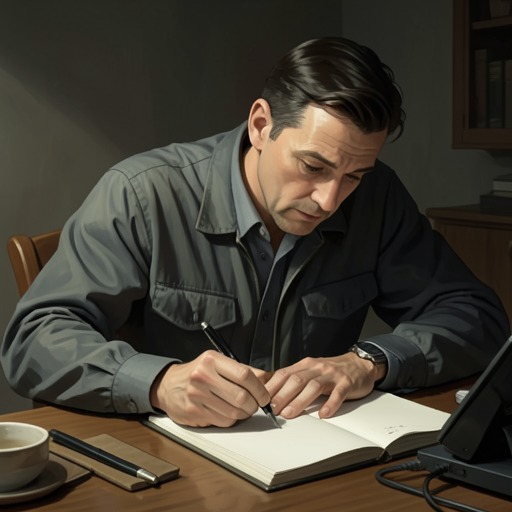
Mike's IBM typewriter
Bag of BonesMike's IBM typewriter is more than a writing machine: its discovery in Johanna Noonan's studio makes Mike suspect that she left something behind, and its image later marks a door in the Ghost House through which he enters a constricted, coffin-like passage. The typewriter connects the ordinary material practice of writing to the novel's supernatural messages and to a journey whose way forward is also a way into fear.
The Typewriter as a Clue
While considering what Johanna might have written, Mike remembers finding his old typewriter in her studio. The object changes the terms of his uncertainty: instead of dismissing the possibility that she left a written trace, he resolves to search the studio carefully. Its presence is concrete evidence around which his suspicions gather, though the supplied episode does not identify what, if anything, Johanna wrote on it.
The machine also belongs to a broader tension in Mike's understanding of writing. He describes creative work as a state in which the intuitive mind can send images and messages without conscious invitation. When he later finds himself staring at refrigerator magnets as words form and break apart, the experience leads him to recognize that Sara Laughs is haunted. The typewriter found in Johanna's studio thus sits at the boundary between writing as deliberate craft and writing as a channel through which something unbidden may emerge.
An Image in the Ghost House
During Mike and Kyra's passage through the Ghost House at the Fryeburg Fair, the maze grows so long that the sounds of the fair—including Sara and the Red-Tops—fall away. They reach three doors: one painted with a red tricycle, another with Mike's green IBM typewriter, and a third marked by an old child's sled. Mike recognizes the sled as Scooter Larribee's, stolen by Devore; the typewriter, by contrast, is identified as his own. Kyra calls the pictured objects their toys, while Mike answers uncertainly that they seem to be.
The typewriter's painted image makes a familiar tool function as a sign in an unfamiliar landscape. Mike understands the surrounding place as the between-time, where people slip through the cracks, and chooses the typewriter-marked door. It opens easily onto another narrow corridor of wooden walls and the sweet smell of pine. He does not want to enter: the passage suggests a long coffin, and the door slams behind him. Yet his anticipated panic attack does not take hold. He ties the dark blue ribbon from Kyra's hat around his wrist and moves forward, carrying a tangible keepsake into the space marked by the image of his writing machine.
Writing, Materiality, and Passage
Across these episodes, the typewriter shifts from evidence of a possible private record to a painted marker in a supernatural maze. The object is familiar enough to identify immediately, but its appearance in the Ghost House makes that familiarity unsettling: rather than simply enabling composition, it points Mike toward a confined passage whose destination is unknown. Its significance rests in this contrast between a practical instrument and the uncanny route its likeness opens.
The typewriter also helps bind separate forms of narrative communication together. Johanna's possible writing remains an unanswered question; Mike's account of creative intuition presents writing as susceptible to images and messages beyond conscious control; and the Ghost House turns the typewriter itself into an image that guides action. The machine does not supply the missing text or explain the supernatural events. Instead, its recurrence makes the act and possibility of writing part of the same uncertain territory Mike must enter.