My Childhood Friend manuscript
Bag of BonesMy Childhood Friend manuscript is both a work of fiction and a hidden message system: the novel Mike Noonan writes after his writing block lifts carries Jo Noonan’s repeated clue, “owls under studio,” directing him toward the evidence she concealed at Sara Laughs. Its plot and form become inseparable from Jo’s effort to communicate across her absence and from Mike’s discovery that his renewed writing was part of that effort.
Composition and Embedded Story
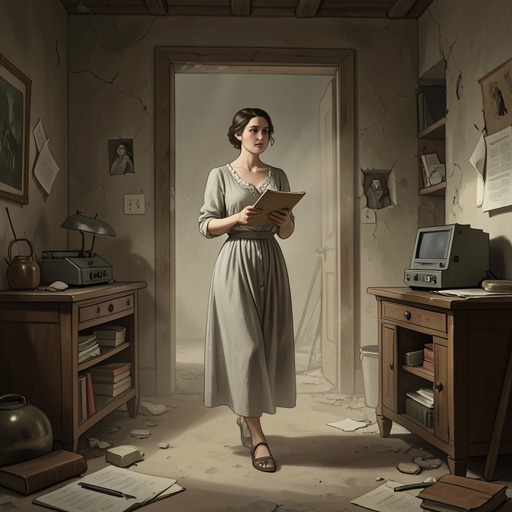
Mike has written just over 120 pages of the manuscript when he returns to it during a storm at Sara Laughs. On page nineteen, the novel’s characters Tiffi Taylor, a former call-girl who has reinvented herself as Regina Whiting, and Andy Drake discuss an earlier rescue: John Sanborn, an alias for John Shackleford, saved Tiffi’s three-year-old daughter, Karen, from a hot tub. The manuscript’s embedded episode concerns a child who nearly drowns and a rescue that the rescuer refuses to treat as proof of heroism. Its place on page nineteen later connects it to the clue Mike deciphers there.
The novel’s names and settings also make the message detectable through repetition. Andy Drake scowls rather than frowns, because there is an owl in every scowl; Shackleford has lived in Studio City, California; Drake first meets Regina in her studio; Ray Garraty’s last-known address is the Studio Apartments in Key Largo; and Regina’s best friend and her husband are Steffie and Towle Underwood. Mike recognizes these recurring owl and studio references as a pattern rather than incidental details.
The Acrostic and Jo’s Message
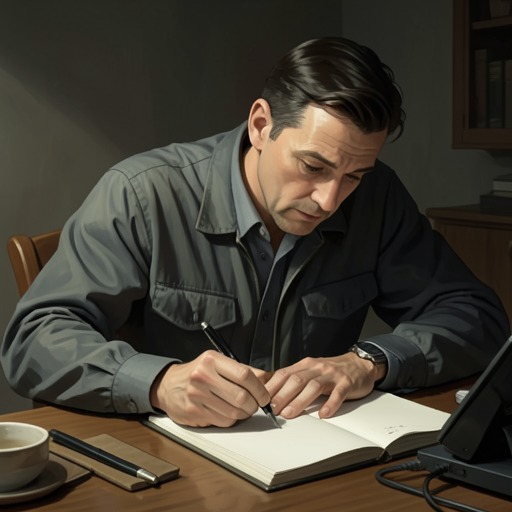
Reading the first letter of each line of the page-nineteen passage downward, Mike finds the beginning of the instruction “owls under studio.” Allowing for an indented line, he sees the full wording, “owls under studIO.” The spacing and capitalization do not change the message: it directs him to the owls beneath the studio. The clue has been present almost since he began writing the novel, but he understands it only when he uses his steno pad to align the manuscript’s lines.
The same phrase appears again on page ninety-two, where Shackleford speaks to Drake in a prison visitors’ room. Mike stops reading the fictional dialogue once he recognizes the recurring marginal message. He recalls the relief of being able to write again, then revises his understanding: Jo, not a solution he had found on his own, had broken the block. She had used the manuscript to leave him a trail, and the continuation of his writing career had been less important to her than getting him to understand it.
From Manuscript to Hidden Archive
The manuscript’s clue belongs to a larger chain of traces Jo left behind. Before Mike discovers its meaning, Jo’s appointment calendar has already helped him reconstruct one of her unexplained trips. A 1993 entry records “S-Ks of Maine, Freep, 11 A.M.”; the notation identifies a Soup Kitchens of Maine board meeting in Freeport on Tuesday, November 16. Jo had served on the organization’s board from 1992 until her death. The appointment helps explain how a day’s obligations could have been followed by a drive of roughly seventy miles to the TR to collect two plastic owls, but it does not resolve every question about the errand.
Later, Ward Hankins sends Mike photocopied pages from Jo’s appointment calendars while Mike speaks with Bonnie Amudson. Mike asks whether Jo had discussed writing about the township around their summerhouse; Bonnie recalls Jo sharing photographs and herb samples, but not writing. These records establish the investigative context around the manuscript without making its clue self-explanatory: Mike still has to connect the calendar, the owls, and the repeated words in his own pages.
The instruction finally leads him to a plastic owl containing a small tin box marked “JO’S NOTIONS.” Inside are folded papers, two wirebound steno books, and a photographic negative of Jo standing on the swimming float. Mike understands the box as material Jo had brought to Sara Laughs in July 1994 to gather and hide. The manuscript’s acrostic thus points beyond itself: it is the route to the physical archive, not the archive’s replacement.
The Archive and the Local Past
Among the concealed papers are clippings about Sara Tidwell and the Red-Tops. Their reviews praise the performers in language that is genial in tone but openly racist in its descriptions. Mike finds no account in the clippings of why the group left. Instead, one newspaper report, dated July 19, 1933, recounts the wildfire at Halo Bay. When the wind changed, fire threatened the settlement; people trying to leave became trapped behind a road blocked by vehicles. The press material supplies a record of events, but its scope and omissions leave important parts of the history unresolved.
Jo’s notes carry the investigation further. Mike learns that the crying boy was Reg Tidwell Jr., and that Reg spent much of August 1901 pressing the county sheriff first to search for Sara and her son, then to find their bodies, and finally to identify their killers. By September, people around the TR widely knew that Sara and her boy had been murdered and had a strong idea who was responsible. The manuscript’s hidden instruction therefore leads Mike into a history preserved across different kinds of documents: calendars, notes, clippings, and the people who remember what the records leave out.
Narrative Function
The manuscript converts Mike’s ordinary act of writing into a form of transmission. Its fictional rescue scene supplies the page on which the first acrostic becomes legible; its recurring owls and studios repeat the clue across otherwise separate passages; and the repeated message sends Mike to Jo’s concealed box. The work that appeared to mark his return to an independent writing life is revealed instead as part of the communication Jo had set in motion.
The novel also links private memory to a damaged public record. Mike does not find a complete explanation in any single clue or document. The calendar clarifies a date and destination; the manuscript points to the owl; the box preserves Jo’s notes and the clippings; and those sources, read together, lead toward the suppressed history she was investigating. My Childhood Friend manuscript matters not simply as an unfinished thriller, but as the medium through which Mike can follow Jo’s evidence and recognize the purpose behind its recurring pattern.