Romeo Bissonette
Bag of BonesRomeo Bissonette is the lawyer Michael Noonan turns to during the custody dispute over Kyra Devore. He serves as both legal counsel and a practical ally: at Michael’s deposition he checks Elmer Durgin’s questioning, and later he joins George Kennedy in supporting the family when the conflict becomes physically dangerous. His role links the formal machinery of the custody case to the personal loyalties that develop around Mattie and Kyra.
Identity and Introduction
Introduced through Michael’s legal preparations, Bissonette is a lawyer from Lewiston whom John Storrow has arranged as counsel. Storrow describes him as a safety net rather than someone Michael must visit in person immediately. He advises Michael to call first, then meet Bissonette at the Route 120 Diner at 9:15 on Friday. The practical plan reflects the case’s competing demands: Michael is to tell the truth about the morning of July Fourth, while Bissonette is ready to object if questioning strays beyond its proper scope.
The unusual name becomes a small moment of levity in the middle of the legal pressure. Storrow wonders aloud whether Romeo Bissonette can be a real name; Michael recognizes it as plausible in Maine, particularly around Lewiston. The joke makes the lawyer memorable before he appears, but his later conduct gives the name a more consequential association: he is the person who speaks up when Michael is being pressed unfairly.
Counsel at the Deposition
Bissonette accompanies Michael to the deposition before Durgin, Kyra’s guardian ad litem. The proceedings take place in a conference room at Durgin, Peters, and Jarrette on Bridge Street in Castle Rock. Their formality is heightened by a stenographer using a Stenomask, whose muffled repetition of each answer makes the exchange feel more like an official record than an ordinary conversation. Bissonette is present in that setting as counsel, not merely as a name on a referral.
His most important intervention comes when Durgin tries to cut off Michael’s account of Kyra’s recollection of a playful incident with her mother. Bissonette tells Durgin to let Michael finish, pointing out that the gathering is not a courtroom and that Durgin is not cross-examining him. The intervention protects Michael’s ability to give context rather than leave a potentially damaging fragment on the record. Durgin says he is thinking of Kyra’s welfare and apologizes if he has seemed to badger the witness, but Michael does not accept the apology, judging that to do so would make the exchange false.
Bissonette later objects more specifically when Durgin attempts to place Michael’s statement about picking flowers on the record. He asks that the material be stricken and accuses Durgin of trying to get the witness to say something he has not said. He also raises the possibility of pausing the deposition to seek Judge Rancourt’s opinion. These actions establish his method through observable conduct: he monitors the questioning, identifies leading or unsupported material, and is willing to challenge the guardian ad litem in the room rather than leave Michael to manage the pressure alone.
Practical Support and Alliances
Bissonette’s involvement extends beyond the deposition. When Michael later meets him at the terminal, the lawyer is with George Kennedy, the private detective, and carries a blue-wrapped present tied with a white ribbon. Bissonette and Kennedy have pooled their money to give Michael something in recognition of his help to a woman in distress. He asks Michael to call him Rommie, shifting the relationship from formal lawyer and client toward a more familiar friendship. The exchange is warm and teasing, but it also makes clear that Bissonette sees Michael’s involvement as an act deserving reciprocal support.
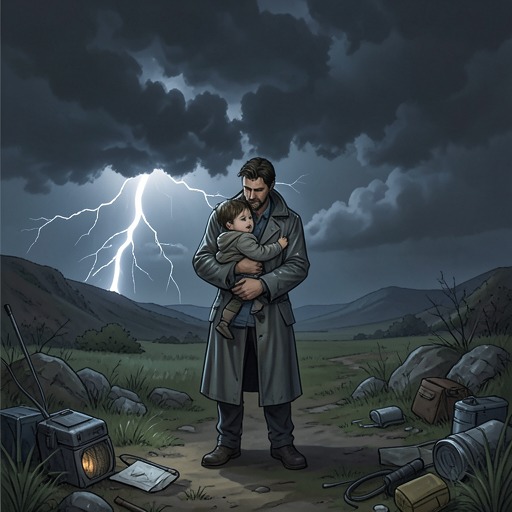
That alliance is visible again at Mattie’s home. After the attack on Mattie, Bissonette checks on her condition and begins praying aloud when he sees how badly she has been hurt. Michael tells him to stop and asks him to go inside and check on Kyra. Bissonette obeys and makes his way toward the trailer despite his injured ankle. Later, inside, he reports that Kyra is all right and that she appears to be waking, while explaining that he can no longer walk because of the pain in his ankle. He has already tried the telephone, but the storm has rendered it useless. His role in this emergency is neither that of a detached observer nor a substitute for Michael: he carries out the immediate task Michael gives him, and reports the child’s condition when he reaches safety.
Character and Narrative Role
Bissonette’s actions make him a counterweight to the misuse of legal authority represented in the deposition by Durgin’s questioning. He does not claim that the case itself is simple or that formal procedure can resolve every danger. Instead, his contribution is concrete: he helps Michael prepare, guards the integrity of Michael’s testimony, and remains present as the custody conflict spills beyond the conference room.
His characterization also joins professional competence to personal warmth. The lawyer who invokes the possibility of consulting a judge is the same man who asks to be called Rommie, shares a present with Kennedy, and turns toward Kyra when Mattie is gravely injured. The narrative does not provide a full account of his private life or legal career; it defines him through these decisions and relationships. In a story where local pressure and economic influence complicate the formal custody process, Bissonette supplies a limited but meaningful form of reliable help: he uses his position to resist unfair questioning and, when the crisis becomes immediate, attends to the child’s safety.