The Drowning Motif
Bag of BonesThe Drowning Motif makes water a recurring threshold between past violence and present danger. It first overtakes Mike as a vision of a drowned boy, then returns in a real assault that nearly kills him; when Max Devore later dies by drowning himself, the motif binds these episodes together without making their causes identical.
The Vision at the Lake
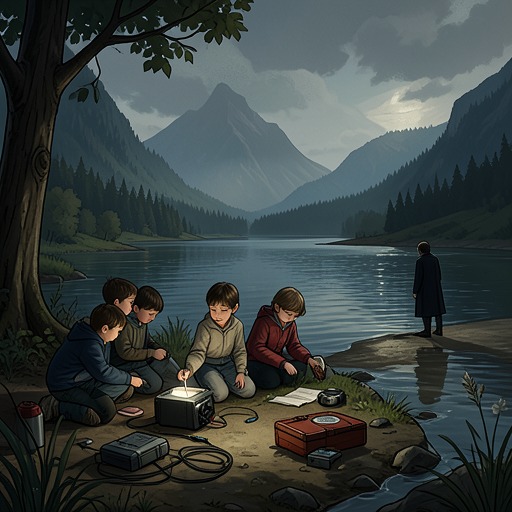
As Mike walks north along The Street, he has begun to suspect that Jo may have left something in her studio. The words “help im drown” interrupt that line of thought. The appeal seems to come at once from the woods, the water, and Mike himself, and his body responds before he can make sense of it: he feels ill, his chest tightens, and the lake seems to enter his mouth and eyes. The episode makes the boundary between an external haunting and an internal experience uncertain.
The pressure in Mike’s chest takes the shape of hands holding him down. He then sees a boy lying drowned in the lake, and experiences the scene from both sides: as the child below the surface and as himself above it, trying to call out. He recognizes the child as a Black boy whose name was probably Tidwell. The vision therefore connects Mike’s immediate terror to a death associated with the Tidwell family, but it gives him no complete account of what happened.
The vision recedes, but it leaves a physical aftereffect: Mike staggers to a birch at the water’s edge, still gagging, and notices a foul odor that seems to come from a presence that should be dead. After he sees the boy, the smell appears again to come from the ground nearby. The scene shifts between bodily illness, an apparition, and clues in the landscape; it presents the drowning not as a finished past event, but as something that can return through sensation and place.
The Assault on Mike
The motif becomes literal when Devore drives his wheelchair toward Mike at the lakeside and Mike falls into the water. Mike’s foot strikes a submerged root, and the lake enters his mouth as he struggles to get away from the bank. He thinks of the drowned boy beneath him and fears the dead child might reach up. The earlier vision has prepared that fear, but the danger now comes from a present human attack rather than a vision alone.
Mike reaches for a swimming float while Devore and Rogette Whitmore follow along the shore. As the light fades and his arms grow heavy, a cramp seizes his left leg. He goes under, swallowing water, and understands that he is actually drowning. The episode repeats the vision’s helplessness in material form: his breathing and movement are failing, and the earlier imagined submersion has become immediate physical peril.
Mike is pulled back to the surface by hands that seize his neck and leg; the cramp releases, and he manages to reach the float’s ladder. When he climbs out, Devore and Whitmore are gone. His survival does not erase the assault, but it reverses the scene’s outcome: the person who had just been forced into the lake escapes, while his attackers disappear from the shore.
Devore’s Death and the Motif’s Reversal
The following morning, Bill tells Mike that Devore killed himself in a tub of warm water, using a plastic bag over his head. Bill connects the quickness of the death to Devore’s damaged lungs. The detail gives the drowning motif a third form: unlike the boy’s remembered death or Mike’s forced submersion, Devore’s death is a reported suicide, carried out in a tub rather than the lake.
Mike is glad to hear of Devore’s death, though he is sorry to feel that way. He recalls that Devore had dumped him in the lake the previous night; before that night ended, Devore had died by drowning himself. The juxtaposition gives the motif a stark reversal, but it does not establish that Devore’s suicide was a consequence of the assault or explain his motive. Mike’s reaction instead registers the immediate end of a threat and the uneasy relief that accompanies it.
Recurrence and Significance
Across these episodes, drowning moves between an unnamed cry for help, Mike’s vision of a dead child, an attack on Mike, and Devore’s self-inflicted death. The forms differ, and the evidence does not collapse them into one cause. Their recurrence nevertheless makes the lake’s past difficult to keep separate from the present: Mike encounters the drowned boy before he is himself nearly drowned, and later recognizes the reversal when Devore dies in water.
The motif is also carried by repeated bodily sensations and images: water in the mouth, pressure on the chest, a struggle to surface, and the fear of an unseen presence below. These details join vision and physical danger without resolving whether the boy’s appearance is supernatural, psychological, or both. Drowning thus structures the passages as a repeated crossing between witnessing and suffering, the dead and the living, and a prior violence that continues to intrude upon present events.