The Moon and Sixpence
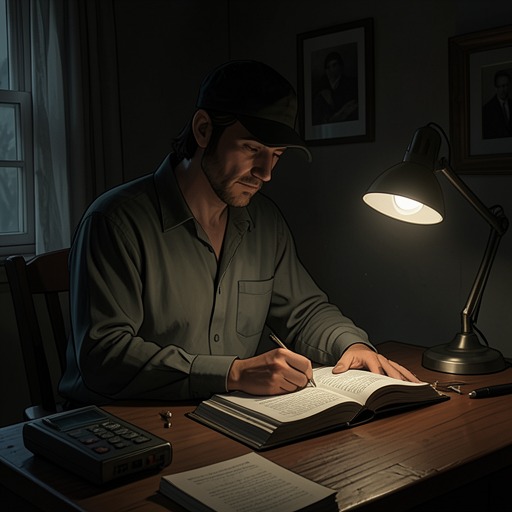
Bag of BonesThe Moon and Sixpence is the paperback Michael Noonan finds beneath the bed on Johanna’s side, open to a passage that gives his grief its most devastatingly concrete form. The book binds the couple through their shared literary past, but after Jo’s death its dusty pages, card bookmark, and unfinished reading become more than reminders: they stage the moment Michael understands that she will never turn the page again. The novel’s words recur at Sara Laughs, linking intimate bereavement to the larger pattern of memory, haunting, and return that shapes his life.
The book and the couple’s shared past
Michael discovers the open paperback while inspecting the house before visitors arrive. The underside of the bed is coated in dust, and the gray film on the book makes him think of Jo’s face and hands in her coffin. He tries to push that association away, but it returns throughout the day. The ordinary object has acquired an unsettling double: it belongs to a familiar domestic place, yet its dust makes the space beneath the bed seem like a miniature grave.
The book carries a history that predates their marriage. Michael and Jo were both English majors at the University of Maine, and their literary tastes had helped bind them together. Michael recalls meeting Johanna Arlen in a twentieth-century British literature class around 1980. She was a sophomore; he was a senior taking the course because he had time in his final semester. When she argued that future critics would regret embracing D. H. Lawrence while neglecting Maugham, the class laughed, but Michael did not. He fell in love with her. Finding Maugham’s novel under their bed therefore brings their courtship and their shared reading into the scene of his bereavement.
The paperback is open at pages 102 and 103, with a playing card serving as a bookmark. The marked passage concerns Dirk Stroeve discovering that his wife has left him for Strickland, and the narrator’s attempt to comfort him. Michael murmurs the reassurance to the room that now belongs only to him, registering how easily a line from the novel can become an address to the bereaved reader rather than to its character.
The page that makes death undeniable
When Michael turns the page, he reads of Stroeve attacking Strickland in a fit of rage, only to end up on the floor. Strickland calls him “You funny little man.” The words make Michael understand that Jo will never turn the page and encounter that line. His realization is sudden and final: her death is not a mistake that will be corrected, or a dream from which he will wake.
The book accomplishes what the visible facts of death had not. Michael had seen and identified Jo’s body on a video monitor, attended her funeral, heard Pete Breedlove sing “Blessed Assurance,” and stood through the graveside service. Even so, he had not truly believed she was gone. Sitting on her side of the bed with the paperback in his hand, he breaks down. The particular interruption in her reading—the page she will never reach—makes her absence present in a way that the coffin and funeral could not.
The scene’s force depends on reading as an action that time can stop. A bookmark preserves a place, but it cannot preserve the reader who left it there. The card marks a small interval between two pages; for Michael, that interval becomes an irrevocable divide between the life Jo shared with him and the life he must continue alone.
The dream beneath the bed
Michael cries himself to sleep, and the book returns in a vivid dream. He imagines waking, finding the paperback on the coverlet, restoring the card to its place between pages 102 and 103, and leaning over the side of the bed to put it back. The dream rehearses a simple act of tidying, but as he reaches down he sees Jo lying among the dust-kitties, with a strand of cobweb touching her cheek.
In the dream Jo appears in the blue dress Michael buried her in. She takes the book from him, her fingers cold, opens it to her place, and lays Maugham’s novel over her face like a shroud. She calls it her “dust-catcher.” The phrase gives the paperback a practical, almost comic domestic use even as the scene turns it into a covering for the dead. Her appearance under the bed fuses the household’s neglected dust with burial, and turns the book that confirmed her death into the means by which his dreaming mind brings her back.
Michael wakes with a muffled cry and nearly tumbles off the bed. His cheeks are still wet, and the dream is so vivid that he looks beneath the bed, expecting Jo and her cold touch. There is nothing there. He spends the rest of the night on the study couch, where he sleeps without another dream. The paperback has not literally moved or summoned her; its remembered place and language give grief a scene in which the impossibility of her return can be felt and then, on waking, confronted again.
A phrase carried to Sara Laughs
The line associated with the marked page does not remain confined to the bedroom. When Michael returns to Sara Laughs, he stops near Tidwell’s Meadow, where Sara Tidwell and her group had built cabins, and looks over the calm water of Dark Score Lake. Without knowing why, he speaks Strickland’s words: “You funny little man, said Strickland.” The remembered phrase accompanies his entry into a place already charged with history and a sense of dreamlike return. The novel has become a verbal trace through which an earlier grief resurfaces in a new setting.
Later, before going back into the house, Michael hears a remembered question about whether he is going to fight. He answers, and the thought “Well, then — that's all right, isn't it?” settles his decision. He gets into his car, drives down the lane, and turns into the driveway. The phrase had first belonged to the consolation offered to Stroeve; in this later moment, its echo accompanies Michael’s choice to face what waits at Sara Laughs rather than leave. The repeated literary language does not dictate events, but it gives his experience a pattern of loss, response, and return.
Reading, work, and the life that continues
After an episode of danger and supernatural disturbance at Sara Laughs, Michael walks down toward the lake and breaks into tears. He grieves the empty years without Jo, friends, or work, and feels gratitude that the years without work may be ending. Eight pages of typescript do not guarantee a career’s revival, but the possibility matters. He also cries from fear after realizing that he has been walking a white line since Jo died and has somehow been carried out of harm’s way. The water’s coolness feels like resurrection. The book’s earlier scene of halted reading thus belongs to a longer movement: from the page Jo cannot turn to the possibility that Michael can write again.
During the final supernatural confrontation, Jo appears as a dim figure after Sara’s hatred has been burned away. Michael sees her as exhausted and diminished, yet present to help him; the Outsider is gone. He tells her they did it, and understands her distant, inaudible reply as an expression of their continuing connection. This later encounter does not erase the bedroom’s recognition of death. Instead, the novel’s role in Michael’s life sits within the book’s more complicated account of how the dead may remain emotionally and supernaturally present.
At the end, Michael remembers telling Kyra that it is best not to leave love letters lying around, because they can come back to haunt their writers. He admits that he is haunted anyway, but says he closed his book of dreams of his own free will; he could have poured lye over those dreams, but chose not to. The distinction is crucial. He does not claim to be free of memory, nor does he destroy the past that continues to trouble him. Rather, he refuses to make himself its willing tormentor. The Moon and Sixpence first becomes the object that forces him to accept Jo’s death, then part of a network of literary echoes through which grief and return acquire form. What finally matters is not that the book can restore the dead, but that Michael can carry his love forward into caring for Kyra and a life beyond the haunting.