The Past Remains Alive
Bag of BonesThe Past Remains Alive describes how the history of the TR persists beneath its present-day life: not as safely completed local lore, but as a network of concealed violence, racial exclusion, and private grief whose effects return through testimony, archives, and supernatural experience. The past’s persistence is both social and physical. People protect one another by withholding painful knowledge; documents preserve what public histories omit; and Mike Noonan encounters an earlier time in which objects and voices collapse the distance between then and now.
Local Silence and Hidden Connections
When Bill Dean explains why Jo Noonan’s questions about little Kerry Auster were dangerous, he describes a small town in which events are connected beneath the surface and old tragedies can still hurt the living. His image is of unseen cables: the connections are not immediately visible, but they remain in place. The past, he says, dies more slowly in such a community. His warning concerns more than the risk of reopening Normal Auster’s terrible family tragedy. It reveals a local habit of treating knowledge as a threat because it may implicate people who are still present or remembered by those who are.
Bill distinguishes that painful history from the story of Sara Tidwell and the Red-Tops by calling them wanderers from away. His hesitation before that description exposes the racial language and hierarchy underneath his attempt to soften it. They were Black outsiders, and the town’s treatment of them cannot be understood as an old story detached from the community that remembers it selectively. In the same exchange, Mike recognizes that Bill may be telling the truth about not having seen Jo’s writing while also withholding the full meaning of what he knows. Silence here is not empty: it preserves the town’s connections and protects its inherited account of itself.
The haunting of Sara Laughs gives that persistence a direct, present-tense form. When Mike tells Bill that his house is haunted, Bill answers that Sara Laughs has always been haunted and that Mike has stirred the spirits up. He even suggests that Mike return to Derry so they can settle. The haunting is framed not as a new disturbance arriving from nowhere, but as something long resident in the place, reactivated when someone disturbs what had remained submerged. The property itself holds continuity between historical injury and present danger.
Jo’s Research and the Counter-Archive
Jo’s investigation begins, as Frank Arlen later explains, as research for an article: a lark, with Jo playing detective. She reads books but chiefly talks to people, drawing out their memories of the old days and encouraging them to look for letters and diaries. Frank remembers her as particularly good at this work. Her method gathers the kinds of evidence that official local history can leave out: personal recollections and documents kept in private hands.
Jo did not tell Mike what she was doing. Frank says that at first she may have intended the research as a surprise; later, on their final visit to the lake house, she asked him not to tell Mike they had been there. She planned to explain everything when she was ready, but died before doing so. The delay turns Mike into the eventual reader of work his wife could not complete or disclose. It also leaves her reasons partly unknown, even as what she collected makes clear that her curiosity had encountered something dangerous.
The materials Jo leaves behind form a counter-archive. Mike discovers that she came to Sara Laughs in July 1994 to gather and conceal her research, hiding it in a tin box inside a plastic owl and wrapping the materials in plastic. Among them are photocopied newspaper clippings from the Castle Rock Call and its predecessor, the Weekly News. Jo marked their dates in her firm handwriting; the oldest, from 1865, reports the return of Jared Devore. The surviving paper trail lets Mike reconsider family chronology and recognize that the seemingly mismatched generations have a history behind them.
Yet the archive also records the limits of what can be recovered. Jo’s clippings describe Sara and the Red-Tops in openly racist terms, calling them “our Southern blackbirds” and “our rhythmic darkies,” while presenting Sara through a condescending account of her appearance and “animal high spirits.” Mike recognizes these as favorable reviews, which makes their praise part of the evidence: the community’s records preserve the performers by reducing them to racial stereotypes. The clippings do not explain the circumstances of the group’s departure, and the town histories contain no account of the harassment Jo’s other sources describe. The documents speak, but their omissions speak too.
What the Community Remembers—and Suppresses
Jo’s history reaches Mike in fragments: press clippings, recollections, photographs, and the guarded memories of residents. According to the account drawn from her notes and Royce Merrill’s testimony, the Red-Tops’ community had begun to break up by the time the group played the Castle County Fair. By Labor Day, active harassment had begun and grew more frightening each day. The story is absent from the town histories, even though people in the community knew about the events Jo was investigating.
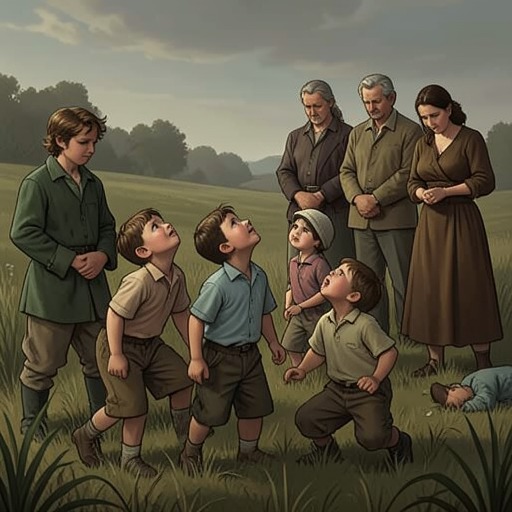
Son Tidwell did not want to leave until he learned what had happened to his sister and nephew. The separation of the wider community and the persistence of the family in the meadow show how historical injury can be carried forward as an unresolved demand for knowledge. Jo’s sources connect that demand to a clearing about a mile east of what is now Tidwell’s Meadow, where a large birch cross stood. After local churches shut their doors to the Black community, its members held services there. Son’s young relative, called Junior in the account, often went to the clearing to pray or sit quietly; people in the township knew his routine. Someone used that knowledge to conceal a leghold trap along his path beneath leaves and needles.
The danger in this history lies not only in violence, but in the community’s management of what may be said about it. Bill’s warning that Jo had stepped on sore toes describes a living social structure, not a neutral disagreement about old news. Frank’s account of her investigative conversations and Mike’s discovery of the hidden clippings challenge the town’s public version with testimony and evidence that had been kept out of it. The past survives in precisely the conflict between what the community records, what it remembers privately, and what it refuses to put into its histories.
The Past Made Present
The principle becomes uncanny when Mike experiences a time-slip on The Street. He finds himself walking through an October landscape rather than the muggy middle of summer: lanterns line the way, autumn leaves stream in the wind, and music from Sara and the Red-Tops carries across the lake. Sara’s singing sounds like laughter and, unsettlingly, like a snarl. Her voice is not merely a memory Mike recalls; in this experience it belongs to a past he has entered.
Mike asks whether the experience is really happening. A loon calls twice, and he recalls the one-tap/two-tap code: twice means no. A crow then caws once when he asks the day whether this is real. Those signs do not make the episode ordinary, but they give its uncertainty a structure. The past is encountered as a place that can answer, rather than as a story safely contained in the mind.
At the water’s edge, Mike looks for the drowned boy he has seen before but finds no boy. On the bottom lies Royce Merrill’s Boston Post cane, its gold head visible among rocks, roots, and waterweed, with white ribbons edged in bright red curling around it. The cane is a material impossibility within the time Mike has entered: Royce is not yet born, and will not be born until 1903, while Sara and the Red-Tops have already been gone for two years by then. The object joins incompatible moments in a single image, making time itself evidence that the past has not stayed put.
The cane also lets Mike understand why Royce has not answered the telephone: his answering days are over. He recognizes that he has come to a time before Royce’s birth, while Sara is present and singing. The narrative makes historical knowledge experiential: Mike does not simply learn that Sara’s era precedes Royce’s; he sees an object associated with Royce lying in the lake during that earlier world. The ribbons, the submerged boy’s earlier absence, and the music together turn the lake into a surface under which different periods remain in contact.
Meaning and Narrative Function
The concept connects the novel’s social history to its supernatural structure. In the town, the past remains alive through family ties, racial exclusions, unspoken complicity, and the fear that old events can still injure living people. At Sara Laughs, that persistence acquires a literal haunting; in Mike’s time-slip, it becomes a journey in which anachronistic objects and historical voices coexist. These are not separate forms of recurrence. Each makes the same point in a different register: what has been buried continues to shape the present.
Jo’s research is central to that design because it turns remembrance into an act of recovery, while refusing the comfort of a complete explanation. She finds sources the local histories omit, but some clippings do not tell what happened, and Mike cannot know all her motives. The remaining gaps matter. They show how historical silence can survive even when evidence is saved, and why testimony must be assembled from several imperfect forms rather than accepted from a single authoritative account.
The result is a town whose history behaves like Bill’s hidden cables: unseen until someone catches on them. The archive, the guarded conversation, the enduring haunting, and the cane at the bottom of the lake all make the past active rather than finished. Mike’s investigation does not simply expose earlier events; it reveals that the present has been built around their unfinished consequences.