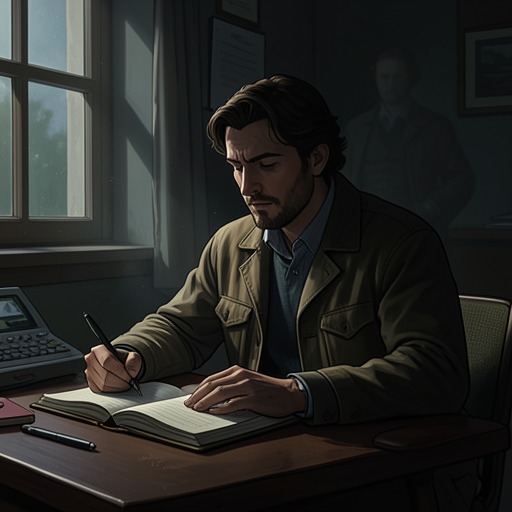
The Writer's Zone
Bag of BonesThe Writer’s Zone is Michael Noonan’s name for the concentrated, trance-like state in which writing seems to draw on an intuitive part of the mind. It can produce associations and images outside deliberate reasoning, but its surrender of ordinary attention also leaves Michael open to influences he does not recognize. In the novel, creative absorption is therefore both a source of imaginative work and a condition that can make him dangerously unaware.
Nature of the Zone
Michael describes the writer’s mind as having an intuitive part that unlocks when work begins and rises, in his image, to a height of six feet or even ten on a good day. It hovers there, sending what he calls black-magic messages and bright pictures. For the rest of the day, this part is usually shut off from the mind’s other functions; at times, however, it comes loose unexpectedly, and associations form without rational direction.
The state is not simply sustained concentration that a writer can summon at will. Michael says the half-hypnotized stare can be cultivated and switched on or off when things are going well, yet the intuitive mind may also break through of its own accord. His image of the muses as ghosts captures that double character: creative inspiration can be invited through work, but it can also arrive unbidden.
Fridge Writing and Trance
At the refrigerator, Michael finds himself moving the magnets without intending to open the door, watching words form, break apart, and change. He recognizes the activity as a peculiar kind of writing, and the way his attention begins to trance out tells him he is entering the Zone. The movement from words to fragments and back again makes composition visible as association rather than deliberate, orderly drafting.
In a deeper spell, he stands before the refrigerator and spells out bits of thought without consciously thinking them through. He explains that writers know such unplanned composition is possible. The magnets become an external surface for mental activity that ordinarily remains inaccessible: ideas take shape in words even while the conscious mind cannot give a clear account of how they arrived.
Absorption and Vulnerability
Michael’s experience at the Fryeburg Fair shows how thoroughly the Zone can narrow his attention. He passes the exhibition barns, games, attractions, and the Ghost House without really noticing them. The children laughing and squealing inside the dark attraction are present to his senses, but they do not hold his focus. His attention is fixed instead on the stage beneath the Ferris wheel, where he sees Sara Tidwell alive and in her prime, singing with her band and laughing at the October sky.
The episode connects the writer’s trance to a larger loss of ordinary boundaries: Michael is not merely daydreaming about the past but experiences Sara as present in the scene. His description that nothing feels pretend conveys the force of the absorption without establishing a rational explanation for it. A cry from behind him, calling him to wait, is what finally draws him out of the daze.
Later, reflecting on how Sara had sought him out and how Jo could have discovered something distressing about the house, the lake, or the TR without telling him, Michael identifies his own absence as the common explanation. He had been away, zoning and writing, hypnotized by fantasies in his head; in that state, he realizes, a person is easy to lead. The Zone thus carries a consequence beyond distraction: it helps explain how he could have arrived in a situation without recognizing the forces or information shaping his path.
Narrative Significance
The concept joins the novel’s account of literary creation to its supernatural uncertainty. Michael understands the Zone through the familiar language of craft—intuition, images, association, and the writer’s practice—yet describes its unexpected arrivals as ghostlike. At Sara Laughs, that metaphor acquires a literal-seeming pressure: his trance coincides with the appearance of Sara from another time, while the house is described as haunted. The evidence leaves the precise relation between creative absorption and supernatural influence unsettled, but makes their overlap central to Michael’s experience.
The Zone is consequently both productive and perilous. It enables Michael to make connections and enter a vivid imaginative state; it also suspends the alertness that would help him assess what is real and what is directing him. The same openness that allows the writer’s mind to receive images can leave the man himself susceptible to being led.