The refrigerator messages at Sara Laughs
Bag of BonesThe refrigerator messages at Sara Laughs turn an ordinary household surface into a contested channel between the living and the unseen. Magnetic letters circle, rearrange, and briefly spell names or cryptic instructions; their significance lies not only in what they say, but in the physical force that sometimes makes them appear and the force that tries to erase them. For Mike Noonan, the messages blur the boundary between writing, involuntary association, and supernatural communication, until one sequence establishes that Jo Noonan is present and attempting to guide him.
The refrigerator as a writing surface
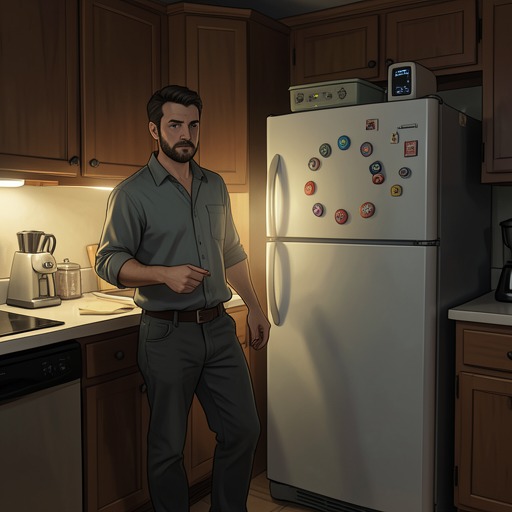
Mike repeatedly approaches the refrigerator intending to open it, only to find his hands moving the magnets instead. He watches words form and dissolve, and recognizes the activity as a peculiar kind of writing. Its resemblance to composition is sharpened by the trance into which he feels himself slipping: the letters seem to offer a text, but he cannot tell whether he is making it or receiving it.
Mike’s account of creative work gives this uncertainty a psychological vocabulary. He describes the intuitive part of the mind as unlocking, rising above ordinary thought, and sending images and messages; at other times, it breaks free unexpectedly and produces associations that have no rational connection. In that account, the muses are like ghosts that arrive uninvited. The refrigerator’s activity therefore occupies two explanations at once: it resembles the writer’s own half-conscious process, yet the house’s haunting makes it possible that the apparent writing comes from elsewhere.
That ambiguity becomes explicit when Mike tests the letters rather than merely watching them. He forms the word “stirred,” surrounds it with fruit and vegetable magnets, then replaces it with “haunted.” The enclosing circle matters to him: he calls the haunting “in the circle,” while the faint chime of Bunter’s bell seems to agree. The messages thus emerge through an arrangement Mike can manipulate, but their setting and accompanying sign make the exercise feel less like ordinary wordplay than a response from Sara Laughs.
An instruction without a key
After a telephone call leaves Mike uncertain about what has happened, he discovers a small arrangement of letters within the magnet circle: “d” and “go.” A steak knife in his pocket and an aerosol can he has been carrying return him to the practical business of the kitchen, but the letters interrupt that ordinary sequence. He wonders whether he put them there while absorbed in the zone, or whether an invisible presence did so.
He reads the arrangement as “Go down 19n,” then considers a different possibility: the message may direct him to a crossword clue at 19 Down. This interpretation links the refrigerator’s compressed lettering to the puzzle books in the house, but it does not solve the mystery. The crossword he is currently working on supplies no apparent connection, and the possible 19 Down answers in that book offer nothing useful. Even the object that should make the message legible—the crossword—multiplies possible meanings instead.
The episode makes interpretation itself part of the haunting. Mike can recognize a direction, a puzzle reference, or an accidental product of his own trance, but he cannot yet identify which reading is correct or what the instruction concerns. Unlike a complete note, the refrigerator message offers only fragments; its missing context obliges him to search beyond the letters without guaranteeing that he will find an answer.
Carla Dean and the competing presence
A later message makes the refrigerator’s agency harder to dismiss. As Mike fills a glass of water in the kitchen, the magnets begin sliding. He turns in time to see nine plastic letters drawn from different directions into a circle, spelling “CARLADEAN.” The event is accompanied by a sudden, powerful rush of air-like force and a sharp fall in temperature: Mike spills water, feels buffeted, sees his breath in the cold kitchen, and feels the sweat on his body turn icy.
The name does not remain in place. The letters burst outward, with the fruit and vegetable magnets flying from the refrigerator and scattering across the kitchen. Mike senses a fury in the dispersal, while another presence seems to give way with the rueful whisper “Oh Mike. Oh Mike.” He recognizes the voice from the Memo-Scriber tape as Jo’s. The sequence therefore contains two opposed actions: one presence brings the name together so Mike can read it; another violently scatters the letters before the message can settle.
Mike does not initially know who Carla Dean is, and the text leaves that identification unresolved in the moment. He considers whether she might be connected to Bill Dean as his mother or grandmother, while distinguishing her from Bill’s wife, Yvette. The message supplies a name, not an explanation. Its force is consequently both revelatory and incomplete: it establishes that the letters carry information, while opening a further question about the person named and the history the message points toward.
Jo’s message and the house’s occupants
After collecting the scattered magnets and returning them to the refrigerator, Mike understands the name as something Jo wanted him to know. He also understands that the force that disrupted the message did not want him to read it. The revelation is not simply that the refrigerator can produce words; it is that communication within the house is contested, with a guiding presence and an obstructing one acting on the same set of letters.
The sequence confirms Jo’s presence in the house, but does not make her the only voice there. Mike also concludes that the boy who weeps at night is present. That recognition broadens the messages from a peculiar link between husband and wife into evidence of multiple unseen occupants, whose identities, purposes, and relation to one another remain uncertain.
The refrigerator’s changing words give the haunting a form that is at once intimate and difficult to control. The letters can be rearranged in the manner of a writer searching for a phrase, yet they also move without Mike’s touch, announce a name, and are scattered by an opposing force. The progression from “haunted,” through the obscure instruction, to “CARLADEAN” moves from naming the condition of the house to delivering a specific clue. Jo’s attempt to make that clue readable, and another presence’s attempt to destroy it, make the refrigerator a small stage on which the larger struggle over what Mike is allowed to know becomes visible.