Tidwell's Meadow
Bag of BonesTidwell's Meadow is the lakeside tract where Sara Tidwell and the Red-Tops established a small community around the turn of the twentieth century. First called Day's Hill, the place became both a home and a working base for the musicians, and later a landscape through which the narrator encounters the persistence of their history: their cabins are gone, yet the meadow remains linked to their music, their persecution, and the uncanny nearness of the past.
Setting and Settlement
From the lane, the meadow opens toward the cup of Dark Score Lake and the White Mountains. The narrator pauses there to watch the water shift between gray and blue as the view changes, an ordinary landscape made mysterious by its association with Manderley and by the history it seems to hold. The meadow is not simply a scenic overlook; it is the site where the Red-Tops’ former community can be imagined as present beneath the visible landscape.
At the turn of the century, more than forty Black people settled in the area. Most were related, and many belonged to a musical group that had first been called The Red-Top Boys and later Sara Tidwell and the Red-Tops. The musicians bought the meadow and a substantial stretch of lakeside land from Douglas Day. Sonny Tidwell, who negotiated the purchase and played chickenscratch guitar, said the family had saved the money over ten years. The purchase made the land a collective home as well as a place from which the group could travel to perform.
The expected shanty settlement never appeared. Instead, neat white cabins stood around a larger building that may have served as a meeting place, rehearsal space, or performance hall. Their orderly arrangement contradicts the hostile expectations voiced by local opponents before the settlement. The buildings were evidence of a community putting down roots, not the disorder that the protestors had anticipated.
Music and Local Reception
Sara and the Red-Tops performed around western Maine for more than a year, perhaps closer to two, appearing in towns including Farmington, Skowhegan, Bridgton, Gates Falls, Castle Rock, Morton, and Fryeburg. Old show posters still surfaced at barn bazaars and junk shops, a small material trace of a band that had once been popular on the regional circuit. The group’s membership could change from performance to performance, and sometimes included a Red-Top Girl; the name and lineup were not fixed even as the band became a favorite with audiences.
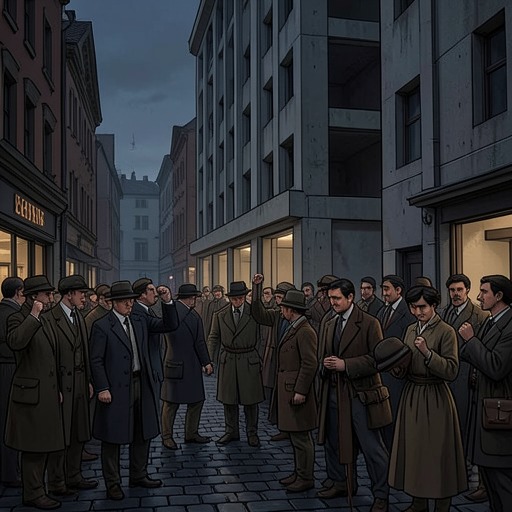
The community’s arrival had provoked an uproar, including a meeting to protest the settlement of Black newcomers. Local acceptance remained qualified. The town’s practical approval rested on the community’s conformity to expectations: residents said the newcomers paid their bills, kept to themselves, and did not accept charity. That last phrase functions as a measure of respectability, but also exposes its limits. The neighbors could tolerate the settlement so long as the newcomers remained self-sufficient and socially separate; their presence was accepted without erasing the racial hostility that had greeted them.
At some point Sara Tidwell became known as Sara Laughs. The account gives no precise date or explanation for the change, leaving it as a transformation embedded in the community’s history rather than a fully documented event. The name nonetheless became inseparable from the meadow’s later identity and from the music that outlasted the settlement.
Departure and Destruction
By the late summer of 1901, after playing at one or two county fairs, the Tidwell family left the area. The account says only that TR-90 must not have been what they wanted; it does not assign a single cause for the departure. The cabins remained behind and provided summer-rental income to the Day family, giving the meadow a new use after the musicians had moved on.
The settlement’s departure was not the end of the family’s presence in the region. Later evidence places Son Tidwell and his close relatives at the meadow after other members of the community had left for safer or friendlier locations. According to Royce Merrill’s account recorded in Jo’s notes, harassment began around Labor Day and grew steadily more threatening. Son did not want to leave until he learned what had happened to his sister and nephew. This later history recasts the meadow: the place once remembered as a successful settlement became the setting of a campaign of intimidation and a family’s unresolved search for what had happened to its own.
In 1933, summer fires burned the cabins, charring the east and north sides of the lake. The physical remains of the settlement thus disappeared, and with them the most visible evidence of the community’s time there. The contrast between the cabins’ former neatness and their destruction makes the meadow’s history especially vulnerable to omission: buildings can vanish, while town histories can leave the more troubling parts of a community’s past unrecorded.
Memory and Narrative Significance
The meadow returns in the narrator’s walks as a threshold between the visible present and an imagined, almost perceptible past. Near dusk, he watches the light fade and hears thunder over New Hampshire; the surrounding trees and bushes seem to take on faces and arms. Against that unsettled perception, he recalls that he and Kyra had visited a version of the Fryeburg Fair in 1900 and imagines the Red-Tops nearly present in their cabins, with guitars, voices, lanterns, and the smells of food. The scene makes time feel as thin as the boundary between ordinary forms and the ghosts he associates with the place.
The vision remains uncertain rather than becoming a confirmed appearance. A sound in the underbrush briefly makes the narrator expect Sara in Mattie’s clothes, but he finds no one and attributes the noise to Chuck the Woodchuck. Even so, the possibility of Sara’s arrival has already altered his experience of the meadow: dusk, mist, remembered music, and the threatened shape of a figure overlap without resolving into a single explanation. He turns back toward home, while the meadow continues to hold the emotional force of the history he has been recalling.
During the July storm, the meadow becomes a break in the wooded route along Lane Forty-two. Lightning and fire appear in the trees, and as the narrator’s car reaches the open ground the hail gives way to torrential rain. The exposure makes the clearing a practical hazard in the storm, but its place in the route also brings the meadow’s familiar landscape into the immediate danger of the present. Across these scenes, it functions both as a real location and as a point where histories and moments seem to touch.
The meadow’s central significance lies in the contrast between disappearance and survival. The settlement’s cabins burned, and the history of harassment was absent from the town histories the narrator consults, even as Jo’s notes preserve an account of it. Sara and the Red-Tops’ music, by contrast, survives in remembered songs and the narrator’s sense of their imagined presence. He leaves the meadow singing one of Sara’s songs: the buildings are gone, but the sound continues, giving the place a history that cannot be reduced to the empty ground left behind.