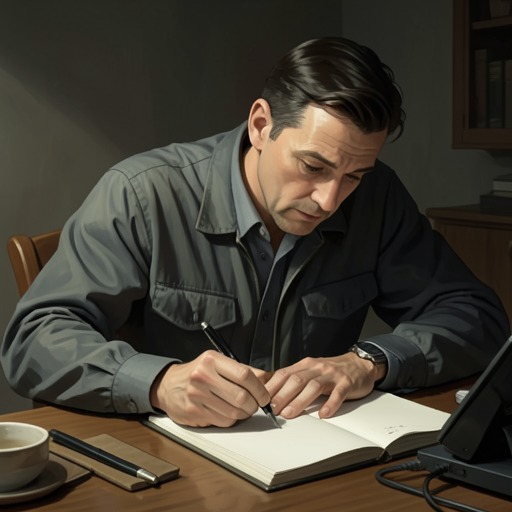
Writer’s block
Bag of BonesWriter’s block is the prolonged, grief-linked inability to write that overturns Michael Noonan’s working life after Johanna’s death. The novel presents it not as a lack of ideas but as a disabling conflict between the wish to write and a body and mind that refuse the attempt: even a blank word-processing screen can bring panic, while in Michael’s dreams the blockage becomes literal immobility before an apparently necessary shelter.
Background and onset
Michael had never experienced writer’s block during the ten years of his marriage, nor immediately after Johanna died. The condition had already taken hold before he recognized that anything was wrong. Because he associated writer’s block with a certain kind of literary intellectual, he did not initially recognize the experience as something that could happen to him.
His writing career had nearly coincided with his marriage. He completed the first draft of his first novel, Being Two, shortly after he and Johanna became engaged; he finished All the Way from the Top about a month after she was declared dead. That novel, about a psychotic killer drawn to high places, appeared in fall 1995. The near overlap between the beginning of his career and his marriage gives the later inability to write an intimate context: the loss of Johanna and the collapse of Michael’s creative work occupy adjoining parts of his life.
For years, his publishing routine had concealed a reserve of completed work. Beginning with Being Two in 1984, he published a book each year, but in four of those years he wrote two books, publishing one and storing the other. He thought of this practice as saving up manuscripts, not as preparation for a future crisis. By February 1995, however, at least two promising ideas had failed to develop, and the manuscripts in his reserve could not resolve the problem he now recognized.
The hidden crisis
The evidence of Michael’s distress first appears in what he does not tell other people. His publisher, editor Debra Weinstock, and agent Harold Oblowski do not know that he is unable to write. Nor does Frank Arlen, Johanna’s brother, whom Michael phones every few weeks. Frank had offered to be a brother to him, but Michael does not accept that offer as a direct appeal for help. When asked whether he is working on a book, he says that he is and that it is going well, concealing how completely the work has stalled.
The gap between that reassuring account and his private experience is severe. When Michael tries to write even two paragraphs, he describes being overwhelmed by a rush of physical and mental distress: his heartbeat accelerates, breathing becomes difficult, and he feels trapped. His inability is therefore not simply a failure to produce publishable work. The act of beginning is itself a source of acute fear, and his repeated insistence that he does not call for help extends the blockage into his relationships.
A professional deadline exposes the practical consequences. Michael usually delivered a manuscript to Harold by January; by mid-February 1995, the agent calls to ask whether everything is all right, because the publisher would need to accelerate production to bring out that year’s book in time for the Christmas season. Michael does not disclose the truth. Instead, he says that he has just finished a new manuscript and promises to send it by Federal Express. The false reassurance protects him from Harold’s anticipated response, but it also leaves his agent acting on a fiction while the crisis continues.
Attempts and bodily consequences
Michael continues to fill his days with other activities, but none restores his ability to write. When he does try to force a sentence, the effort can end in vomiting and leave him unable to approach his desk. After crawling away from the computer, he can eventually look back at its screen but cannot go near it; later, he turns it off with his eyes closed. The computer becomes a concrete boundary between ordinary activity and the work he can no longer face.
The experience recurs rather than resolving through a single failed attempt. Michael says that sometimes he tries to write and locks up every time. The apparent possibility of a fresh sentence does not become a first step forward: trying to produce one is enough to trigger a physical collapse. This repeated pattern makes the blockage more than a temporary shortage of material. It takes control of the conditions under which he can work, shaping his behavior around avoidance of the desk and screen.
The New Year’s attempt
On New Year’s Day 1998, Michael wakes with the sudden conviction that something has changed and that he can write again. He goes to his study, opens Word Six, and sees the program’s pen-and-parchment logo. The hope lasts only until the writing program appears: he becomes unable to breathe normally, pushes away from the desk, and falls when the chair catches on a small rug Johanna had found during the last year of her life. He regains consciousness after the fall, but the attempted return to work has not succeeded.
After a further spell of illness and recovery, Michael sits in the bathroom and decides that, barring a miracle, his writing career is over. He imagines Harold’s distress and Debra’s disbelief, but neither reaction can make writing possible. His question about what to do with the remaining years of his life gives the episode a wider consequence: the loss is no longer only professional. The blockage forces him to consider how to live if writing, the activity that has organized his career, does not return.
The scene’s decisive reversal is between Michael’s calm confidence before opening the program and the immediate crisis brought on by the sight of its blank screen. The computer is still available, and he still wants to write, but access to the tool cannot restore access to the work. The episode ends not with recovery but with a narrowed horizon: he sets aside the question of the rest of his life and tries to get through that day.
Dream image and narrative significance
Michael’s dreams give the blockage a spatial form. In the Sara dreams, he stands between the woods behind him and a house below. Darkness and danger gather in the woods, while the house, however unsettling, appears to be the only shelter. Yet Michael cannot move toward it. He identifies this frozen state as writer’s walk, linking the inability to act in the dream with the inability to proceed in his work.
The nightmare alters the meaning of that image. Michael finally moves toward shelter, but the house proves more dangerous than he expected: a figure resembling his dead wife comes out to attack him. The connection is not presented as a simple explanation of the blockage. Rather, the dream turns its central bind into a contradiction: movement is necessary, yet the anticipated refuge cannot be trusted. The house offers protection in the dream’s first arrangement, then becomes a source of threat when Michael reaches it.
Across these episodes, the blockage is defined by the distance between intention and action. Manuscripts once kept in reserve, a promised deadline, a familiar computer, and a sudden sense of readiness all suggest that writing ought to remain possible; each fails to overcome the paralysis. The dreams recast that paralysis as being trapped between danger and shelter, while the New Year’s episode returns it to the ordinary desk. Writer’s block thus governs both Michael’s working life and the novel’s imagery of stalled movement, without resolving into a straightforward cure.