Alfred Pennyworth
Batman the Dark Knight Returns 10th Anniversary Edition HardcoverAlfred Pennyworth is the devoted attendant and closest domestic ally of Bruce Wayne, a figure whose service binds the retired man to the identity of Batman while also reminding him that the mask has bodily and emotional limits. Across the story, Alfred’s care is practical, skeptical, and deeply personal: he tends to Bruce Wayne’s household and injuries, challenges the wisdom of renewed vigilantism, supports him when danger returns, and ultimately confronts the possibility that loyalty to Batman may mean surviving Bruce Wayne.
Identity and Function
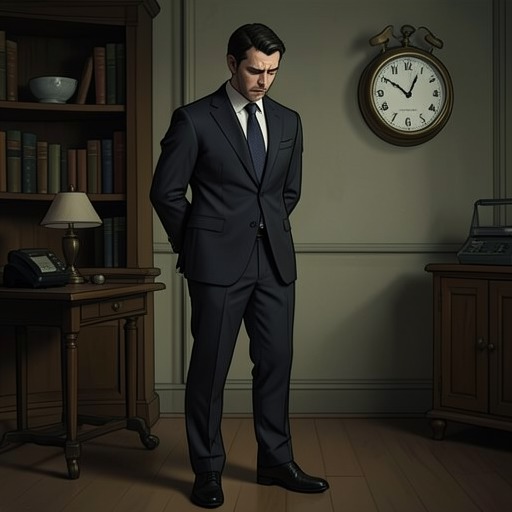
Alfred Pennyworth occupies the threshold between Wayne Manor’s private life and Batman’s public war. He is not merely a servant who maintains equipment and prepares a home; he is the person who sees the exhausted, aging Bruce Wayne behind the symbol. That position gives him a distinctive authority. He can speak to Bruce Wayne with an intimacy unavailable to the police, the media, or the city’s frightened citizens, and his presence keeps the narrative from treating Batman’s return as a purely heroic triumph.
His role is therefore both protective and restraining. Alfred Pennyworth preserves the conditions that make Batman’s work possible, but his concern also registers the danger of allowing an old identity to consume the remainder of Bruce Wayne’s life. The tension is not between loyalty and disloyalty. It is between loyalty to the man and loyalty to the mission that the man refuses to relinquish.
Life Alongside Batman’s Return
When Bruce Wayne resumes activity as Batman after years of retirement, Alfred Pennyworth becomes an immediate witness to the physical severity of that decision. The return is not presented as a painless recovery of youth. Bruce Wayne acts with the accumulated force of an old obsession, while Alfred Pennyworth observes the strain placed on a body no longer able to absorb violence without consequence.
Alfred Pennyworth continues to serve even when his judgment warns him that service may be enabling self-destruction. His support is expressed through the domestic and technical labor surrounding Batman’s operations, but the emotional meaning of that labor is larger: he helps Bruce Wayne cross from private withdrawal back into public danger. The renewed partnership also reveals how much Batman’s apparent independence depends on an older network of care.
As Gotham City’s crisis deepens, Alfred Pennyworth remains connected to the consequences of Bruce Wayne’s choices rather than to their glamour. Batman’s confrontations with the Mutant Leader, the Joker, and the state’s increasingly militarized response all place Alfred Pennyworth in the position of a witness to escalation. He understands that every victory draws Bruce Wayne further from ordinary retirement and closer to a final reckoning.
Loyalty, Warning, and Care
The relationship between Alfred Pennyworth and Bruce Wayne is marked by an unequal but reciprocal form of dependence. Bruce Wayne possesses the will, resources, and physical courage to act as Batman, while Alfred Pennyworth provides continuity, judgment, and care. Their bond is familial in practice even when it is expressed through the language of household service. Alfred Pennyworth’s objections do not weaken the relationship; they demonstrate that his loyalty is not blind obedience.
That resistance gives his character moral weight. He does not celebrate violence simply because Batman is effective, and he does not mistake Batman’s symbolic power for proof that Bruce Wayne is invulnerable. His concern makes visible the costs that Batman’s legend tends to conceal: exhaustion, age, isolation, and the possibility that a mission once undertaken to protect Gotham City can become an end in itself.
Alfred Pennyworth also stands in contrast to the younger people drawn into Batman’s orbit, especially Carrie Kelley / Robin. Carrie Kelley’s emergence shows that Batman can inspire a successor, while Alfred Pennyworth embodies the generation that has carried Bruce Wayne through the earlier stages of his life. Together, the two relationships frame Batman’s return as both a continuation and a transfer: Alfred Pennyworth preserves the past, whereas Carrie Kelley / Robin points toward the future.
The Final Break and Its Meaning
The later crisis makes Alfred Pennyworth’s position increasingly untenable. Bruce Wayne’s preparations and confrontations move beyond the controlled operations of a returning vigilante and toward a broader attempt to reshape Gotham City’s fate. Alfred Pennyworth sees the danger in that transformation, because the more completely Bruce Wayne becomes Batman, the less room remains for the private life that Alfred Pennyworth has protected.
His eventual departure is consequently more than a household change. It is the severing of the last ordinary structure around Bruce Wayne. Alfred Pennyworth’s absence marks the point at which Batman’s mission can no longer be balanced by domestic care, familiar counsel, or the expectation of a safe return to Wayne Manor. The separation carries grief because it is produced not by indifference but by the limits of devotion: Alfred Pennyworth can remain faithful to Bruce Wayne only up to the point where continued participation would mean accepting his destruction.
The ending gives that departure a further consequence. After Bruce Wayne’s apparent death, the survival of his larger project depends on transmission rather than on the continued public presence of Batman. Alfred Pennyworth’s long service has helped preserve Bruce Wayne’s identity, methods, and resources, but the final movement of the story turns those accumulated resources toward successors and concealed continuation. Alfred Pennyworth thus belongs to the world that made Batman possible, even as the ending begins to move beyond the world in which he could remain at Bruce Wayne’s side.
Narrative and Thematic Significance
Alfred Pennyworth functions as the story’s human measure of heroism. Bruce Wayne can turn himself into a symbol, but Alfred Pennyworth keeps returning attention to the aging person who pays for that symbolic existence. Through him, Batman’s return becomes a question of endurance and inheritance rather than a simple restoration of a familiar superhero status.
His character also anchors the story’s treatment of aging. James Gordon and Bruce Wayne represent older men confronting the disappearance of former public roles, while Alfred Pennyworth represents the intimate labor that allows such men to continue. He does not become a replacement Batman or claim the city’s spotlight. His importance lies in maintenance, warning, remembrance, and the final recognition that even the most faithful support cannot make an extreme life harmless.
Alfred Pennyworth’s ending therefore carries the emotional truth of the larger narrative. Batman may survive as an idea, a method, or a movement, but Bruce Wayne’s survival is inseparable from the people who have cared for him and challenged him. Alfred Pennyworth’s loyalty gives the return its foundation; his refusal to remain indefinitely within its consequences gives the return its boundary.