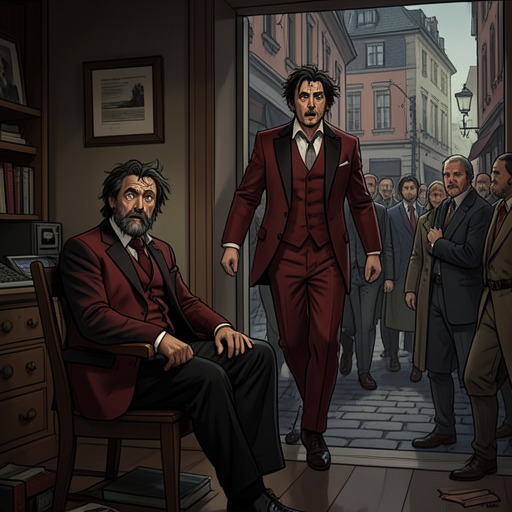
Bartholomew Wolper
Batman the Dark Knight Returns 10th Anniversary Edition HardcoverBartholomew Wolper is a psychiatrist whose role in Gotham City is defined less by physical action than by interpretation. He treats criminality, vigilantism, and public violence as psychological and social phenomena, placing him opposite Bruce Wayne / Batman’s conviction that disorder must be confronted through decisive action. Through Wolper, the story gives institutional form to a recurring question: whether dangerous behavior should be explained as illness and social failure, or answered as a threat requiring force.
Identity and Public Role
Bartholomew Wolper appears as a medical and intellectual authority in a city increasingly anxious about violence. His professional language frames figures such as Harvey Dent / Two-Face and The Joker through diagnosis and treatment rather than through the moral vocabulary of guilt and punishment. That framework gives him a recognizable public function: he does not merely observe Gotham City’s crises, but helps explain them to an audience that wants violence made intelligible.
His position also places him within the city’s wider argument over Batman’s return. Where supporters see Bruce Wayne / Batman as a necessary answer to social decay, Wolper’s perspective treats the masked vigilante as part of the pathology being examined. The contrast is not simply between a doctor and a fighter. It is between two competing methods of restoring order: psychological explanation on one side, and fear, discipline, and direct intervention on the other.
Explanations of Criminality
Wolper’s treatment of Harvey Dent / Two-Face illustrates the limits and attractions of his approach. Harvey Dent / Two-Face has undergone a period understood as reform or recovery, and Wolper’s professional interpretation encourages the belief that the divided criminal identity can be treated and reintegrated. The later relapse exposes how fragile that confidence is. A medical explanation may clarify the conditions surrounding violence, but it cannot guarantee that violence will not return.
The same interpretive tendency becomes more consequential in relation to The Joker. Wolper’s language places emphasis on The Joker’s mental condition and on the social environment that produced or sustained him. This approach risks shifting attention away from the victims of The Joker’s actions and toward the criminal as an object of fascination, diagnosis, or sympathy. The book uses that imbalance to sharpen its criticism of explanations that become morally evasive when confronted with deliberate cruelty.
Conflict with Batman’s Ethics
Wolper’s disagreement with Bruce Wayne / Batman is rooted in fundamentally different ideas of responsibility. Bruce Wayne / Batman acts as though the immediate prevention of harm takes precedence over institutional permission, while Wolper’s approach privileges diagnosis, rehabilitation, and the possibility that violent people are themselves products of damaged conditions. Neither position is presented as a simple technical disagreement: each implies a different theory of what Gotham City owes its citizens and what citizens may do when official systems fail.
The conflict also reflects the book’s treatment of labels. Terms such as criminal, hero, madman, and vigilante do not merely describe behavior; they shape public fear, police response, and expectations of future violence. Wolper participates in that process by supplying a clinical vocabulary, even when his intention is to resist condemnation. His interpretations therefore have a double effect. They challenge the easy moral certainty surrounding criminals, yet they can also minimize the danger recognized by those who have experienced violence directly.
Narrative Function and Consequences
Wolper’s importance lies in the tension between his explanations and the events that follow them. The continuing return of violence undermines any confident assumption that diagnosis alone has solved the problem. Harvey Dent / Two-Face’s relapse demonstrates that a reformed identity can collapse; The Joker’s emergence from catatonia demonstrates that apparent incapacity does not erase the threat associated with him. In both cases, Wolper’s framework is tested by consequences that are more brutal than theory can contain.
His presence also helps the story stage a broader social debate about moral panic and deviance. Media discussion, official reaction, and public anxiety repeatedly assign identities to groups and individuals, amplifying fear and encouraging stronger measures. Wolper represents the voice that resists simple demonization, but the narrative keeps that resistance under pressure by showing how explanations can be received in a city where violence is not abstract. The result is an uneasy portrait of expertise: necessary for understanding, yet vulnerable to becoming detached from responsibility.
Thematic Significance
Bartholomew Wolper embodies the book’s suspicion of institutions that interpret crisis without being able to control its consequences. His psychiatric perspective broadens the question of crime beyond individual wickedness and acknowledges the social conditions surrounding Gotham City’s decay. At the same time, the story refuses to let psychological language settle the issue. Explanation may expose causes, but it does not by itself protect victims, restore public order, or prevent recurrence.
For that reason, Wolper functions as an ideological counterweight to Bruce Wayne / Batman rather than as a conventional antagonist. He gives voice to a humane ambition—the wish to understand violent people instead of reducing them to monsters—while the plot repeatedly asks what happens when humane interpretation is mistaken for effective containment. His character keeps the moral argument open, even as the surrounding violence makes every answer costly.