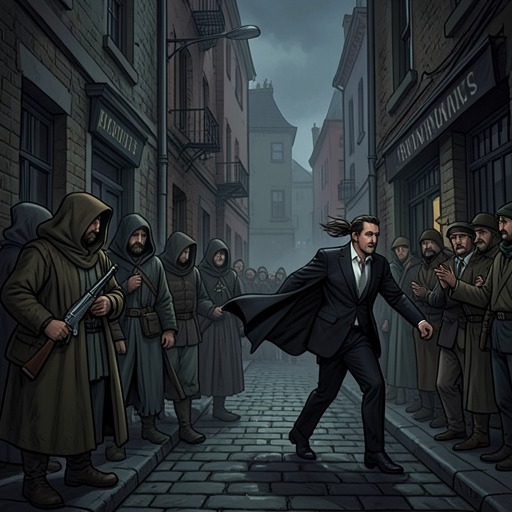
Batman Does Not Kill Principle
Batman the Dark Knight Returns 10th Anniversary Edition HardcoverBatman’s no-killing rule is the defining limit placed on Bruce Wayne’s violence. It separates his campaign against crime from murder, even when Gotham City’s institutions are failing and his opponents repeatedly create situations in which restraint seems dangerous. The rule is therefore not passive mercy: it is the condition under which Bruce Wayne can remain Batman rather than become another armed authority claiming that order justifies any act.
Definition and Ethical Function
The rule governs how Batman responds to violence without denying the reality of force. His methods include intimidation, pursuit, surveillance, physical combat, and the use of specialized equipment, but the boundary remains that he must not deliberately kill. This distinction gives his actions a moral and narrative shape. Criminals may be incapacitated, exposed, or handed over to authorities; they are not to be treated as disposable obstacles.
The principle also preserves a contrast between Batman and the violent powers around him. The Mutant Leader rules through brutality, The Joker turns murder into spectacle, and state or military actors treat overwhelming force as a solution to public crisis. Against each of these models, Batman’s code insists that effectiveness does not erase responsibility. His violence is presented as a constrained response, not as permission to make himself judge, jury, and executioner.
The Rule Under Pressure
When Bruce Wayne returns from retirement, the worsening condition of Gotham City makes the code difficult to sustain in practice. The Mutant Gang Uprising turns public disorder into organized intimidation, while official institutions struggle to contain it. Batman reenters that world by fighting the gang and confronting its leader, but his objective is not simply to destroy an enemy. He seeks to break the gang’s hold and restore a form of order without adopting the gang’s logic of domination.
The confrontation with The Mutant Leader makes the distinction especially severe. Batman is older and physically diminished, and the fight exposes the cost of his refusal to abandon a principled limit. He must survive an opponent whose power depends on unrestrained violence, yet victory cannot be defined as killing the stronger combatant. The rule turns the encounter into an ethical contest as well as a physical one: Batman must defeat brutality without becoming its most efficient practitioner.
The same pressure recurs as Gotham City moves through broader emergencies. Batman’s return occurs amid social decay, institutional fear, and later political and military escalation. In each setting, the possibility of killing would offer a simple final answer, but the code keeps the story focused on what kind of authority Batman represents. He may impose discipline through fear and force, but he cannot claim that the lives of his enemies are his to end.
Enemies, Authority, and Consequences
The Joker is the most direct challenge to Batman’s no-killing rule because his crimes are designed to make restraint appear absurd. His escape and massacre transform their conflict from private antagonism into a public catastrophe. Later, their final confrontation forces Batman to face an enemy whose identity is inseparable from repeated murder and whose continued survival threatens further victims. Batman’s refusal to kill The Joker therefore carries a visible cost: the code does not guarantee safety, redemption, or institutional justice.
Yet the rule also prevents The Joker from controlling the moral terms of the encounter. The Joker wants violence to collapse every distinction between hero and murderer, between punishment and amusement. Batman’s restraint denies him that victory. Even when their conflict becomes terminal in consequence, Batman’s conduct remains framed by the prohibition against killing rather than by the pleasure of revenge.
Batman’s relationship with James Gordon further clarifies the code’s place within public life. James Gordon has served within the Gotham City Police Department and recognizes both Batman’s illegality and his usefulness. Their alliance depends on a distinction between Batman’s extralegal intervention and the killing authority claimed by a state or a criminal gang. Batman can act outside ordinary procedure, but the no-killing rule limits the kind of power he may exercise when he does so.
The code also matters in Batman’s relationship with Carrie Kelley / Robin. Carrie Kelley enters a violent world in which heroic action can easily become imitation of the enemy. Batman’s example teaches her that courage is not measured by the willingness to kill. His influence thus operates through succession as well as combat: the rule is part of what he transmits to the next generation, even when his methods and command structure remain severe.
The Final Test and Apparent Death
The rule reaches its broadest political test during Batman’s conflict with Clark Kent / Superman. Their confrontation is not merely a contest between two powerful individuals; it places Batman’s human, self-imposed limits against the extraordinary power and governmental legitimacy represented by Superman. Batman prepares for the encounter through strategy, armor, and technological means rather than by accepting a direct contest of strength. His aim is to neutralize Superman’s intervention and expose the danger of unchecked power, not to kill him.
This distinction becomes crucial because Batman’s plan depends on making the world believe that he has died. Batman’s staged death allows him to escape the immediate consequences of the confrontation while preserving the public meaning of his defeat. The apparent death is not a rejection of the code but an extreme form of evasion and control: rather than cross the line into killing, Bruce Wayne changes the conditions under which the conflict is understood.
The consequences are double-edged. Batman’s actions help create the possibility of a new underground organization and a continuing struggle for Gotham City, but they also show how closely his methods approach authoritarian command. He organizes people, directs force, and seeks to shape the city’s future, yet the prohibition against killing remains the boundary separating his insurgent order from openly murderous rule.
Meaning and Legacy
Batman’s no-killing rule is less a claim that violence can be made harmless than a discipline imposed upon someone who possesses unusual capacity for violence. It acknowledges that force may be necessary in the world of the story while refusing to let necessity become an unlimited excuse. The rule therefore produces recurring tension between immediate consequences and long-term identity: killing might end a threat faster, but it would transform the person who claims to oppose it.
By the end, the code functions as a form of continuity. Bruce Wayne’s body ages, his public identity changes, and Batman appears to die, but the principle survives as part of the instruction carried into the future. Its importance lies not in making Batman morally pure or politically uncomplicated. It keeps his crusade permanently unfinished, forces him to confront enemies who exploit restraint, and preserves the possibility that power can be exercised without claiming the right to decide who must die.