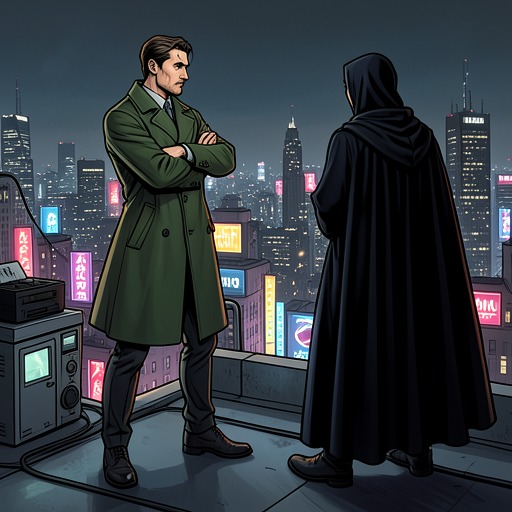
Batman and Green Arrow's relationship
Batman the Dark Knight Returns 10th Anniversary Edition HardcoverThe relationship between Bruce Wayne / Batman and Oliver Queen / Green Arrow is defined less by intimacy than by a durable political and tactical understanding. Both men are aging vigilantes who oppose the concentration of power in official or superhuman hands, yet they express that opposition differently: Bruce Wayne / Batman relies on preparation, technology, and organized action, while Oliver Queen / Green Arrow retains the identity of the outspoken insurgent willing to make his opposition public. Their connection becomes most significant when the struggle over Gotham City expands into a national and international conflict.
Shared History and Political Temperament
Bruce Wayne / Batman and Oliver Queen / Green Arrow belong to an older generation of costumed crime-fighters whose era has largely passed into memory or suppression. Their association therefore carries the weight of a common past, even when the narrative does not dwell on its particulars. Oliver Queen / Green Arrow’s return to the story places that past in active relation to Bruce Wayne / Batman’s own return: both reject the idea that age, retirement, or official disapproval should end their responsibility to oppose injustice.
Their shared outlook is not identical, however. Bruce Wayne / Batman works through secrecy and disciplined planning, turning personal conviction into a network of vehicles, weapons, allies, and contingency plans. Oliver Queen / Green Arrow is more openly confrontational and politically expressive. The contrast gives their alliance its tension: Bruce Wayne / Batman embodies controlled strategic resistance, while Oliver Queen / Green Arrow embodies an older radical conscience that refuses to become respectable merely because the state has declared the vigilante age finished.
The Return of the Older Vigilantes
When Bruce Wayne / Batman resumes operations in Gotham City, the decision is presented as a challenge to a society that has accepted decay, institutional weakness, and the disappearance of its former protector. Oliver Queen / Green Arrow’s presence reinforces the sense that the conflict is also generational. The older heroes are not simply repeating youthful adventures; they are acting from bodies and histories marked by time, while younger authorities and newer political structures treat their continued activity as anachronistic or dangerous.
This shared return also distinguishes Oliver Queen / Green Arrow from the younger allies gathered around Bruce Wayne / Batman. Carrie Kelley / Robin becomes part of an emerging succession, whereas Oliver Queen / Green Arrow represents continuity with the earlier heroic order. His importance lies partly in proving that Bruce Wayne / Batman’s resistance is not an isolated relapse into the past. The return of one veteran can be dismissed as obsession; the reappearance of another makes it look like a suppressed tradition reasserting itself.
Alliance Against Superman’s Authority
The relationship reaches its decisive stage when Bruce Wayne / Batman prepares to confront Clark Kent / Superman. The confrontation is not merely a personal duel. It concerns whether extraordinary power will remain answerable to human judgment, especially after Clark Kent / Superman has become aligned with governmental authority. Bruce Wayne / Batman’s strategy depends on anticipating Clark Kent / Superman’s superior physical capabilities and converting the encounter into a contest in which preparation, armor, technology, and will can offset raw strength.
Oliver Queen / Green Arrow supports this resistance directly. His role is not to duplicate Bruce Wayne / Batman’s methods but to create the opening required for the larger plan. He uses a Kryptonite arrow against Clark Kent / Superman, exploiting the one weapon capable of weakening him. The act is both tactical and symbolic: an aging human archer helps make a superhuman opponent vulnerable, demonstrating that power is not invulnerable when opponents possess knowledge, patience, and the willingness to coordinate.
The alliance therefore operates according to a logic of mutual deterrence. Bruce Wayne / Batman cannot match Clark Kent / Superman physically, and Oliver Queen / Green Arrow cannot defeat him through ordinary force. Together, however, they combine planning with a precisely chosen countermeasure. Their cooperation exposes the security dilemma at the center of the conflict: actions undertaken by Clark Kent / Superman as protection can appear to his opponents as domination, while resistance to him can appear to the state as an escalation requiring further control.
The Cost of Resistance
Oliver Queen / Green Arrow’s support is not consequence-free. His attack contributes to the danger surrounding the confrontation and confirms that the older vigilantes are prepared to place themselves in direct opposition to a vastly more powerful figure. The relationship thus moves beyond nostalgic camaraderie. It becomes a pact of risk in which each man accepts that the defense of human autonomy may require actions that invite retaliation.
Bruce Wayne / Batman’s staged death after the confrontation gives the alliance a further dimension. His apparent death allows his methods and purpose to continue without leaving him exposed to the same form of official containment. Oliver Queen / Green Arrow’s assistance belongs to the final visible phase of Bruce Wayne / Batman’s career, but the meaning of that assistance extends beyond the battle itself: it helps preserve the possibility that resistance can survive even when its most famous figure disappears from public view.
Narrative Significance
The relationship between Bruce Wayne / Batman and Oliver Queen / Green Arrow links the story’s personal mythology to its broader argument about authority, aging, and political resistance. Oliver Queen / Green Arrow is neither a subordinate nor a replacement for Bruce Wayne / Batman. He is a fellow veteran whose distinct methods make the central plan possible and whose presence confirms that the conflict is larger than one man’s private compulsion.
Their partnership also complicates the boundary between lawful defense and private warfare. Both men act outside ordinary institutions, yet their opposition to Clark Kent / Superman is framed as an attempt to prevent unchecked power from becoming the only available form of order. The relationship’s final image is therefore not reconciliation but coordinated dissent: two aging human heroes using the tools and convictions left to them to challenge a system backed by overwhelming force.