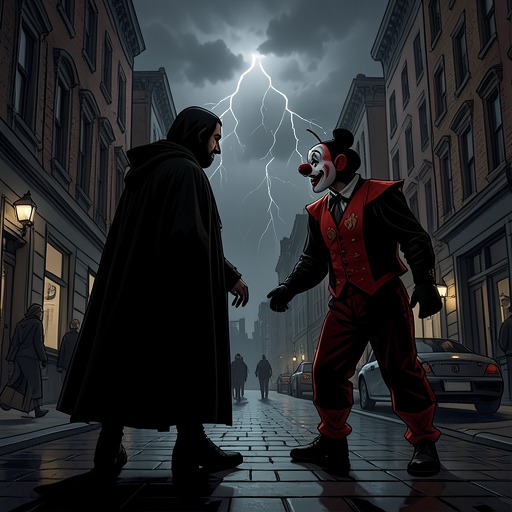
Batman pursues the Joker
Batman the Dark Knight Returns 10th Anniversary Edition HardcoverBatman hunts the Joker as the decisive pursuit that reconnects Bruce Wayne / Batman’s revived crusade with his oldest and most destructive enemy. It begins after the Joker’s long catatonic silence ends and follows the trail of his renewed violence through a Gotham City already destabilized by crime, political fear, and the collapse of confidence in established authority. The hunt is therefore both an investigation into a fugitive criminal and a return to the unresolved moral conflict between Batman and The Joker.
Causes and Background
The pursuit is made possible by Batman’s return from retirement. His reappearance has already demonstrated that Gotham City’s social decay cannot be contained by official language or routine policing, and his actions against the Mutant gang have turned him into a contested public symbol: to some, a criminal; to others, the force willing to confront dangers that institutions cannot master. The Joker’s awakening gives that renewed mission its most intimate target, because his violence represents not merely another outbreak of crime but the return of the enemy most closely tied to Batman’s identity.
The Joker’s previous inactivity has made his reappearance especially destabilizing. His catatonia had allowed Gotham City to treat him as a contained threat, while Batman’s retirement had left their conflict suspended rather than resolved. Once The Joker resumes activity, the old opposition returns in altered circumstances: Batman is older and physically burdened, Gotham City is more openly chaotic, and the authorities are determined to define the crisis through capture and control rather than through the personal history that makes the danger intelligible.
The Course of the Hunt
Batman’s pursuit develops alongside the authorities’ response to The Joker’s renewed presence. The hunt is not presented as a simple transfer of evidence from a crime scene to a courtroom. It unfolds through surveillance, public alarm, institutional pursuit, and Batman’s own willingness to act outside official procedure. His knowledge of The Joker’s patterns allows him to interpret the threat as a continuing campaign, while the police and public must confront the visible consequences after violence has already begun.
The pursuit also crosses the boundary between Batman’s private mission and Gotham City’s collective crisis. The Joker’s return occurs within a city where labels carry political force: Batman is treated as an outlaw even as his interventions produce results, while The Joker’s identity as a mad criminal is used to contain the meaning of his actions. That contrast sharpens the hunt’s central tension. Batman is pursuing a known enemy, but he is also struggling against the institutions and public narratives that repeatedly misunderstand, delay, or absorb the threat.
Batman’s objective is not limited to locating The Joker. He seeks to stop the recurrence of a pattern in which The Joker’s violence exposes Gotham City’s vulnerability and Batman answers with increasingly direct intervention. The pursuit consequently becomes a test of whether Batman can resume his role without being reduced to the same category of public menace as the criminal he opposes. His methods remain private, coercive, and physically dangerous, yet the urgency of the hunt derives from the demonstrated consequences of allowing The Joker freedom to act.
Escalation and Confrontation
As the hunt advances, the distance between pursuer and pursued narrows until the conflict becomes openly personal. The Joker is not merely escaping Batman; he is reentering the theatrical and destructive relationship that has defined both figures. Batman, in turn, is not simply performing police work. His pursuit carries the accumulated force of years of antagonism, the memory of prior crimes, and the conviction that The Joker’s freedom will produce further catastrophe.
This escalation makes the hunt a threshold event in the larger narrative. Earlier confrontations with gangs and public disorder establish Batman’s capacity to act again, but the pursuit of The Joker reveals what that return costs him emotionally and ethically. It draws him toward the final confrontation at the amusement park, where pursuit gives way to direct reckoning. The hunt’s movement is thus from recognition, to tracking, to enclosure, and finally to a confrontation in which neither character can remain only a public label.
Consequences and Significance
The hunt restores the unfinished conflict between Batman and The Joker to the center of Gotham City’s story. It shows that Batman’s return is not a temporary response to the Mutant gang or a symbolic gesture toward a decaying city. The Joker’s reappearance forces Batman to continue, because the old enemy embodies the recurring violence that retirement had failed to erase.
At the same time, the pursuit exposes the unstable boundary between justice and vigilantism. Batman’s private investigation and direct action challenge the legitimacy of official control, while The Joker’s crimes make institutional delay appear dangerously inadequate. The narrative does not reduce the hunt to a clean legal process; instead, it presents a city in which public order is repeatedly recovered through contested acts of force. Batman’s chase therefore prepares the story’s later consequences: it leads to the confrontation that closes one phase of his conflict with The Joker and intensifies the broader question of whether Gotham City can survive through institutions alone or must be reorganized by the people who have learned to act outside them.