Batman’s Final Confrontation with the Joker
Batman the Dark Knight Returns 10th Anniversary Edition HardcoverBatman’s Final Confrontation with the Joker is the culminating clash between Bruce Wayne / Batman and The Joker. After The Joker’s escape and massacre, Batman pursues him to an amusement park, where their conflict becomes both a physical battle and a final contest over the meaning of Batman’s rule against killing. Batman prevails, but The Joker uses Batman’s restraint against him, breaking his own neck to create the appearance that Batman has murdered him. The encounter therefore ends The Joker’s active career while leaving Batman morally, legally, and psychologically entangled in the death.
Causes and Background
The confrontation is prepared by the return of The Joker after a long period of catatonia. Batman’s reappearance in Gotham City revives the identity that The Joker has treated as his defining counterpart, while The Joker’s release restores the threat that Batman had hoped the city could contain without him. Their relationship is not simply that of a criminal and an opponent: each character’s public identity gives force to the other, and The Joker’s renewed violence makes Batman’s retirement impossible to sustain.
The Joker’s escape and massacre turn that latent antagonism into an immediate pursuit. His crimes are directed outward at civilians, but they also function as a summons to Batman. Batman responds outside ordinary police procedure, treating the pursuit as a personal responsibility even as the authorities and the wider public increasingly regard him as a dangerous vigilante. The encounter consequently carries two linked stakes: stopping The Joker’s violence and determining whether Batman can confront his oldest enemy without abandoning the principle that he does not kill.
The Confrontation at the Amusement Park
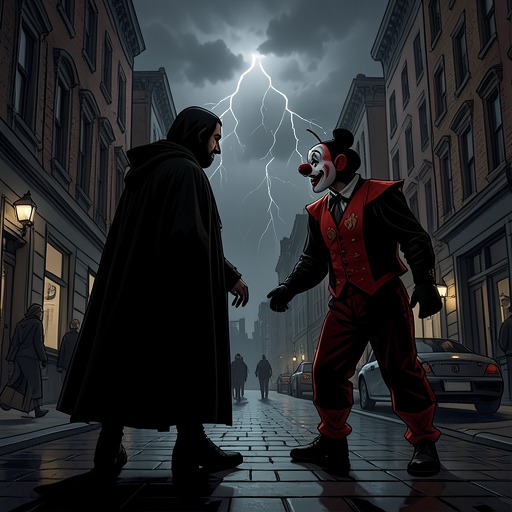
Batman tracks The Joker to an amusement park, a setting that converts spectacle into menace. The location recalls the theatrical logic through which The Joker turns murder into public entertainment, while Batman’s arrival gives the scene the shape of a ritual return. Their combat is direct and sustained rather than an isolated exchange: Batman attacks The Joker, The Joker resists and taunts him, and the fight repeatedly presses Batman toward the boundary between incapacitation and execution.
Batman ultimately gains the physical advantage. The result is not presented as a clean victory, because Batman remains committed to stopping The Joker without deliberately killing him. That restraint becomes the confrontation’s central mechanism. The Joker recognizes that Batman will not finish him by ordinary lethal force and manipulates the consequence of Batman’s attack, twisting his own body until his neck breaks. The Joker’s death is thus caused through an act that Batman initiated but did not intend as murder, creating an ambiguity that the scene refuses to resolve comfortably.
The apparent killing also allows The Joker to claim the final gesture. Batman has defeated him, yet The Joker engineers a death that can be attributed to Batman, preserving the public image of Batman as a killer and forcing Batman to carry the burden of the result. The struggle ends with The Joker dead, but not with the moral victory Batman might have sought: The Joker’s last act is another assault on Batman’s identity and on the distinction between justice and vengeance.
Consequences and Aftermath
The Joker’s death removes the immediate source of the massacre, but it does not restore order. Batman must leave the scene under the shadow of a death that witnesses and authorities can interpret as homicide. The confrontation therefore intensifies the conflict between Batman’s private code and the state’s demand for legal accountability. His refusal to kill survives as an intention and a governing principle, yet the outcome demonstrates how little control that principle gives him over an enemy determined to die on his own terms.
The event also deepens the reciprocal structure of Batman and The Joker’s relationship. The Joker cannot exist in the story merely as an external criminal threat; he is the enemy who understands how Batman’s restraint, reputation, and need for control can be turned against him. Batman, for his part, cannot end The Joker’s violence without confronting the fact that every nonlethal intervention still carries force, risk, and consequence. The final battle makes that paradox physical: Batman wins by overpowering The Joker, but The Joker determines the meaning of the death.
Place in Batman’s Final Arc
The confrontation precedes Batman’s staged death and helps make that later deception necessary. With The Joker dead and the authorities pursuing Batman, Bruce Wayne / Batman has reached the point at which his public identity can no longer continue openly. His apparent death becomes a strategic response to the political and legal consequences of the amusement-park battle rather than a simple retirement. The Joker’s end therefore closes one cycle while pushing Batman toward another form of existence.
The aftermath also belongs to the larger transformation of Gotham City. Batman’s battles have already shown that the city’s institutions cannot easily absorb a retired hero’s return, and the final encounter supplies the most damaging evidence against him: a dead criminal, a public spectacle, and a vigilante whose methods remain outside formal law. Yet the same event confirms Batman’s continuing power to confront threats that conventional authority has failed to contain. His victory is consequently both incriminating and necessary, a contradiction that the narrative carries forward into his disappearance and the secret training of successors.
Narrative Significance
Batman’s Final Confrontation with the Joker completes the pair’s central dramatic opposition without offering reconciliation or moral simplification. The Joker’s death appears to be the endpoint of their struggle, but its circumstances preserve the antagonism in another form: The Joker’s body is gone, while his accusation remains attached to Batman. The scene turns the no-killing rule from a simple ethical boundary into a test of intention, responsibility, and interpretation.
The encounter also rejects a straightforward heroic return. Batman does not defeat The Joker and then resume a stable public role. Instead, the victory produces scandal, danger, and the need for concealment. In that sense, the confrontation is both an ending and a threshold. It ends The Joker’s violence, exposes the cost of Batman’s methods, and leads directly into Batman’s staged death, after which Bruce Wayne / Batman can continue his mission beyond the reach of the institutions that have come to define him as the problem.