Gotham Blackout
Batman the Dark Knight Returns 10th Anniversary Edition HardcoverGotham Blackout is the citywide loss of electrical power that converts Gotham City’s long social decay into a visible crisis of order. Darkness removes the ordinary supports of communication, policing, commerce, and public confidence, allowing violence and political uncertainty to spread at once. Its decisive significance lies in the vacuum it opens: when established systems can no longer guarantee security, competing forms of authority become visible, and Bruce Wayne / Batman’s methods acquire the force of an alternative civic order.
Causes and Background
The blackout occurs within a Gotham City already strained by institutional weakness, criminal violence, and recurring confrontations between official authority and private force. It therefore functions less as an isolated technical mishap than as an accelerant. Earlier conflicts have shown that the city’s stability depends on fragile arrangements: the Gotham City Police Department struggles to contain disorder, while Bruce Wayne / Batman treats the failure of public institutions as a summons to action rather than a reason for retreat.
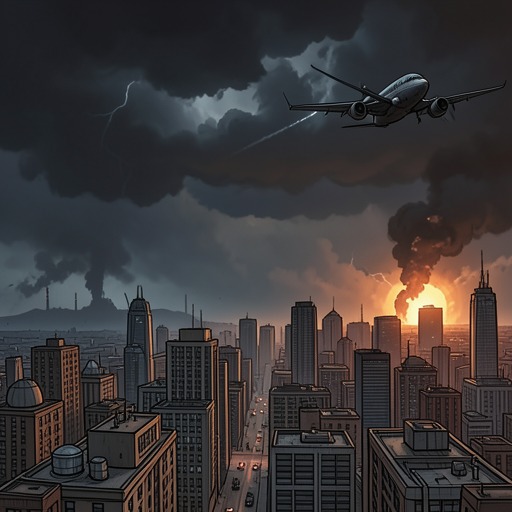
The event also belongs to a wider atmosphere of national and international insecurity. The story places Gotham City’s local emergency beside military escalation and the threat of nuclear catastrophe, making the city’s darkness part of a larger security dilemma. Defensive claims, coercive power, and fear of retaliation repeatedly produce greater insecurity; the blackout gives that logic a domestic and immediate form. A crisis that begins with absent electricity becomes a crisis over who can define danger and who may respond to it.
What Happens
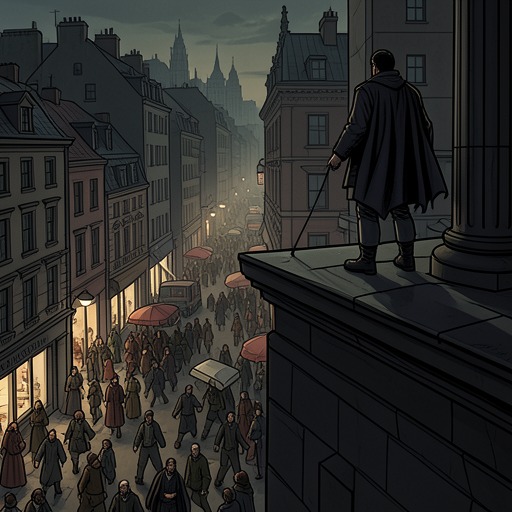
When the power fails, Gotham City loses the visible signs of normal administration. Streets, buildings, and public systems are deprived of the infrastructure that ordinarily coordinates civilian life, and the city becomes vulnerable to rapid disorder. The blackout’s force comes from simultaneity: it affects the population as a whole, so private fear and public breakdown develop together rather than in separate incidents.
The darkness changes the balance between the Gotham City Police Department, criminal groups, ordinary residents, and Bruce Wayne / Batman. Police authority remains formally recognizable, but its practical reach is diminished by the emergency. Criminal and militant groups can exploit confusion, while residents must navigate a city in which the usual guarantees of safety have become uncertain. Against this background, Bruce Wayne / Batman’s knowledge of Gotham City, mobility, preparation, and symbolic authority allow him to act where conventional systems falter.
The blackout is consequently linked to collective mobilization rather than only individual survival. The same emergency that exposes institutional incapacity creates an opening for organized action. Bruce Wayne / Batman’s interventions and the subsequent rise of the Sons of Batman show how quickly a population’s desire for protection can be redirected into a new power structure. The event does not simply leave Gotham City empty of authority; it makes authority available to whoever can organize people, command fear, and present a credible promise of order.
Consequences and Aftermath
The immediate consequence of Gotham Blackout is the suspension of ordinary civic life. Communication and coordination become more difficult, while violence can occur beyond the reliable reach of official supervision. The blackout thus intensifies the city’s existing social divisions: those with organization and force can act collectively, whereas isolated civilians are left exposed to the consequences of institutional failure.
Its deeper consequence is political. The loss of electricity demonstrates how closely modern authority depends on material systems, yet it also reveals that power can be transferred through symbols and personal allegiance when those systems fail. Bruce Wayne / Batman’s authority is not granted by law, election, or ordinary bureaucratic procedure. It is built through action, reputation, and the ability to impose or restore order. During the emergency, that charismatic authority can appear more effective than formal governance, even while remaining legally unaccountable.
The crisis also prepares the transformation of Gotham City after the old order has been weakened. The Sons of Batman emerge as a mobilized force capable of occupying the space left by failing institutions. Their rise carries an unresolved contradiction: the blackout makes collective action necessary, but collective action organized through violence can reproduce the coercive structure it claims to replace. Gotham City’s recovery therefore cannot be understood as a simple return to normality. The emergency changes the terms on which order is imagined and who is permitted to enforce it.
Narrative and Thematic Significance
Gotham Blackout externalizes a central problem of The Dark Knight Returns: whether security can be restored without surrendering legality, accountability, or civilian autonomy. Darkness is both literal condition and political metaphor. It conceals violence, but it also strips away the reassuring appearance of a functioning system, forcing the city’s dependence on fragile institutions into view.
The event further connects private memory to collective crisis. Bruce Wayne / Batman’s return is rooted in old wounds and old symbols, yet the blackout turns his personal decision into a public consequence. His readiness to act is no longer confined to the hidden spaces of the Batcave or to a solitary confrontation; it enters the life of the entire city. The emergency allows a remembered figure to become a present organizing principle.
The blackout also provides a bridge between disaster and regime change. It helps explain why Gotham City can move from institutional paralysis toward competing forms of emergency rule, including the later intervention of the Sons of Batman and the city’s increasingly militarized response. In that sense, Gotham Blackout is a threshold event: it does not by itself settle who will govern, but it makes the question unavoidable. By removing light, infrastructure, and confidence simultaneously, it exposes the political reality beneath Gotham City’s surface—order survives only while someone possesses the means, will, and legitimacy, however contested, to maintain it.