The Joker
Batman the Dark Knight Returns 10th Anniversary Edition HardcoverThe Joker is the central malignant force behind the story's return to violence, even before he physically reappears. His long catatonic silence functions as a suspended threat within Gotham City, a relic of the earlier era that Bruce Wayne / Batman has tried to leave behind. When Batman resumes his work, The Joker awakens into a city already destabilized by social decay, institutional weakness, and public fascination with its old symbols of crime. His escape and massacre turn that dormant history into an immediate crisis, and his final encounter with Batman gives the conflict its most intimate and irreversible form.
Identity and Dormancy
The Joker is presented not simply as another criminal but as the defining counterpart to Bruce Wayne / Batman. His identity has been inactive for years in a catatonic state, leaving him physically present yet narratively suspended. That silence contrasts with the continued memory of his crimes and with Batman's own retirement. Gotham City's apparent calm therefore does not erase The Joker; it holds him in reserve, as though the city's former nightmares have been sedated rather than overcome.
Batman’s Return changes the meaning of that stillness. The reappearance of Batman restores the conditions in which The Joker's identity has always flourished: a city watching for spectacle, authorities attempting to manage public fear, and a masked adversary whose existence gives violence a symbolic shape. The Joker's awakening is consequently linked to the revival of Batman rather than treated as an isolated medical or criminal development. The old antagonism returns because the world that produced it has begun to move again.
Awakening and Escape
The Joker's release from catatonia occurs during the broader resurgence of disorder in Gotham City. Once he is no longer contained by his inert condition, he resumes the role associated with his earlier crimes and becomes a public danger on a massive scale. His escape is not merely a prison failure; it is the removal of the last barrier between a remembered criminal past and the city's vulnerable present.
The resulting massacre gives The Joker's return its defining political consequence. At a moment when television commentary, police action, and public opinion are already struggling to decide whether Batman represents protection or renewed lawlessness, The Joker supplies evidence of violence that cannot be absorbed into a simple debate about vigilantism. He converts fear into spectacle and turns civilian vulnerability into the stage for his reassertion. The attack also places pressure on Batman to respond, because The Joker's violence is both a crime against Gotham City and a direct summons to Batman's history.
Pursuit and the Final Confrontation
Batman pursues The Joker as the crisis develops, and the pursuit is shaped by more than the need to apprehend a fugitive. The Joker is the unresolved enemy most closely attached to Batman's previous life, so finding him means returning to the origin of a conflict that retirement had only interrupted. The chase carries the weight of recurrence: Batman has fought The Joker before, but the return of both figures makes the old struggle newly dangerous because Gotham City is less stable and Batman himself is older.
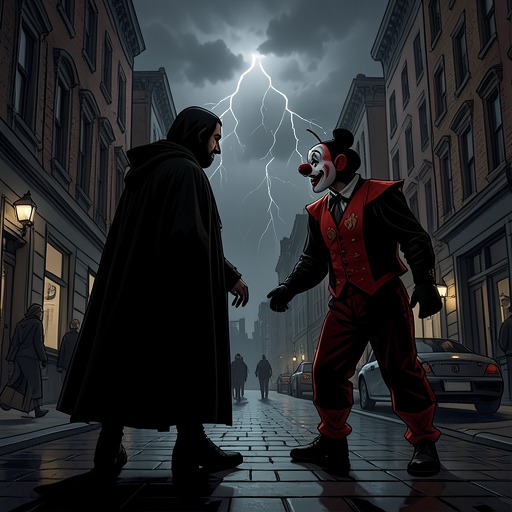
Their final confrontation takes place in the setting of an amusement park, a location that intensifies The Joker's theatrical method. The cheerful public environment becomes inseparable from terror, entertainment from murder, and performance from bodily danger. The Joker's violence seeks to force Batman into a recognizable response, while Batman attempts to end the threat without abandoning the principle that he does not kill. The confrontation therefore becomes an ethical contest as well as a physical one. Every movement carries the question of whether Batman can stop The Joker without becoming defined by the same lethal logic.
The encounter culminates in The Joker's paralysis and death. The Joker deliberately exploits Batman's refusal to kill, and Batman's attempt to prevent further harm leaves The Joker mortally injured rather than simply captured. The result is a final reversal in their relationship: The Joker dies by turning Batman's restraint into the instrument of his own destruction, while Batman is left to bear responsibility for the consequences of the confrontation. The ending closes the immediate threat but does not make the encounter morally clean.
Relationship with Bruce Wayne / Batman
The relationship between The Joker and Bruce Wayne / Batman is built on mutual recognition and destructive dependence. The Joker's identity becomes active again in the same historical movement that brings Batman out of retirement, suggesting that each figure gives the other's role renewed force. Batman's return offers The Joker an audience, an adversary, and a reason to make his violence public; The Joker's return gives Batman a crisis that cannot be treated as ordinary street crime.
Their conflict also differs from Batman's battles with the Mutant Leader or with Clark Kent / Superman. The Mutant Leader represents collective brutality, while Superman represents state power and an opposing conception of order. The Joker is more intimate and more recursive. He attacks the meaning of Batman's mission itself, turning Batman's code, reputation, and past victories into material for provocation. The final encounter is thus not only Batman versus a criminal; it is Batman confronting the enemy who most insistently argues that their identities are bound together through violence.
Change, Ending, and Narrative Significance
The Joker begins as a figure of suspended menace and ends as a figure whose violence has forced the story to acknowledge the cost of the past. His catatonia initially suggests that evil may be dormant, containable, or exhausted. His awakening rejects that comfort. The subsequent escape and massacre demonstrate that repression has not produced resolution, while his confrontation with Batman shows that the return of an old enemy can expose weaknesses in both personal ethics and public institutions.
His death changes the external situation by removing one of Gotham City's most dangerous criminals, but it does not restore innocence or erase the history between the two adversaries. Batman survives the confrontation with his commitment against killing still central, yet the outcome leaves that commitment under severe pressure. The Joker's narrative role is therefore larger than that of a recurring villain. He is the embodied return of unresolved violence, the performer who makes social collapse visible through spectacle, and the shadow that tests whether Batman's renewed mission can remain a form of justice rather than become another expression of vengeance.