The Mutant Leader
Batman the Dark Knight Returns 10th Anniversary Edition HardcoverThe Mutant Leader is the commanding figure of the Mutant gang, the violent force that exploits Gotham City’s breakdown and confronts Bruce Wayne / Batman at the decisive beginning of his return. He represents strength stripped of restraint: a leader whose authority rests on intimidation, collective violence, and the gang’s ability to make the city feel abandoned by ordinary institutions. His conflict with Bruce Wayne / Batman therefore becomes more than a physical contest; it tests whether organized terror or disciplined purpose will define Gotham City’s future.
Identity and Position
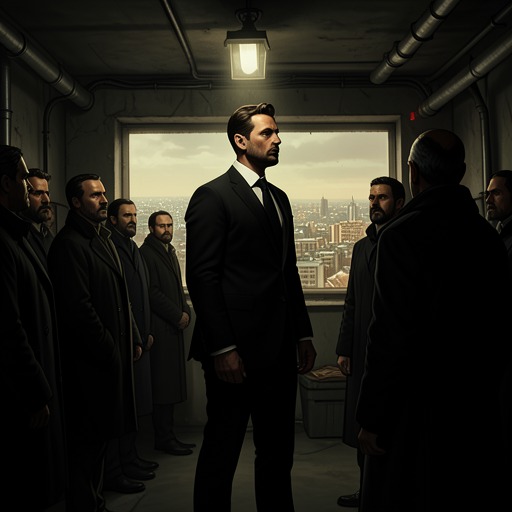
The Mutant Leader is distinguished from the ordinary members of the Mutant gang by his command, his stature, and the force of personality through which the gang operates. The gang is not merely a collection of criminals in the narrative. It is a visible alternative power structure within Gotham City, and its leader gives that structure a single face. Through him, diffuse urban violence becomes directed political pressure: the gang can threaten neighborhoods, challenge the Gotham City Police Department, and make public order appear to belong to whoever can impose it.
His power is primarily charismatic and coercive rather than institutional. He does not inherit legitimacy from law, public office, or a stable civic tradition. Instead, obedience follows from fear of his physical dominance and from the gang’s shared investment in violence. That distinction matters because it places him in direct opposition to Bruce Wayne / Batman, whose authority also exceeds ordinary law but is organized around symbols, preparation, and a stated moral limit. The Mutant Leader commands bodies in the streets; Bruce Wayne / Batman seeks to command the meaning of those streets.
Rise of the Mutant Gang
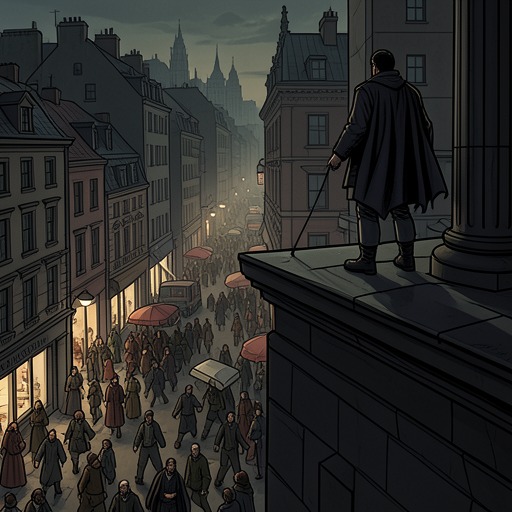
The Mutant Leader emerges from the conditions of Gotham City’s social decay. A city marked by insecurity, institutional weakness, and public anxiety provides the gang with both recruits and opportunities. Its presence converts social disorder into a pattern of territorial power, while the leader’s command gives the disorder a recognizable center. The gang’s rule is thus presented as a crisis of sovereignty: the question is not simply whether criminals are dangerous, but whether the city still possesses an authority capable of opposing them.
The return of Bruce Wayne / Batman interrupts this apparent succession. After years of retirement, Bruce Wayne / Batman re-enters Gotham City as a figure from an earlier order, and the Mutant Leader becomes the clearest obstacle to that re-entry. Their opposition is structured as a generational and ideological contrast. The Mutant Leader embodies an aggressive present in which violence has become ordinary and collective intimidation has replaced civic confidence. Bruce Wayne / Batman embodies an older discipline that has been weakened by age and absence but has not disappeared.
Confrontation with Bruce Wayne / Batman
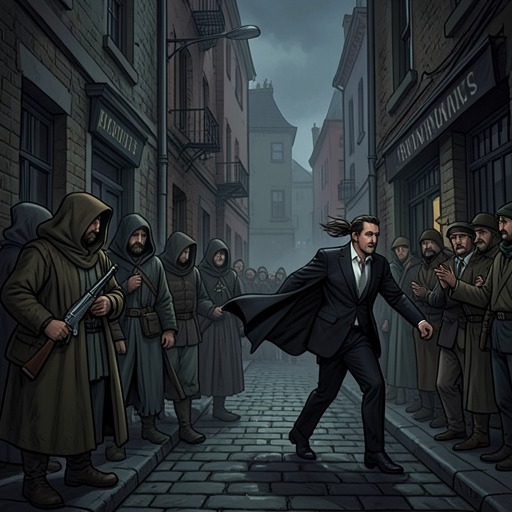
The confrontation between Bruce Wayne / Batman and the Mutant Leader is the central test of Bruce Wayne / Batman’s renewed identity. The encounter exposes the physical costs of returning: Bruce Wayne / Batman is older, his body is no longer an unquestioned instrument, and victory cannot depend on youthful endurance alone. Against the Mutant Leader’s raw strength, Bruce Wayne / Batman must use timing, strategy, and the environment. The contest turns a presumed disadvantage into a different kind of power.
The Mutant Leader’s confidence is built on the assumption that superior force automatically produces victory. Bruce Wayne / Batman challenges that assumption by refusing to meet strength on its most favorable terms. The fight therefore defines both men at once. The Mutant Leader is most dangerous when violence remains a spectacle of dominance; Bruce Wayne / Batman becomes effective when he transforms that spectacle into a problem of control, positioning, and exhaustion. The result is the defeat of the Mutant Leader and the collapse of the image that the Mutant gang cannot be resisted.
That defeat carries a consequence beyond the individual encounter. By overcoming the gang’s commander, Bruce Wayne / Batman demonstrates that the Mutant gang’s authority is not invulnerable. The leader’s body had functioned as the gang’s proof of power; once that proof fails, the gang’s command structure is exposed as dependent on fear and momentum. Bruce Wayne / Batman’s victory consequently becomes a public and symbolic intervention in Gotham City’s struggle for order.
Power, Legitimacy, and Aftermath
The Mutant Leader’s importance continues after his defeat because the forces he represents do not vanish with him. The gang’s organization, its violence, and the city’s vulnerability remain part of the wider crisis. His downfall changes the balance of power, but it does not restore Gotham City automatically. Instead, it creates an opening through which Bruce Wayne / Batman and later collective forces can redirect the energy of the streets.
In this sense, the Mutant Leader is both a character and a political sign. He shows how quickly an abandoned social space can be occupied by a group able to mobilize people, weapons, fear, and a simple image of strength. His rule has the appearance of a regime, but its continuity depends on coercion rather than durable civic consent. The contrast with Bruce Wayne / Batman makes the issue sharper: both operate outside conventional institutional authority, yet one seeks submission through terror while the other turns a personal symbol into a rallying point against collapse.
Narrative Significance
The Mutant Leader functions as the first major threshold opponent in Bruce Wayne / Batman’s renewed campaign. Defeating him proves that the return is not a nostalgic gesture or a temporary reaction to crime. It is an irreversible commitment to action, with consequences for Bruce Wayne / Batman’s body, Gotham City’s politics, and the public meaning of the Batman symbol.
His defeat also establishes the book’s recurring tension between individual force and collective mobilization. The Mutant gang demonstrates that violence can organize a population around fear, while Bruce Wayne / Batman’s response suggests that symbols, discipline, and leadership can mobilize people differently. The Mutant Leader therefore matters not because his personal history is extensively developed, but because his command makes Gotham City’s crisis legible. He is the concentrated expression of a city’s lost order—and the first formidable proof that the returning Bruce Wayne / Batman can challenge whoever has claimed to replace it.