David Sheff
Beautiful Boy: A Father's Journey Through His Son's AddictionDavid Sheff, the father at the center of Beautiful Boy (Darling Boy), is both the memoir’s narrator and a participant in the crisis it records. As Nic Sheff’s addiction repeatedly draws him into fear, searching, and attempted rescue, David comes to see that his consuming attention has not given him control over his son’s life. His decisive change is not a resolution of Nic’s addiction but the beginning of David’s own recovery: learning to care without making vigilance the measure of fatherhood.
Identity and Narrative Perspective
David is a father whose understanding of Nic changes under the pressure of events he cannot reliably predict or prevent. The memoir follows that experience from close range: family scenes and Nic’s returns home sit beside David’s retrospective effort to understand how addiction reorganizes a household. His account does not present him as an impartial observer. The worry, uncertainty, and self-questioning are part of what he is describing, and his interpretations change as he recognizes the limits of what a parent can know while a child is using drugs.
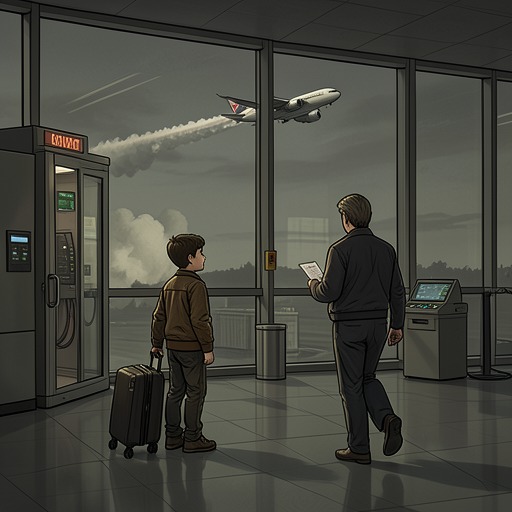
The book’s opening family portrait shows the affection that persists within that uncertainty. On the evening before Nic returns from college for summer vacation, eight-year-old Jasper Sheff and five-year-old Daisy Sheff make welcome-home notes and banners; the children have not seen their older brother in six months. At the airport, Nic arrives carrying an army-green duffel, dressed in a faded red T-shirt, his girlfriend’s cardigan, sagging jeans, and red Converse shoes. The children compete to sit beside him, and he climbs between them in the car, clasps each child’s head in his hands, and kisses their cheeks. David records Nic’s greeting to his siblings and his parents as evidence of a genuine, loving bond, not as proof that the danger has passed.
Fatherhood Under the Pressure of Uncertainty
David’s vigilance takes the form of waiting. When Nic is out late after a recovery meeting, David can list harmless possibilities: people may have gone for coffee, or Nic may be talking to a sponsor. At the same time, an opposing inner certainty tells him that something is terribly wrong. Earlier episodes of Nic ignoring curfew have taught him to associate lateness with catastrophe, so a quiet night becomes an ordeal of imagined outcomes. He remembers listening for a car in the driveway, footsteps on the stairs, or a telephone call that might come either from Nic or from the police.
This is not presented as a single, exceptional night. David describes having waited for years, repeatedly fearing that Nic was dead and then feeling both furious and relieved when an ordinary explanation arrived. That repetition makes his anxiety a condition of family life, not simply a reaction to one crisis. Even when David knows that worry is useless, he cannot prevent it from taking hold. His account conveys the difference between intellectually understanding that fear cannot control events and physically experiencing each silence as a possible emergency.
The family’s homecoming rituals reveal what the fear threatens to displace. Nic’s affection for Jasper and Daisy is real, and David’s attention to their welcome makes clear that the household contains more than the parent-child emergency. Later, when Nic is in recovery again, David and Karen Barbour borrow children’s books about addiction from the library, encourage Jasper and Daisy to talk about their feelings, and meet with their teachers to ask how they are doing. Their teachers say the children seem all right so far. These practical efforts show David beginning to attend to the effects of addiction on the younger children as well as on Nic.
From Rescue to Recognition
David eventually names his own pattern as becoming addicted to his child’s addiction. His preoccupation with Nic, he says, sometimes took precedence over his responsibilities to Karen, Jasper, and Daisy. He had justified that absorption as the necessary response of a parent to a life-or-death struggle, but came to recognize that it had not helped Nic and might have harmed him; its damage to David and the rest of the family, he says, was certain. He does not claim that this insight explains Nic’s illness or releases him from regret. It changes what David understands his responsibility to be.
That change is difficult because it asks him to accept uncertainty rather than answer it with action. When Nic disappears again, David fantasizes about a procedure that could erase the painful attachment, like the one in Eternal sunshine of the spotless mind. The fantasy expresses exhaustion, not indifference: even as he longs to remove Nic from his thoughts, he immediately remains consumed by the question of where his son is. Karen warns that searching may not help if Nic does not want to be found and may leave David disappointed. She eventually allows him to go, while resenting how the repeated crisis has taken him away from the rest of the family. Her response makes the cost of David’s pattern visible within his marriage and household.
David also returns to Al-Anon. At a lunchtime meeting, he shakily begins by saying, “My son is in rehab again,” and a woman gives him a pamphlet called “3 Views of Al-Anon.” Its account of addiction emphasizes that promises may be sincere when made yet still fail, and that denial and exploitation can coexist with love. David’s engagement with this material does not offer a cure for Nic or a guarantee against another relapse. It gives him language for holding compassion together with justice and boundaries, rather than treating love as a reason to accept every promise.
Illness, Attachment, and the Father’s Recovery
David’s own cerebral hemorrhage brings the limits of mental control into brutal physical focus. In the neuro intensive care unit at UCSF Medical Center, he cannot remember his name or the year. He describes the hemorrhage as a kind of brain scraping, yet even this crisis does not dislodge his fear for Nic. The image of wanting to erase his son returns in altered form: David had wished to remove Nic from his mind, but discovers that the bond remains. He understands his children as woven into him more deeply than conscious identity, an attachment that neither fear nor bodily injury can simply switch off.
The later Oakland deception sharpens the conflict between attachment and control. Nic tells David that he had been in Joshua Tree, but David learns that Nic was in Oakland with Z. Nic later acknowledges that David knows the truth and says he had lied because he did not want to worry his father or feel pressured to visit while in the Bay Area; he also says he and Z. left after the man they encountered turned out to be dangerous. David’s discovery does not settle the uncertainty surrounding Nic’s safety. Instead, it renews the familiar strain between wanting the truth and recognizing how little reassurance a new explanation can provide.
David’s change becomes concrete in a small decision involving his phone. While watching Jasper play lacrosse, he keeps his cell phone switched off, something that had once been unthinkable. He understands the phone as a connection to Nic that made every ring a shock, offering either reassurance or confirmation of disaster and feeding his obsession. Therapy is the deeper part of his work, but turning off the phone is a practical boundary: for that interval, David is present at Jasper’s game rather than waiting for Nic’s next call. The action does not mean that he has stopped loving or worrying about his son. It marks a change in how he tries to live with that love.
Narrative Role and Significance
David’s trajectory gives the memoir a second account of addiction: alongside Nic’s recurring attempts at treatment and relapse is a father’s struggle to recover from the habits his son’s illness has produced in him. David admits that he does not absolve himself, and he continues to wrestle with how much blame or forgiveness to assign Nic. He also acknowledges that Nic can seem loving and charismatic when not using, and distant, self-destructive, and dangerous when he is. Holding those contrasting impressions together prevents David’s testimony from reducing his son to either the beloved child of the homecoming scene or the threat imagined during a night of waiting.
His recognition that parents cannot choose whether their children live or die is devastating because it withdraws the promise that enough vigilance can guarantee safety. It is also, in David’s account, liberating: he chooses life for himself and accepts that Nic must decide how to live his own. That acceptance does not end the family’s uncertainty, and it does not make David’s attachment disappear. It redirects the memoir’s emphasis from rescue as a parental power to recovery as work that David himself must undertake, for his own sake and for the sake of the family still gathered around him.