David Sheff and Vicki’s Divorce and Long-Distance Co-Parenting Arrangement for Nic
Beautiful Boy: A Father's Journey Through His Son's AddictionDavid Sheff and Vicki’s Divorce and Long-Distance Co-Parenting Arrangement for Nic transforms the end of a marriage into a lasting geography of separation. After David and Vicki split, Nic Sheff is raised between two homes; when Vicki moves to Los Angeles, the distance makes their informal shared-care arrangement untenable. A child psychologist’s three-month evaluation establishes a schedule in which Nic spends the school year with David in San Francisco and holidays and summers with Vicki in Southern California. The arrangement keeps both parents in Nic’s life, but its repeated departures make clear that sharing custody is not the same as giving a child one settled home.
Marriage Breakdown and the First Separation
The memoir places the custody conflict against the collapse of David and Vicki’s marriage. Nic’s first three years have seemed to his parents like a tired but blissful half-sleep of new parenthood; that apparent idyll gives way to escalating marital problems. David is ill-equipped to manage the conflict and, while addressing it in couples therapy, announces that the marriage is over. He has fallen in love with a family friend whose son is one of Nic’s playmates. Vicki is caught off guard. David recognizes the decision as part of a pattern of sabotaging relationships, but the stakes have changed: a child is now caught in the consequences.
At home, Nic retreats to the laps of his pandas while his parents argue. The memoir describes the divorce’s collateral damage as widespread and enduring, and says Nic is hit hard. David and Vicki divide not only their china and art but also their young son. At first, joint custody seems self-evidently fair: both parents want Nic with them, and they see no reason to reject the prevailing assumption that a child should continue to be raised by both. Nic acquires two homes. On drop-off days, David hugs him at the white picket gate and watches him march inside his mother’s house.
That informal pattern fails when Vicki moves to Los Angeles and remarries. The parents still both want Nic with them, but five hundred miles now separate them. Their sincere convictions about what is best for their son become entangled with a bitter contest over which parent should have him. They hire divorce lawyers, then turn to the therapist Nic has been seeing since soon after the separation. Rather than pursue a costly custody battle in court, they agree to let her conduct an evaluation and to abide by her decision.
The Evaluation and Custody Decision
The psychologist’s investigation lasts three months and feels to David like an inquisition. She interviews the parents, their friends, and their families; visits their respective homes in San Francisco and Los Angeles; and spends long sessions with Nic in her office, playing checkers, cards, and blocks. Nic calls her his worry doctor. During one session with a dollhouse, he shows her the mother’s room on one side and the father’s room on the other. Asked about the little boy’s room, he says that the boy does not know where he will sleep. The child’s answer gives concrete form to the uncertainty the adults are trying to resolve.
At the decision meeting, the psychologist describes Nic as resourceful, sensitive, expressive, and highly intelligent, while also recognizing that he is suffering from the divorce and uncertainty about his future. She says the plan should minimize stress and preserve consistency as far as possible, while acknowledging there is no ideal choice. Her ruling is that Nic will spend the school year with David in San Francisco, and holidays and summers with Vicki in Southern California.
David experiences the decision as both a win and a loss: he will have Nic for the routines of the school year, but will be without him at Christmas, Thanksgiving, and in summer. David and Vicki sign the written decision in the psychologist’s office. The scratching of the pen on coarse paper becomes the memoir’s image for the irreversible emotional weight of the arrangement: David feels that, in signing, he has given away half of his son’s childhood. The ruling solves the immediate dispute over where Nic will live, but it cannot make the divided schedule feel whole.
Travel, Belonging, and the Cost of Two Homes
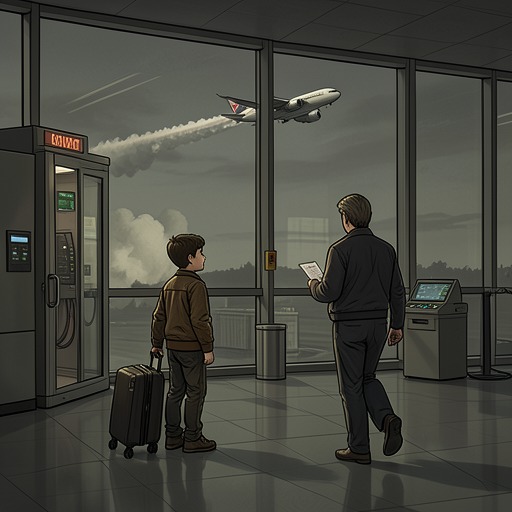
The handoffs make the custody plan a repeated experience rather than a single legal outcome. Before flights to his mother’s home, Nic packs clothes and toys in a Hello Kitty suitcase with a pretend lock and key. On one airport drive, he tells David that he has a pit in his stomach. He wants to see his mother and stepfather, but he does not want to leave. At first, a parent accompanies him on every flight. When Nic is five, he begins travelling alone, graduating from the little suitcase to a canvas backpack containing books and journals, Star Trek Micro Machines, plastic vampire teeth, a Discman and CDs, and a stuffed crab. A flight attendant leads him onto the plane; the family’s word for their jumble of love, missing, and sorrow at each departure is everything. On the flights, Nic can order Coca-Cola, forbidden at home, but that small freedom is overshadowed by his fear that the plane will crash.
David’s account later states its objection to the premise beneath joint custody: that children can do equally well while divided between two homes, each shaped by different parents, stepparents, expectations, discipline, and values. He invokes Emily Dickinson’s description of home as a holy thing, then stresses how difficult it is for a child to experience two primary homes as a single secure base. In this account, home is both a physical place and a psychological cradle associated with safety, stability, and the rules of life. The custody schedule may be the best available arrangement, but its fairness to both parents does not remove the strain imposed on Nic.
The following week, David interviews child psychologist Judith Wallerstein for a magazine article. Wallerstein describes children returning between homes and moving from object to object—table, bed, sofa—to touch each and reassure themselves that familiar things remain. As children grow older, she says, they may feel that both homes are illusory and impermanent. She also identifies a change in the pressures of shared custody over time: long separations from a parent can be painful for young children, while frequent transitions, particularly over long distances, can harm older children. Wallerstein reports that children complained that going back and forth prevented them from enjoying activities with peers; teenagers in particular resented spending summers with parents instead of friends. Her conclusion is that many children cannot easily maintain parallel lives in two homes, and may mistake that difficulty for a personal flaw.
Retrospective Meaning and the Story’s Limits
The custody arrangement continues to shape family life after the psychologist’s ruling. When Nic is in Los Angeles, David and Nic speak regularly by telephone. Nic tells him about movies, ball games, a playground bully, a new friend, and books. Summer is quieter in David’s household, but the arrival of a new baby does not erase the low-grade melancholy of Nic’s absence. When Nic comes north for two weeks, the family packs in surfing, swimming, kayaking, time with friends, and evenings together. They make the most of their limited time, but do not grow used to his being gone.
In the later telling, David resists presenting the family’s history as a sequence whose outcome could have been predicted. He says he avoided foreshadowing because it would falsely suggest that families can anticipate how addiction and its consequences will unfold. He also admits that, looking back, he is aghast at what he did and did not do, and often feels that he failed his son. That self-accusation sits beside, rather than replaces, the account of the parents’ decisions and their limits. The memoir’s treatment of the custody arrangement is thus neither a claim that the schedule alone determined Nic’s later life nor a simple defense of the parents’ intentions: it records an effort to preserve both parental bonds while acknowledging the instability and grief the effort imposed on a child.
The later publication of David’s article about the family’s experience extends this private history into public telling. David discusses the article with Nic and the rest of the family before submitting it to The New York Times Magazine, anxious about exposing them to scrutiny but hoping the story might help others. The response encourages both David and Nic; Nic says that recognition by people at AA meetings affirmed the work he was doing in recovery. David subsequently writes more deeply about the experience, finding the process painful because it makes him relive both the suffering and the moments of hope, love, and miracle. In the memoir’s larger design, the divided childhood is not offered as a neat explanation for what came later. It remains an early, consequential family rupture whose emotional effects are revisited through memory, research, and the difficult act of telling.