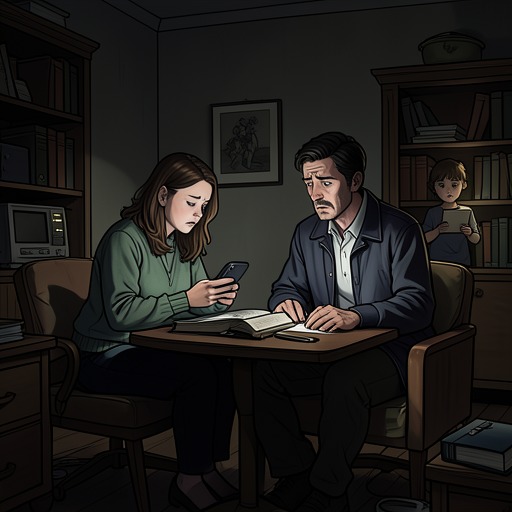
Nic’s Family Discovers Him with Marijuana for the First Time
Beautiful Boy: A Father's Journey Through His Son's AddictionNic’s Family Discovers Him with Marijuana for the First Time is the moment marijuana use becomes visible to Nic’s family, transforming a small discovery into a larger confrontation about secrecy, trust, and parental responsibility. The episode begins with a bag in a backpack, but its consequences extend beyond the immediate punishment: David learns that Nic has concealed other experimentation, and the family must face how little it knew about his behavior.
Discovery and confrontation
In early May, David picks Nic up after school to take him to dinner at Nancy and Don’s. He notices cigarette smoke when Nic gets into the car. Nic initially denies smoking and says he had been around other boys who were smoking, but, when David presses him, he admits to taking a few puffs with a group behind the gymnasium. David lectures him, and Nic promises not to do it again. The exchange offers a first small sign of concealment, but it does not prepare David for what he finds several days later.
The following Friday, Nic is tossing a football with a friend in the garden at Inverness. David is packing an overnight bag for Nic, who is spending the night at the friend’s home, and looks in the backpack for a sweater. Instead, he finds a small bag of marijuana. He calls the boys over while Nic holds the football. David faces them with the marijuana in his outstretched hand and says he needs to talk. The ordinary preparations for a night away have become a confrontation about what Nic has been doing without his parents’ knowledge.
David and Karen Barbour stand together to question the boys, but neither parent has a clear script for the moment. David is shaken not only by the discovery that Nic is smoking marijuana, but by the realization that he had no idea. Asked what happened, the boys say that this is the first time they bought it and that they had tried it one other time. The distinction between a first purchase and prior use makes the disclosure more complicated: the family has uncovered an incident, but not the beginning of Nic’s experimentation.
Discipline, trust, and further disclosure
David’s immediate uncertainty concerns whether to trust Nic. Before the discovery, he had not considered that his son might lie to him; now dishonesty seems as troubling as the marijuana itself. He also contacts the other boys’ parents. One father thanks him and says he is concerned but not surprised, recalling difficulties with older children and acknowledging that the family cannot monitor everything. The mother of the boy who sold the marijuana is angry and denies her son’s involvement, accusing Nic and the other boy of trying to get him in trouble. The adults’ different responses underscore that the incident reaches beyond one household, while leaving the central account disputed among the families.
When David and Nic are alone, Nic is contrite and accepts that David and Karen have decided to ground him. The parents want to take the breach seriously without overreacting. Grounding is meant to make clear that household rules and the relationship have consequences; David also hopes it will limit the time Nic spends with his new group of friends. He knows that he cannot choose Nic’s friends for him, and that forbidding them outright could make them more attractive. He describes another purpose for the punishment as watching Nic more closely, trying to understand what is happening in his life. Discipline thus becomes both a boundary and an attempt to recover parental attention to a son whose activities have become less visible.
The conversation opens onto a second concealed episode. Asked about alcohol, Nic eventually admits that he and Philip got drunk once on a ski trip to Lake Tahoe. While David and Karen were asleep, the boys, bored and looking for cards, found the liquor cabinet and poured small amounts of different drinks into glasses. They drank a mixture that included rum, bourbon, gin, sake, tequila, vermouth, Scotch, and other liquor. Nic says they wanted to know what it was like to get drunk. David recalls that he and Karen heard the boys being sick during the night, but assumed they had the flu; Philip’s mother likewise agreed that an illness was going around. The next day, the boys remained ill during the long drive home through the Sierra.
David is disturbed by both the drinking and the deception, yet he also appreciates that Nic is now telling him about it. Nic says that the experience made him feel sick and that he had not touched alcohol since; he also acknowledges that things are hard without offering the confession as an excuse. His account complicates the parents’ first response to the marijuana: the discovery is not an isolated fact but an opening into behavior they had already misread. At the same time, the conversation supplies no proof that either episode alone explains what follows in Nic’s life.
Wider context and the limits of explanation
The book places this family episode against a public-health landscape in which drug use crosses economic and social boundaries. David later reflects that addiction affects people regardless of income, education, race, geography, or intelligence, and that no single family circumstance accounts for every case. He considers whether divorce, privilege, school, or parenting might explain Nic’s addiction, then recognizes that families with very different circumstances appear in treatment and mutual-help settings. The marijuana discovery therefore remains a concrete early incident, not a settled explanation of Nic’s later illness.
The national context the book supplies is especially focused on methamphetamine, not on this episode of marijuana use. In 2006, a survey of 3,400 drug-enforcement agencies found that 40 percent identified methamphetamine as their most significant drug problem. Treatment admissions for methamphetamine addiction had risen from 28,000 annually in 1993 to about 150,000 in 2005, more than a fivefold increase. David also recounts that a survey of 500 local law-enforcement officials had identified methamphetamine as their leading problem, while federal officials had initially downplayed its results. These figures establish the scale of the later drug crisis described in the book; they do not show that the marijuana found in Nic’s backpack caused his subsequent addiction.
The family’s later efforts to speak openly about addiction sharpen the contrast with the secrecy surrounding this first discovery. David writes that he once kept the problem private partly to protect Nic’s reputation, and that hearing other families’ stories helped him understand the value of breaking that silence. At an Al-Anon meeting, he encounters the principles that relatives did not cause, cannot control, and cannot cure another person’s addiction, even while admitting that he struggles to believe them and continues to blame himself. The earlier scene of the backpack thus gains significance in retrospect: David’s first impulse is to establish consequences and watch more closely, while the later narrative shows him confronting the limits of surveillance, punishment, and parental control.
Consequences and significance
The event’s immediate outcome is grounding and a more candid conversation, not a resolution of the family’s concern. Nic acknowledges prior marijuana experimentation and hidden drinking; David and Karen discover that their assumptions about what they know of their son are unreliable. The later account of Nic’s arrest after failing to appear in court for a marijuana-possession citation shows that marijuana possession also enters his contact with the legal system, though the narrative does not establish that this citation arose from the bag found in Inverness.
The scene matters because it marks a change in what the parents can take for granted. Before it, David believes he trusts Nic without qualification. After it, he must reckon with the possibility that Nic can conceal important facts, while also recognizing that disclosure can restore some connection. The bag is not presented as a complete explanation or as a prophecy with a simple meaning. It is the first family discovery of marijuana, and a sharply bounded instance of the larger uncertainty that will recur: parents can set rules, ask questions, and respond to what is revealed, but they cannot infer an entire future from one moment.