Vicki
Beautiful Boy: A Father's Journey Through His Son's AddictionVicki is Nic Sheff’s mother and David Sheff’s former wife, but the book’s account of her is shaped above all by the work of remaining Nic’s parent through separation, distance, and repeated addiction crises. She and David begin with a shared devotion to their young son; after their marriage ends, they try to make room for both parents in his life. When Nic’s illness repeatedly turns that hope into fear and urgent decisions, Vicki’s role is neither simple rescuer nor detached observer. She continues to reach for him, while she and David learn to share concern even when they disagree about what help should mean.
Marriage, separation, and the custody decision
Vicki and David’s marriage fractures while Nic is still very young. David acknowledges that he responds to their escalating disagreements badly: he falls in love with a family friend and, in couples therapy, announces that the marriage is over. Vicki is caught off guard. The separation is not presented as a quiet administrative change. David describes the divorce as bitter and damaging, with Nic among those most deeply affected; when his parents argue at home, the child takes refuge in the laps of the pandas.
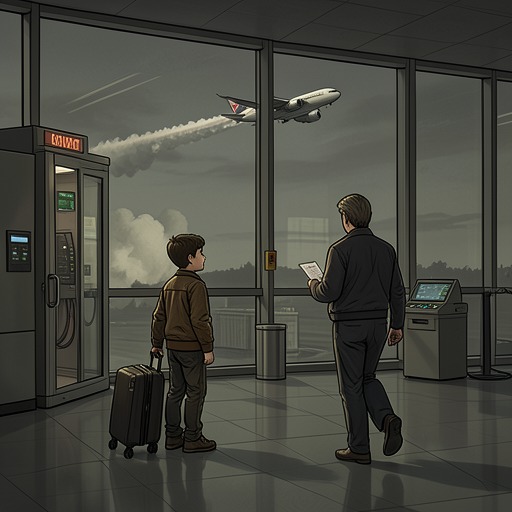
At first, both parents believe joint custody is the best way to preserve Nic’s relationship with them. They divide their belongings and their time with him, and David watches him walk through a white picket gate to his mother’s home after their goodbyes. The arrangement gives Nic two homes, but it also means repeated handoffs: in a Hello Kitty suitcase with a pretend lock and key, he packs toys and clothes for the trip between parents. At the airport, he tells David that he has a pit in his stomach—not because he does not want to see his mother and stepfather, but because he does not want to leave.
The arrangement becomes harder to sustain when Vicki moves to Los Angeles and remarries. Five hundred miles separate the parents, and their informal exchange of custody no longer works. David and Vicki each sincerely believe Nic should live with them, and that conviction becomes entangled with the bitterness of the divorce. They hire lawyers, then agree to let Nic’s therapist assess the situation and abide by her recommendation. The therapist decides that Nic should spend the school year with David in San Francisco and holidays and summers with Vicki in Southern California.
The decision is framed as a plan to reduce stress and make Nic’s life as consistent as possible, not as a clean victory for either parent. David experiences it as both winning and losing: he will have the ordinary school-year days, but not Christmas, Thanksgiving, or summer. The signed document makes the division concrete. Vicki’s portion of Nic’s childhood will include holidays and summers, while the arrangement itself keeps the family’s separation in view. Years later, Nic writes about the cost of living across that distance. His published criticism of long-distance joint custody gives public expression to a childhood marked by missing someone, a consequence that neither parent’s wish to remain close could erase.
Motherhood across two homes
The separation does not diminish Nic’s attachment to Vicki. In David’s household, she is sometimes acutely missed; a telephone call can help, though hearing her voice can also leave Nic sadder. David and Karen encourage him to visit Vicki whenever possible and to call as often as he wants, and try to make room for him to talk about the absence. Vicki remains a central presence in his life even when she is not physically there.
That closeness also sharpens the complications of a blended family. Karen sometimes wishes she were Nic’s real mother, but knows Vicki is the mother he adores and to whom he is devoted. David describes how he sometimes intervenes when Karen corrects Nic, rescuing him and undermining her authority. For Nic, a close bond with a stepmother can carry guilt precisely because it does not replace his relationship with Vicki. The book thus shows the custody arrangement not just as a schedule between two addresses, but as a continuing negotiation over absence, belonging, and the roles of the adults around him.
David’s later reflections on Nic’s addiction return to the divorce and the distance between his parents as possible sources of harm. He lists, among his private regrets, the possibility that Vicki and he should have stayed together or lived in the same city after the divorce. But he also recognizes that no definitive causal answer is available: children from divorced families do not all develop addiction, and many people with addiction come from intact families. The account makes room for the damage Nic experienced without claiming that Vicki’s move or the custody arrangement explains his illness.
A shared response to crisis
As Nic’s addiction deepens, Vicki and David’s relationship changes under pressure. Their post-divorce acrimony is pushed aside by the fear that Nic may be in danger. David describes long telephone conversations in which they share an acute, visceral parental worry that cannot be fully shared by their spouses. Their cooperation does not mean that they always agree. It means the emergency gives them a reason to recognize what unites them: their love for Nic.
That cooperation becomes practical when Nic asks Vicki for help after being thrown out of a house and having no money. In an email, he says he is in trouble and describes himself as physically and mentally unwell. In another message, he tells her he has taken checks from a friend’s mother and may have a warrant out for him. Vicki arranges to help pay the debt. David understands her fear but worries that financial support while Nic is using could postpone the consequences of his actions; he is relieved that she will not give him cash. Their disagreement exposes a recurring problem for both parents: how to respond to immediate danger without making it easier for Nic to continue using.
Vicki also becomes a link between Nic and people who may be able to help. When old family friends from New York City are visiting San Francisco, she arranges for Nic to meet them and pleads with him to go to their hotel. He arrives disheveled and visibly high; a security guard initially keeps him out of the lobby until he calls the friends. In their room, they see how debilitated he is and notice track marks on his arms. They urge him to come to New York City, where he can stay with them and detox. Vicki’s intervention does not resolve the crisis, but it helps make another route to help available.
The danger becomes stark when David receives an early-morning call from Nic’s stepfather. A doctor in Brooklyn reports that Nic is in an emergency room after an overdose, in critical condition and on life support. The circumstances have moved beyond parental disagreement: someone who was with Nic called emergency services after he lost consciousness, and the landlord contacted Vicki because she was on Nic’s lease. The doctor tells David that the emergency response came in time to give Nic a chance to survive. Vicki’s connection to the lease places her within the chain of contact that brings the crisis to his parents.
Disappearance, relapse, and renewed care
After a period when Nic appears to be doing well, his disappearance revives the family’s familiar alarm. David calls Vicki, who reassures him that she saw Nic a day or two earlier and that he seemed fine. At David’s request, she checks his apartment. When she reports back, Nic is gone, his bed has not been slept in, and people who expected to see him have not heard from him. Vicki drives to the Santa Monica police station and files a missing-person report. The reassuring sight of him days earlier does not protect either parent from the possibility that he has relapsed.
When Vicki and David eventually learn that Nic is in San Francisco and high, their relief does not amount to confidence that he is safe. Nic’s friend Randy encourages him to return to Los Angeles and to the program. Vicki and David are relieved when Nic agrees, but remain shell-shocked and unable to assume that everything will be all right. Nic manages to pay for a taxi and a plane ticket. Vicki picks him up at the airport and takes him to his apartment, where his roommate welcomes him. Nic retreats to his room and sleeps; the people around him understand that he must go through detox. The return is a step toward treatment, not proof that the danger has passed.
The book later shows Vicki confronting the effects of another relapse in person. Nic has moved to an apartment in Hollywood, and Vicki drives across town because she wants to know whether he is alive. At the apartment, she knocks repeatedly before the door opens. The place is filthy, with brown water on the floor and trash everywhere. Nic appears gaunt, trembling, and vacant-eyed; his girlfriend is behind him, with bleeding legs, and gives an explanation about a broken light bulb. Nic tells the familiar story that they have gone through the worst and are now getting sober. The scene is familiar to David but new to Vicki. She has to see for herself what Nic’s decline looks like, rather than receive it as distant news.
When Nic later agrees to return to treatment in New Mexico, Vicki acts quickly. Early on Tuesday morning she picks him up at a hospital in the valley and drives him directly to the airport. She persuades a security agent to let her through the checkpoint so she can accompany him to the gate and onto the plane. From the lounge, she calls David to say that Nic has boarded and the plane is backing away from the jetway. The gesture is intimate and practical: she helps him reach the next treatment setting while his condition is still frail and uncertain.
Co-parenting and the unresolved ending
Vicki and David’s cooperation persists beyond individual emergencies, though the history between them remains present. At a later family-therapy weekend, Vicki joins David and Nic at the center. David finds it difficult to meet her eyes, even after years of increased phone contact in which they have consoled one another, debated interventions, and worried about the lack of good insurance. Vicki is working to get Nic back onto her insurance policy. Their renewed closeness has not erased the divorce: they have not spent more than a few minutes in the same room since it, apart from Nic’s high-school graduation. Yet they are again in the same room because Nic’s treatment requires the family to consider what might help and how the current situation compares with earlier stays in rehabilitation.
Vicki’s story is therefore not a progression from separation to reconciliation, or from crisis to guaranteed recovery. She remains Nic’s mother across two homes and many years, and her efforts repeatedly take the form of calls, arrangements, financial decisions, checks on an empty apartment, a drive to an airport, or a trip to a hospital. Those actions show care without making her able to control Nic’s choices. David’s reflections on addiction insist that it is incurable, though it may go into remission and can be managed through difficult work. In that account, Vicki’s endurance is not a cure or a promise of a happy ending. It is the continuing, shared labor of parenting a son whose future remains uncertain.