“I am always missing someone”
Beautiful Boy: A Father's Journey Through His Son's Addiction“I am always missing someone” is the sentence Nic Sheff used to describe the cost of growing up under long-distance joint custody. First published as the culmination of a teenager’s argument about family separation, it acquires a wider force in David Sheff’s account: absence is not only geographical, but also bound up with addiction, fear, and the limits of parental control.
Origin in Nic’s essay
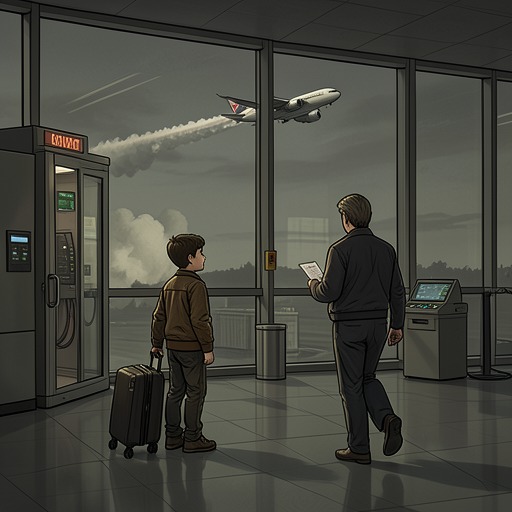
Nic submitted columns to the annual Ernest Hemingway Writing Award for high school journalists and won first place. He then sent a column to Newsweek’s My Turn section; the magazine published it in February 1999. The piece challenged the family’s long-distance joint custody arrangement, arguing that divorced parents with children should remain near them or take responsibility for traveling to see them. Its final sentence, “I am always missing someone,” gives that argument its personal measure. Rather than treating distance as an abstract dispute between adults, the line conveys what the arrangement meant to a child: someone was always elsewhere, and someone was always being missed.
The sentence is brief, but it closes an essay built around a practical question—who should bear the burden of distance—with an emotional consequence that cannot be settled by logistics. Nic’s complaint is not simply that travel is inconvenient. The line makes the persistent absence itself the point, and gives the essay’s public argument the weight of lived family experience.
Absence under the pressure of addiction
As Nic’s addiction deepens, missing him becomes more than a consequence of separate households. During one crisis, the family endures four days of not knowing what has happened to him. In another, after Nic returns home in a drugged and exhausted state, David recognizes that he must find a treatment program immediately, before he loses his son. These episodes shift the phrase’s meaning without erasing its original one: distance remains part of the family’s history, but addiction creates a more frightening uncertainty about Nic’s safety and whereabouts.
That uncertainty does not produce a simple division between responsibility and helplessness. When Nic is hospitalized after an overdose, David reflects that an addicted person may not be responsible for his condition, yet is the only one responsible for it. He also knows he must set limits on what he can accept and do, while remaining prepared to redraw them. The admission joins two truths the sentence holds in tension: a parent can experience a child’s absence as an ongoing wound and still be unable to control the choices that produce it.
Worry that survives bodily crisis
David’s own cerebral hemorrhage gives that tension a startling physical form. In the neuro intensive-care unit, he cannot remember his own name or the year. The experience resembles the brain-scraping he had once imagined as a way to remove thoughts of Nic and the pain of worrying about him; yet even this near-fatal event does not erase that worry. Later, recalling that he could not remember Nic’s telephone number, David recognizes that the hemorrhage did not free him from concern for his son.
His response changes. He no longer wants a lobotomy or a spotless mind, and says he is grateful to have everything, including the worry and pain. The phrase’s emotional logic therefore turns: missing someone remains painful, but the wish to remove the pain would also mean erasing the attachment that makes the person matter. David’s conclusion that he has a son who will never be dead to him makes that attachment explicit, even as he acknowledges that he can love, guide, and try to protect his children without saving them.
Refusal of a closed ending
David had hoped to end his book with Nic’s letter to Jasper, which seemed to offer a neat, happy ending to the family’s story about methamphetamine. Nic’s latest relapse breaks that sense of closure. David recognizes again that addiction is incurable, even when it can go into remission and be managed through difficult work. The family cannot enter a permanent post-addiction phase simply because a hopeful ending once seemed available.
In that context, “I am always missing someone” is not a promise that every separation will be repaired, nor a claim that love can prevent relapse. It begins as Nic’s account of divided family life and comes to echo David’s more difficult understanding: he can remain emotionally present without being able to guarantee Nic’s safety or recovery. The sentence endures because the book refuses to make either absence or love disappear on command.