Karen Barbour
Beautiful Boy: A Father's Journey Through His Son's AddictionKaren Barbour enters the family as an artist and writer whose connection with Nic Sheff develops through sustained, ordinary acts of attention. She becomes David Sheff’s wife and Nic’s stepmother, but the role is never simple: affection grows alongside uncertainty about what she may ask of him, while his addiction later draws the whole household into cycles of worry and vigilance.
Identity and Introduction
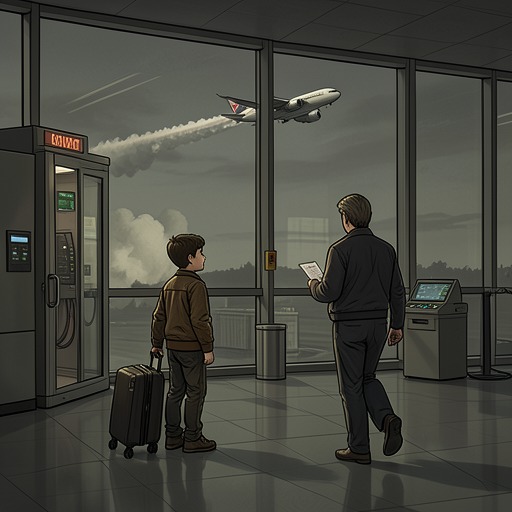
In the summer of 1989, David Sheff meets Karen at a friend’s dinner party. She is visiting her parents in Marin County from Manhattan, where she lives, and tells him she is flying back to New York City the next day. David is due to travel there the following week for an interview. After an awkward pause, a friend passes him a note urging him to get her telephone number; he does, and calls her the next day. Karen’s mother answers despite Karen’s attempt to avoid the call. The scene begins their relationship with a small act of persistence, followed by the practical circumstance that brings them into contact again.
Karen is a painter who also writes and illustrates children’s books. She and David marry in May, beneath roses and bougainvillea on the deck of her parents’ house. Nic, then nine, appears nervous during the wedding. By the next morning, he is relieved that the household still feels familiar. His response establishes an important condition of Karen’s entry into family life: the marriage changes the adults’ relationship, but Nic needs reassurance that it has not displaced his place at home.
Building a Relationship with Nic
Karen and Nic grow closer through creative work and shared interests rather than through a single formal turning point. They make drawings together, taking turns adding to the same picture. Karen takes Nic to museums, where he sits on the gallery floor with a pad and sketches in response to artists including Picasso, Elmer Bischoff, and Sigmar Polke. She teaches him French during car rides, and the two talk about books, classmates, and films. Their connection is marked by repeated collaboration: looking, drawing, discussing, and returning to things they enjoy together.
Their shared humor also gives the relationship its own language. They watch Pollyanna across four evenings before finally finishing it on the fifth, and the movie becomes a source of jokes between them. Nic tries to draw David into a video game, but Karen proves more enthusiastic and skilled, even beating Nic. She enjoys Nic’s music and does not tell him to turn it down, unlike David. These everyday differences matter: Karen’s relationship with Nic is not simply an extension of David’s, but has its own pleasures and habits.
Domestic life also brings friction. Karen works a great deal and resists taking on motherly duties, though she begins driving carpool and tries to involve Nic in household routines. Her attempt to teach him table manners irritates him; she also hires him to remove garden slugs, paying ten cents for each one. The smallness of these incidents underscores the unsettled work of becoming a stepparent: Karen is trying to participate in the ordinary responsibilities of a household, while Nic does not always welcome the authority attached to them.
Stepparenthood and Family Boundaries
Karen acknowledges that the relationship does not come naturally to her. When Nic cries in the car, she is surprised and asks her mother, Nancy, what is wrong; Nancy reminds her that little boys cry. On another occasion, Karen notices Nancy drawing Nic close and rubbing his back while they sit together. Nic is content, and Karen recognizes in the scene a kind of ease with children she had not known she was missing. Her response is not presented as a steady state. She sometimes wishes she were Nic’s mother, while understanding that he already has a mother he adores: Vicki.
The difference between affection and parental authority becomes a continuing tension. Karen carries some responsibility for Nic’s upbringing but does not have the same authority as a parent. David sometimes defends Nic when Karen corrects him, including over table manners, and realizes that his intervention has undercut her. The conflict therefore involves more than Karen and Nic: David’s response affects whether she can occupy a meaningful role in the household. Nic, meanwhile, may feel guilty about being close to someone who is not his mother. The family’s arrangement asks Karen to care while reminding her, repeatedly, that care does not make her the parent.
The book dedicates itself in part to Karen and David’s children, Nic, Jasper Sheff, and Daisy Sheff, placing her within the family the narrative addresses. Later, when Nic is leaving for Los Angeles, he arrives in the midst of a domestic scene with Jasper. He uses an elaborate performance to distract Jasper while David brushes out the younger boy’s hair. The episode presents Nic’s humor and attentiveness to his brother, but also places Karen within a family whose connections are formed in daily routines even as separations and crises approach.
Addiction, Anxiety, and the Family
As Nic’s addiction becomes the focus of family life, Karen is described as one of the people caught in its effects. At a treatment program, a counselor uses a mobile of paper dolls to explain how a family can become organized around an addicted person. Karen and the children are represented at the periphery, tied to Nic’s moods and drug use; David is positioned as an enabler, making excuses, caring for Nic, and trying both to protect the others and to keep the family connected. The image gives visible form to an imbalance in attention: the household’s emotional life becomes increasingly dependent on Nic’s condition.
The counselor explains that relatives may blame themselves, search for drugs, manage where the addicted person goes, or try to solve the problem, while also warning that they cannot control an addict. The account specifically describes how a parent’s attention can be taken over at the expense of a spouse and other children. Karen’s place in the family is therefore affected not only by the stepmother role but by the way addiction reallocates concern and responsibility. The narrative identifies David’s enabling behavior as part of this system, rather than treating Karen’s distress as an isolated reaction.
During a later family-therapy session, Karen and the children initially sit tensely, but become more at ease as they speak about experiences that have not been adequately acknowledged. Nic is safe in rehabilitation at that moment, the therapist notes, but his safety does not make the future certain. Karen explains that after Nic’s thefts, missing belongings can trigger panic that he has entered the house again. The ringing telephone brings a similar fear: she worries that it may announce another crisis, that Nic may be calling while high or unwell, or that he may not call and leave her disappointed. At meals and in the evening, she sometimes lets the answering service take the call rather than face the uncertainty. Jasper notices that she does not answer, and her tension affects him too.
Karen’s trajectory is thus not a simple passage from outsider to unquestioned parent. Her closeness with Nic is real and particular, built through art, language, films, music, and shared humor; so are the limits and stresses of her position. As addiction repeatedly reorganizes family attention, therapy gives Karen and the children room to name the fear that has become part of ordinary life. The account holds both facts together: care can create a durable bond, but it cannot guarantee authority, safety, or control over what Nic does next.