David and Vicki’s post-divorce co-parenting relationship
Beautiful Boy: A Father's Journey Through His Son's AddictionDavid and Vicki’s post-divorce co-parenting relationship takes shape under the pressure of Nic Sheff’s addiction. For years, they live apart, but Nic’s crises repeatedly draw them into decisions neither can resolve alone. Their cooperation is neither a return to marriage nor a simple reconciliation: it is the difficult work of supporting their son, facing the effects of his addiction on the family, and acknowledging the history between them while trying to respond to what is happening now.
Distance and a difficult reunion
David and Vicki have been divorced for twenty years when they meet again at Nic’s treatment center. In the years since the divorce, their contact has gradually become closer. They speak by phone, console and support one another, discuss possible interventions, and worry about how to secure adequate insurance for Nic. Vicki is working to get him back onto her policy. Yet practical cooperation has not erased their distance: before this visit, they have not spent more than a few minutes together in the same room since the divorce.
Their last substantial earlier encounter had been Nic’s high school graduation. Vicki and David sat beside one another, with Jasper Sheff on David’s other side. Afterward, Jasper quietly remarked that Vicki seemed nice. The memory holds the awkwardness of a family still learning how to inhabit its divided shape. The treatment-center meeting brings that history into the present. David feels guilty when he looks at Vicki, recalling that he was twenty-two when they met and that some things cannot be reversed. The previous week would have been their wedding anniversary, another reminder that the past remains present even as their immediate concern is their son.
Crisis makes cooperation necessary
Their renewed communication is driven by Nic’s dangerous instability, not by confidence that they can control his choices. When he calls again while high and asks for money, David and Vicki agonize over what to do. David thinks about an intervention but doubts that it can help after everything they have already tried. Vicki answers the immediate dilemma with a brief insistence: “We have to try.” The sentence expresses a shared obligation, but not certainty about the outcome.
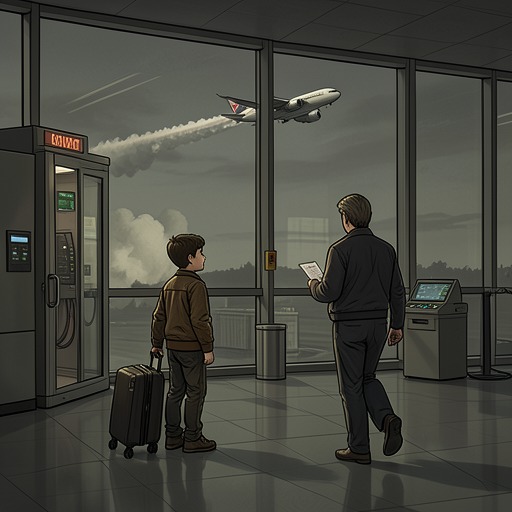
That same combination of urgency and uncertainty shapes their actions when Nic agrees to seek treatment. After a call in which he says he will do whatever it takes, Vicki collects him from a hospital in the valley and drives him to the airport. She persuades a security agent to let her through the checkpoint so she can accompany him to the gate. From the lounge, she calls David to tell him Nic has boarded and the plane is backing away from the jetway. David imagines Vicki watching the aircraft and Nic aboard it, frail and ill. His response, “Everything,” meets Nic’s willingness to accept treatment with the depth of a father’s love, while the scene also shows how Vicki’s practical care carries the decision into action.
A family system, not a private problem
Family therapy gives David and Vicki a setting in which the consequences of Nic’s addiction can be discussed with Jasper and Daisy Sheff. At an earlier program, a counselor uses a mobile of paper figures to describe the family’s roles: Nic hangs at the center, the children and Karen Barbour are placed on the periphery, and David is suspended precariously between them. David recognizes himself as an enabler, trying to protect Karen and the children while also keeping them connected to Nic. The image clarifies that his efforts to care for each person can also keep the family organized around Nic’s moods and drug use.
The counselor warns that an addicted person can take over a family’s attention, leaving other relationships and ordinary sources of joy diminished. David’s account of that pattern makes the parents’ cooperation more complicated than simply coordinating treatment. They are also trying to recognize how fear and caretaking have shaped the household, and how the children have been affected. At a later family-therapy session, Jasper and Daisy first sit hunched on a leather couch, nearly hidden in their sweatshirts. As the family begins to speak about experiences that had not been adequately acknowledged, they sit taller. Their changing posture marks a small but meaningful shift: the adults are making room for the children’s experience rather than treating Nic’s safety as the only subject that matters.
The children’s anxiety is concrete and recurrent. Karen explains that after Nic’s thefts, a missing object can make her panic that he has entered the house again. The ringing phone provokes another alarm: she fears a new crisis, wonders whether Nic will be sane or high, and can also dread that the call will not be from him. Sometimes she lets the phone ring until the answering service picks up, including during meals or quiet evenings. Jasper notices and asks why she does not answer; he too feels the tension. David and Vicki’s shared responsibility therefore extends beyond arranging treatment. The family has to face how the uncertainty surrounding Nic has entered the home and affected its other members.
Resentment, grief, and a shared purpose
The treatment weekend also brings the parents’ earlier injuries into view. In a group exercise, Vicki describes anger toward David as a backpack full of bricks and says, “It’s such a relief not to be carrying them around anymore.” David later suggests that a few bricks may remain; Vicki acknowledges that they might. Their exchange does not resolve the old conflict, but it makes room for its continuing presence without allowing it to displace the immediate work of caring for Nic.
In another exercise, the family makes images and discusses what they have drawn. Vicki’s red mark is a balloon she wants to hold on to as an escape from a black storm; Nic notices that she is there. David sees Nic with both parents and feels sorrow for what each of them has endured. Nic explains that his treatment is not an attempt to excuse his behavior or assign blame. He is trying to understand what leads him to harm himself, endanger himself, turn away from friends who love him, and lash out at his parents and himself. The distinction matters to the parents’ relationship: cooperation does not require them to agree on every past cause, but it gives them a common purpose in helping Nic face his illness and heal.
The therapist frames the weekend as a chance to move beyond lingering resentment rather than to decide which parent is at fault. David remains emotionally guarded, wanting to hear Nic and believe him but afraid to lower the defenses built through repeated crises. That fear is part of the relationship’s reality too. Vicki and David can console one another and unite in trying to save their child without reaching a state of uncomplicated trust or certainty. Their post-divorce partnership is sustained by repeated acts of communication, accompaniment, and shared attention to the whole family; it remains vulnerable to old pain and to the possibility that Nic’s recovery will not proceed in a straight line.