Long-distance joint custody
Beautiful Boy: A Father's Journey Through His Son's AddictionLong-distance joint custody is the arrangement that keeps Nic Sheff connected to both parents after their divorce while requiring him to divide his childhood between homes in San Francisco and Los Angeles. Intended to preserve both parents’ place in his life, it instead makes belonging and separation recurring parts of family routine: school years, holidays, summers, suitcases, airports, and farewells. David Sheff’s account presents the arrangement as a sincere effort to do what seemed best, but also as a structure whose emotional costs fall most heavily on the child moving between households.
From shared parenting to a long-distance arrangement
At first, joint custody seems self-evidently fair to David Sheff and Vicki: both want Nic Sheff with them, and neither doubts the prevailing belief that a child should continue to be raised by both parents. They divide their belongings and their young son, and Nic has two homes. When David drops him at his mother’s, their goodbye takes place at a white picket gate as Nic marches inside. The image gives the arrangement an ordinary rhythm, but it also makes each handoff a visible boundary between households.
That informal pattern becomes untenable when Vicki moves to Los Angeles and remarries, leaving five hundred miles between the parents. Both still want Nic with them, but each comes to believe, with conviction, that the child’s best interests require living with that parent rather than the other. They hire divorce lawyers, then agree to have Nic’s therapist evaluate the family and abide by her decision. The doctor’s three-month inquiry includes interviews with the parents, relatives, and friends; visits to both homes; and long sessions playing checkers, cards, and blocks with Nic. He calls her his “worry doctor.”
In a dollhouse, Nic places the mother’s room on one side and the father’s on the other. Asked where the little boy’s room is, he says, “He doesn't know where he will sleep.” His answer condenses the uncertainty the evaluation is meant to address. The psychologist concludes that Nic will spend the school year with David in San Francisco and holidays and summers with Vicki in Southern California. The schedule gives each parent substantial time, but no one experiences it as an uncomplicated victory. David recognizes that he will have the daily school-year life with his son while missing Christmas, Thanksgiving, and summer. Signing the decision feels to him like signing away half of Nic’s childhood.
The child between two homes
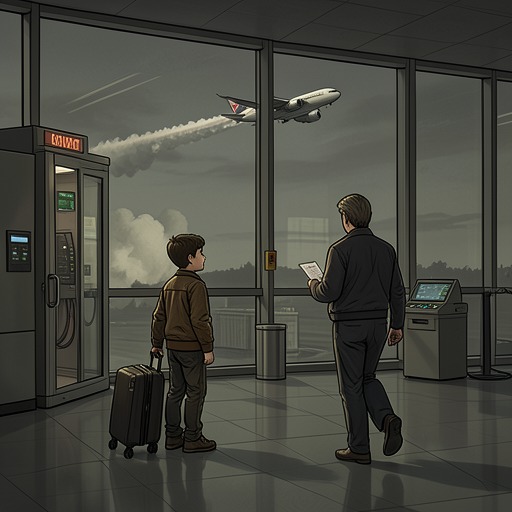
The schedule becomes tangible in what Nic carries. Before the handoffs, he packs clothes and toys into a Hello Kitty suitcase with a pretend lock and key. At first, a parent accompanies him on every flight. At five, he begins travelling alone, eventually replacing the tiny suitcase with a canvas backpack stocked with books and journals, Star Trek Micro Machines, plastic vampire teeth, a Discman and CDs, and a stuffed crab. The changing luggage records the passage of time, while its contents make each journey a small act of reconstructing a familiar world in transit.
The family’s word at departures and arrivals is “everything.” It stands for love, missing one another, and apology, gathered into a single exchange because the feelings are difficult to separate. David watches the plane pull away and take off, and tries to hide how painful each goodbye is so Nic will not feel worse. On the flights, Nic can order Coca-Cola, which is forbidden at home, but that small liberty is set against his fear of a plane crash. The account refuses to treat travel as either pure adventure or pure hardship: the child’s independence comes with pleasures, anxiety, and repeated loss.
David’s later reflection on custody sharpens the difference between having two addresses and feeling at home. He argues that joint custody assumes children can do equally well divided between households shaped by different parents, stepparents, expectations, discipline, and values. Invoking Emily Dickinson’s words, “Home is a holy thing,” he contrasts the idea of home as a stable psychological and physical cradle with the contradiction of making a child’s primary home plural. His objection is not that both parents should cease to matter, but that the language of balance can obscure what frequent movement asks of a child.
Wallerstein’s findings and the cost of parallel lives
The week after Nic leaves, David interviews child psychologist Judith Wallerstein for a magazine article. Wallerstein had studied children whose parents divorced in the early 1970s. At first she expected their distress to be temporary; when she met them again more than a year later, they had not recovered and were doing worse. Her research challenged the hopeful assumption that children would be happier simply because divorce freed their parents from unhappy marriages. It also made her work controversial: different political groups used or attacked her findings, including over her criticism of some forms of joint custody.
When David asks specifically about long-distance joint custody, Wallerstein describes children returning from one home to another and touching a table, bed, or sofa to reassure themselves that these things remain there. As they grow older, that need for tactile reassurance may give way to a sense that both homes are illusory or impermanent. She also distinguishes the needs of younger children, who may suffer when separated from a parent for too long, from those of older children, who may be harmed by frequent transitions. “Going back and forth made it impossible for children to enjoy activities with other children ... Teenagers complained bitterly about having to spend their summers with parents instead of with friends.” In her account, the difficulty is not a character flaw or an inability to love both parents, but the strain of trying to maintain parallel lives.
Nic eventually gives that strain public expression. Encouraged by a journalism instructor, he wins first place in the Ernest Hemingway Writing Award for high school journalists. He then submits a column criticizing long-distance joint custody to Newsweek, which publishes it in February 1999. Nic proposes, in pointed terms, that divorced parents with children should remain near them or take responsibility for travelling to see them. The personal conclusion is simpler than the proposed remedies: “I am always missing someone.” The line names the persistent absence built into a schedule that alternates presence rather than resolving separation.
Continuing consequences and limits of control
The account shows the arrangement continuing through repeated departures rather than culminating in a single solution. Summer visits bring concentrated time together: Nic comes north for two weeks, and the family fills the visit with surfing, swimming, kayaking, and time with friends. Yet David says they never get used to Nic being away. Phone calls carry news of movies, ball games, a playground bully, a new friend, and books, maintaining contact without restoring the ordinary shared days that the school-year schedule places elsewhere.
The family’s later experience of Nic’s addiction belongs to a different crisis, but the narrative also shows how a child’s troubles can reorganize attention across an entire household. David describes himself as an enabler, trying to prop Nic up and protect Vicki, Karen, Jasper, and Daisy while keeping them connected; he also recognizes that a parent’s moods can become dependent on how the addicted child is doing. In family therapy years later, Jasper and Daisy begin to speak about the strain surrounding their brother, and Karen describes panic when the telephone rings. These episodes do not establish that custody caused the later crisis. They do extend the book’s attention to how family arrangements and anxieties are experienced by people beyond the parent-child pair at their center.
As Nic grows older, the legal boundary around parental authority changes too. After he has used meth, David pleads for him to enter rehabilitation but learns that, because Nic is over eighteen, a parent cannot commit him solely over concern about drug use. Looking back, David wishes he had arranged treatment while Nic was young enough for that decision to remain legally available, while acknowledging that no one can know whether it would have helped. His later position is to intervene cautiously and earlier rather than wait for a crisis, but not to imagine that a parent can decide recovery for someone else. That tension echoes the earlier custody dispute: adults make consequential plans in the name of a child’s welfare, yet neither a court-approved schedule nor parental determination can abolish the child’s uncertainty. Long-distance joint custody remains in the narrative as both a practical compromise and an enduring measure of what compromise cannot make whole.