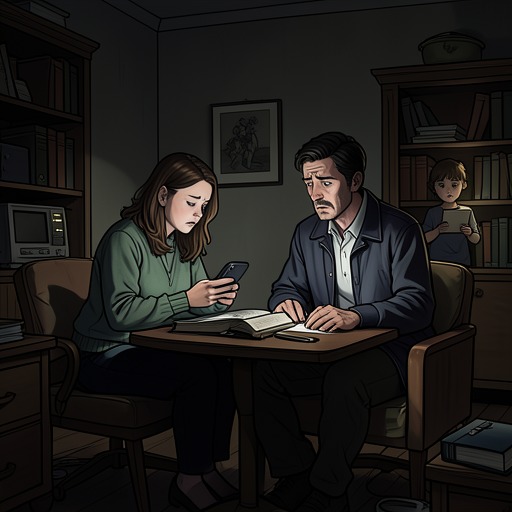
Nic breaks into his mother’s home to steal and must choose between rehab and the police
Beautiful Boy: A Father's Journey Through His Son's AddictionNic breaks into his mother’s home to steal and must choose between rehab and the police is a crisis in which relapse becomes unmistakable through action: Nic takes his girlfriend’s car, breaks into Vicki’s house, and is found in a frantic, confused state inside the garage. The episode ends not with recovery or arrest, but with Vicki’s ultimatum and his family confronting how quickly addiction can turn a feared possibility into an emergency.
The morning the disappearance begins
The episode unfolds on a warm November morning. A thin moon still hangs in daylight; Daisy has called it a sideways smile. Karen has taken Daisy into the city, while the narrator drives to collect Jasper from an overnight stay at a soccer field near the windmill in Golden Gate Park. The ordinary errands continue as the family’s crisis breaks into the day.
As the car crests Olema Hill, the narrator calls Z. She is breathless, frantic, angry, and worried. She explains that Nic dropped her at a market in Pacific Palisades at 5:45 a.m., then took her car to Vicki’s home. Nic had said he was going to break in and steal Vicki’s computer. He promised to return in fifteen minutes; four hours later, he still had not come back. Z. had called the police, presuming he might have been arrested, but they had no record of him. Her matter-of-fact account of the intended theft, as though Nic were making an ordinary visit, intensifies the disparity between the casual promise and the danger she fears.
Z. is sobbing and asks what could have happened in the five blocks between the market and Vicki’s house. The narrator asks her to wait while he checks with Vicki. The journey to pick up Jasper has become a search for a son whose whereabouts and condition are unknown.
The break-in and discovery
The narrator wakes Vicki with his call. At first, she reports that Nic has not arrived and that there is no sign of him. Half an hour later, she calls back with a radically different account: Nic is in the garage. He has broken in and is piling items into shopping bags, apparently trying to rob the house. In his confusion, he has managed to lock himself inside. Vicki describes him as panicked, crazed, and ranting; the narrator identifies the state as tweaking, the methamphetamine-fueled disturbance feared since Nic’s relapse.
The garage is not simply the site of a theft. Nic is trapped there amid the belongings he has gathered, and his confusion has made the situation more volatile. The narrator’s question about what has happened is answered by the details themselves: the break-in, the bags, the locked door, and the frantic ranting expose how severely Nic’s drug use has impaired his judgment. The episode supplies no account of what he intended to do with the stolen things or whether he understood how much danger the situation posed.
By the time the narrator calls Z. again, she has heard from Nic, who called her from a telephone in the garage. She is furious and has started packing his clothes. She tells the narrator that the clothes will be outside on the front porch if he speaks to Nic. Her response marks a change from anxious waiting to a limit: she will no longer treat his disappearance and return as a problem that can simply be absorbed into their relationship.
The ultimatum
After discussing the situation with her husband, Vicki gives Nic a choice. The police can be called and he will be arrested, or he can return to rehabilitation. The two options make the immediate stakes explicit: the family will not conceal the break-in or leave the crisis without a consequence, but treatment remains an alternative to arrest. The evidence does not say which option Nic takes, whether police are called, or what happens to him after the ultimatum.
The narrator is driving through the sunny morning to collect Jasper when the full force of the news reaches him. Nic has broken into his mother’s house; he is out of his mind; the methamphetamine use and tweaking have returned. Since learning of the relapse, the narrator had known that something like this might happen. Knowing that the crisis was foreseeable does not soften its arrival: he describes the dam breaking and emotion flooding in. The episode’s movement from a missing person report to a confirmed break-in gives that fear a concrete, escalating form.
The account closes in alarm and prayer. The narrator asks God to heal Nic and wonders whether it is too late. These are not answers to the ultimatum; they register the father’s terror while the outcome remains uncertain. The crisis is therefore left suspended between two possible immediate consequences—rehabilitation or arrest—and the larger, unanswered fear that Nic’s relapse may cost him his life.
Relapse, limits, and the family’s continuing fear
The episode belongs to a recurring pattern in which a period of apparent possibility gives way to renewed drug use and urgent family intervention. The narrator’s recollection that he expected a crisis after Nic relapsed makes the break-in more than an isolated shock: it is a new, concrete iteration of a disease whose recurrence the family has learned to fear. Later, he rejects the idea that a hopeful ending can mark a permanent post-addiction phase, describing addiction as lifelong and incurable, though it can go into remission and be managed through sustained work. Nic’s conduct here gives that understanding a stark immediate expression: his girlfriend’s car, his mother’s home, and the shopping bags become the material consequences of relapse.
The scene also brings the narrator’s conflicting responsibilities into focus. He understands that an addicted person may not be responsible for the condition itself while remaining the person whose actions have consequences; he has also learned that he must set limits while remaining able to redraw them. Vicki’s choice between police and rehabilitation is one such limit, imposed in response to a specific act rather than an abstract fear. The narrator’s later reflections on worry after his own cerebral hemorrhage reinforce the depth of that bond: even the wish to escape the pain of worrying about Nic gives way to gratitude for the love that accompanies it. Here, however, love cannot settle what Nic will do. The episode ends at the boundary between the family’s intervention and a decision only Nic can make.