Nic's long-term shared-custody arrangement
Beautiful Boy: A Father's Journey Through His Son's AddictionNic's long-term shared-custody arrangement divided his childhood between David Sheff's home in San Francisco during the school year and Vicki's home in Southern California during holidays and summers. A child psychologist recommended the schedule after a three-month investigation intended to find the least disruptive option available. The arrangement kept both parents in Nic's life, but it could not give him one settled home: its recurring handoffs made distance, divided belonging, and the pain of leaving central features of family life.
From informal sharing to a formal decision
After David Sheff and Vicki separated, they initially shared custody informally. Vicki later moved to Los Angeles and remarried, putting about five hundred miles between the two homes. Both parents still wanted Nic with them, but the informal back-and-forth was no longer workable. Each sincerely believed that Nic would be better off living with them, and the disagreement led them to hire divorce lawyers.
The prospect of a court battle brought both expense and strain. Their lawyers charged more than two hundred dollars an hour and required retainers of five to ten thousand dollars. Learning that judges often relied on the recommendation of a court-appointed child psychologist, the parents chose instead to have Nic's existing therapist conduct an evaluation and agreed to abide by her decision. The choice shifted the question from which parent should prevail to what arrangement might best reduce stress for Nic, while making the psychologist's judgment decisive for both households.
Her investigation lasted three months. She interviewed David and Vicki, their friends, and their families; visited their homes in San Francisco and Los Angeles; and spent long sessions with Nic playing checkers, cards, and blocks. In her office, Nic used a dollhouse to show the mother's room on one side and the father's on the other. Asked where the little boy's room was, he answered, “He doesn't know where he will sleep.” The dollhouse turned an adult custody dispute into a child's concrete uncertainty: two parental rooms could be represented, but not a place that was unmistakably his.
The schedule and its immediate cost
At the decision meeting, the psychologist described Nic as resourceful, sensitive, expressive, and highly intelligent, and said that he was suffering from both the divorce and uncertainty about his future. She emphasized consistency and minimizing stress, while acknowledging that there was no ideal choice. Her recommendation was that Nic live with David in San Francisco during the school year and spend holidays and summers with Vicki in Southern California.
David experienced the decision as neither a straightforward victory nor a loss. He would have Nic for the ordinary routines of the school year, but would miss Christmas, Thanksgiving, and summer. The parents signed the written decision in the psychologist's office. David later understood the signature as giving up half of his son's childhood: the legal plan converted a painful division into a schedule, but did not make the division feel less consequential.
Nic's own experience was visible in the work of preparing to leave. He packed clothes and toys in a Hello Kitty suitcase with a pretend lock and key, and told David that he had a pit in his stomach. He wanted to see his mother and stepfather, but did not want to leave. At first a parent accompanied him on flights. At five, he began traveling alone, carrying a canvas backpack filled with books and journals, Star Trek Micro Machines, plastic vampire teeth, a Discman and CDs, and a stuffed crab. A flight attendant led him onto the plane while his parents watched him go. The objects made each journey more than a transfer between addresses: they were the portable contents of a childhood repeatedly packed and unpacked.
Distance as a recurring family condition
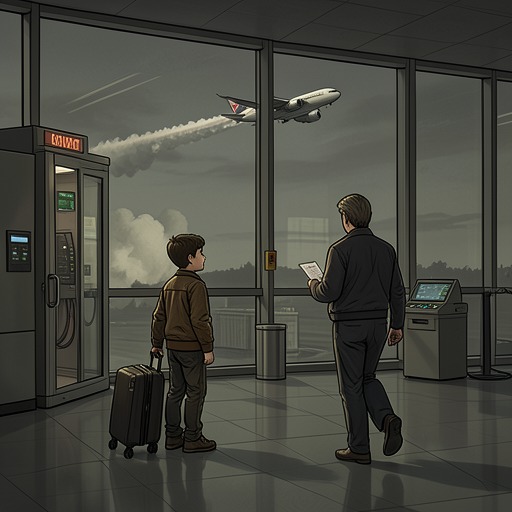
The schedule's emotional cost accumulated through repetition. David describes airport goodbyes as cutting a new slice into his heart, while trying not to show how difficult they were because he did not want Nic to feel worse. After Nic boarded, David watched through the glass as the plane pulled away and took off. The handoff was brief; its absence continued after the plane was gone.
David came to loathe joint custody even while recognizing it as the best available arrangement for his family. He questioned the assumption that children can thrive equally in two homes shaped by different parents, stepparents, expectations, discipline, and values. In his account, home is not merely a pair of addresses but a psychological and physical basis for stability and safety. Two homes may preserve access to both parents, yet still leave a child without the uncomplicated security that adults often assume the word home provides.
His later interview with child psychologist Judith Wallerstein gave this concern a wider context. Wallerstein described young children returning from one household to another and touching objects such as a table, bed, or sofa as if to confirm that they were still there. As children grew older, she observed, they might come to feel that both homes were illusory or impermanent. She also distinguished the pressures of age: long separations from a parent could be difficult for young children, while frequent transitions across long distances could interfere with older children's friendships and activities. The arrangement's core tension was therefore not simply that Nic had two parents, but that keeping contact with each could require repeated departures and limit the continuity of life in either place.
Nic's account and the limits of the arrangement
As a teenager, Nic made the cost of the schedule explicit in writing. His journalism instructor encouraged him to submit columns to a high-school writing award, which he won; he later submitted a piece to Newsweek's My Turn section, published in February 1999. The column criticized long-distance joint custody and argued that parents who moved away from their children should bear the burden of traveling to see them. Its most compressed statement of the arrangement's emotional logic was, “I am always missing someone.” The sentence describes more than sadness at individual departures: in a divided family, being with one parent meant being away from the other.
The custody schedule did not itself explain Nic's later addiction, and the book does not present it as a simple cause. It did, however, establish a family life organized around distance and separation before later crises demanded decisions about treatment and parental limits. When Nic was over eighteen and had used meth, David learned that he could not commit his son to rehabilitation merely because he was worried about his drug use. He regretted not having urged or required long-term treatment while Nic was young enough for a parent to make that decision, while acknowledging that no one could know whether earlier intervention would have helped. His reflections distinguish the custody arrangement from later treatment authority, but both expose the changing limits on what a parent can decide for a child.
The family's later experience also shows how addiction unsettled the wider household. David recognized himself as an enabler, making excuses and trying to care for Nic while also protecting Karen, Jasper, and Daisy and keeping the family connected. He described how an addicted family member could absorb a parent's attention and make other members' moods depend on the addict's condition. In family therapy, Karen and the children began to speak about the fear and tension they had not adequately acknowledged, including panic when the phone rang or something seemed to be missing. These later scenes do not turn the custody schedule into the cause of the family's distress; they reveal how a family already shaped by divided homes faced further uncertainty as Nic's needs changed.
In retrospect, David argues for caution and earlier intervention when a young person's drug use becomes dangerous, while recognizing that treatment cannot guarantee recovery. He would help a child return to rehabilitation after relapse, but would not give money or provide practical support for continued drug use. That position belongs to the later crisis, not to the original custody decision. Together, the two situations mark different stages in parental responsibility: first, choosing a schedule neither parent could make painless; later, confronting the fact that love and legal authority cannot ensure a child's safety or choose recovery for him.