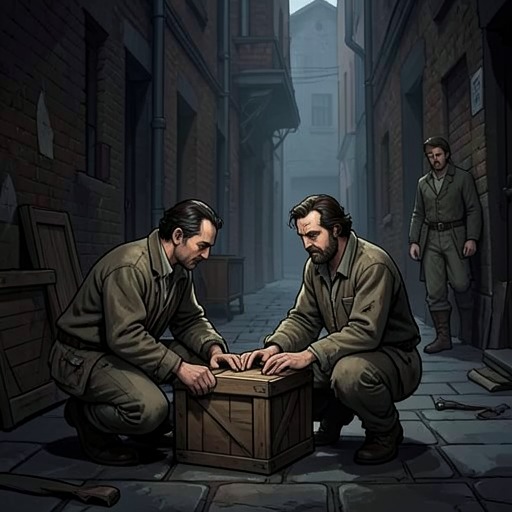
August Gerner
Berlin AlexanderplatzAugust Gerner is a joiner whose home stands beside the yard used by a burglary gang, a position that first makes him a witness and then draws him into the crime. He refuses to inform on the thieves, but resentment, the prospect of profit, and the hope of leaving his circumstances behind gradually overcome that refusal. His eventual arrest, alongside his wife Gusti, turns the building’s ordinary yard and rooms into the stage for a small, compromised rise and fall.
Identity and circumstances
Gerner lives in a crowded residential building where repeated break-ins at a nearby wholesaler have become a public concern. The building itself is described as poorly constructed, with thin walls and a vulnerable exterior; the burglars have tried to break through that wall after the doors and stairs were alarmed. Gerner is present when police and insurance representatives inspect the property, and he quietly joins the group looking over the cellar doors and the building’s condition.
The narration identifies him as August Gerner and a joiner; his wife addresses him as Paul. They share a home and make decisions together, though their responses to the chance of getting ahead do not always match. Gusti worries about being blamed and says that varicose veins would prevent her from helping with a burglary. Gerner nonetheless imagines that a successful job might offer a way out of their cramped life. His position as a resident, and at one point his claim to be the caretaker, gives him access to the yard and makes the boundary between watching the criminals and assisting them unusually thin.
From witness to accomplice
When Franz Biberkopf encounters Gerner among people discussing another theft, Gerner says that he saw the burglars but will not report them. His refusal is not a declaration of loyalty to them: he threatens to deal with anyone who enters the yard again, where he lives and sleeps. A suggestion that he could earn money by going to the police does not change his mind. He dismisses the authorities as responsible for handling their own business.
Soon afterward, two officers question Gerner about where he lives. He acts as though he is helping them identify the joiner, rings his own doorbell, and lets the officers and insurance men inspect the flat. He keeps quiet as they measure and examine the walls. When the group later looks at the cellar doors, Gerner steps back and finds a bottle that has fallen onto paper, muffling its sound. He takes both the bottle and the paper, hides the bottle under his jacket, and brings it home. He and Gusti decide to keep the Danziger Goldwasser rather than return it, reasoning that it has passed from the owners to the burglars and that they should not hand it back to either. The small theft gives Gerner a taste of taking what is available while staying outside the gang’s risks.
The next time the burglars arrive, Gerner sees them flee across a wall when they notice someone in the yard. Instead of reporting them, he calls after them and offers to join. One of the men suspects a trap, but Gerner persuades him that he lives there and can be trusted. He leaves the ladder by the wall and takes the hesitant burglar into the building, where he presents him to Gusti as a friend. Their welcome unsettles the young man, who had expected a trick, but he accepts their hospitality before leaving. Gerner has crossed from opportunistic bystander to someone actively inviting a burglar into his home.
The plan and the break-in
A tall visitor later comes to speak with Gerner about business and the chances of making money through speculation. Their talk is interrupted by detectives and insurance representatives, who ask Gerner to take part in a special surveillance operation aimed at stopping the burglaries. The insurance company is to cover the costs. The visit gives Gerner a seemingly legitimate role in the effort to catch the thieves, even as he and Gusti become drawn into the visitor’s company. The narration marks Gusti’s attachment to the tall man and her growing closeness with him; Gerner, for his part, admires the visitor’s opinions and feels newly valued by the younger men.
After the visitor leaves, Gerner decides to act on his own. He argues that partnerships fail, that his home is closest to the target, and that the ground-floor position gives him an advantage. Gusti says she cannot help, citing her varicose veins, and the narration conveys her private reluctance. On the night of the planned burglary, Gerner and Gusti hide in the cellar after the rest of the group has left. As they wait in the closed building, knocking at the door first alarms them and then becomes recognizable as a signal from someone they know. The tall visitor arrives. Gusti greets him with unmistakable pleasure, and Gerner realizes that she has betrayed him in favor of the man to whom she is attached. Three more men arrive, and Gerner, unable to stop them, goes ahead with the work while deciding that he will break with them afterward.
The burglars spend two hours carrying goods from the cellar into Gerner’s flat: sacks of coffee, currants, and sugar, followed by crates of wine and spirits. The scale of the haul makes Gerner furious that he must share it, but he does not withdraw. After the others leave, he and Gusti stay up from about two until five in the morning, sampling the different drinks and sinking into drunken satisfaction with the night’s events. Their participation has turned the home into a storehouse for stolen property as well as the place where they celebrate the proceeds.
Arrest and narrative role
At about noon, the doorbell rings, but Gerner and Gusti are too drunk to answer promptly. When Gerner finally opens the door, detectives enter and find the rooms and passage crowded with sacks, crates, bottles, and packing material. The stolen goods are in plain view. Gerner says little; Gusti protests that they are decent people and suggests that someone else brought the goods in. Gerner offers a cover story that they had been burgled themselves and were on their way to report it, but the officers tell them they will explain matters at the station. Both are taken away. The narrative does not establish what happens to them after that arrest.
Franz Biberkopf has watched the proceedings without joining the conversations in the hall or yard. As Gerner and Gusti are led out, Franz recognizes in their public shame something he has experienced himself: he recalls having once made a similar walk, though in darkness. His observation gives Gerner’s arrest a double edge. The episode exposes the gap between respectable appearances and criminal conduct, while Franz’s response registers the vulnerability of people who are publicly judged and taken into custody.
Gerner’s story is also shaped by the city’s larger rhythms. The building’s faulty walls, the cellar, the yard, and the route to the street organize the burglaries as a chain of practical opportunities and risks. Nearby, at Alexanderplatz, a pile driver repeatedly hammers rails into the ground in front of Aschinger’s. That construction scene belongs to the surrounding urban world rather than to Gerner’s actions, but its pounding cadence offers a stark counterpoint to his attempted escape from hardship: his brief hope of making a new life through crime ends not in independence, but with the stolen goods exposed and the police carrying him away from the home he tried to use as his advantage.