Buch secure ward
Berlin AlexanderplatzBuch secure ward is the isolated institutional setting in which Franz Biberkopf is observed after his collapse, and where his silence and immobility are treated at once as a medical crisis and a problem of custody. The ward’s exposed position beyond the village, its intensive interventions, and the investigations conducted at his bedside make it more than a place of treatment: it is the threshold between his former life, his possible prosecution, and his eventual release.
Setting and Transfer
After Franz is suspected of feigning madness in the police lock-up at police headquarters, a doctor examines him and he is transferred to the hospital at Moabit Prison. He remains unresponsive there, lies rigid, and refuses food. After two days without nourishment, he is taken to Buch Asylum for observation in its secure house. The decision is presented as necessary both because his condition requires assessment and because his criminal record makes observation institutionally relevant.
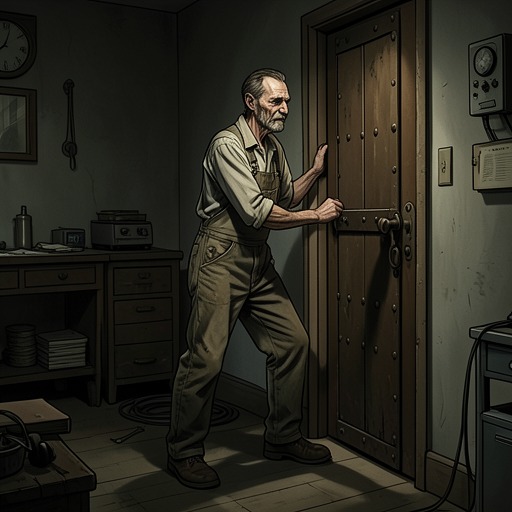
The secure house is separated from the buildings for patients described as sick but not criminal. It stands on open, flat ground beyond the village, with few trees or shrubs and no roads to shield it from the weather. Wind, rain, snow, cold, day, and night bear directly upon the building. This setting gives the ward an exposed, remote character, while distinguishing its residents from the other patients at Buch Asylum through both location and custodial status.
Franz’s Condition and Treatment
Franz is first placed in an observation room. He repeatedly removes his shirt and will not cover himself; otherwise, for weeks, he gives little sign of life. He keeps his eyes shut, lies rigid, and refuses nourishment. Staff feed him through a nasal tube with milk and eggs, with a little brandy, over an extended period. His strength and weight decline so greatly that a single warder can carry him to the bath. There he sometimes opens his eyes and makes sounds, but staff cannot interpret them as meaningful speech.
The treatment scenes show a sustained struggle over food and control. Franz resists the feeding tube and, once feeding is finished, tries to undo its effects; the doctors and warders continue their efforts to keep him alive. His refusal is not simply recorded as a symptom: the narrative presents it as resistance to being forced, while the staff regard nourishment as necessary care. The conflict therefore exposes how treatment in the secure ward can preserve life and simultaneously impose the institution’s authority on a patient unable or unwilling to cooperate.
Doctors try a succession of measures as Franz weakens. They speak to him, examine his pulse, change his position, and give injections, including caffeine and camphor; glucose and salt are also introduced into his veins. They discuss further procedures, among them oxygen and blood transfusion. The prisoners on the ward follow these repeated rounds and treatments, making Franz’s condition a shared subject of attention. Their expectation that another intervention will be attempted contrasts with the doctors’ formal concern and the uncertainty of whether any measure will restore communication.
Medical Interpretations and Institutional Conflict
The doctors agree that Franz is in a stupor, but they do not agree on how to understand it. Younger physicians consider a psychological origin for his rigidity and believe that discussion and analysis might help resolve the conflict they perceive. They attempt to engage him by speaking in the observation room as if he can hear them, hoping to draw him out of isolation. When this approach fails, a trainee doctor arranges faradic stimulation, first on the upper torso and then around the jaw, throat, and base of the mouth.
The senior physician is skeptical of explanations that give the psyche a central role, dismissing the younger doctors’ confidence in psychological theory. The disagreement is not resolved through a conversation with Franz, since he cannot or will not participate. The secure ward thus contains a conflict not only between patient and staff but among medical approaches: observed rigidity and refusal invite competing explanations, while the demands of diagnosis and treatment continue in the absence of an account from Franz himself.
Speech, Investigation, and Release
The change begins when Franz starts to speak and focus his eyes. Detectives and doctors question him for different purposes: the detectives seek information about his past and the doctors seek a diagnosis. He learns that Reinhold, a figure from his former life, has been caught. Questions about Brandenburg and a man named Moroskiewicz are repeated, but Franz initially remains silent. The ward is therefore also a place where police inquiry reaches into medical care, and where even a partial return of attention can reopen the question of criminal responsibility.
The following day Franz makes a statement denying involvement in the Freienwalde affair and saying that Reinhold would be mistaken if he claimed otherwise. Asked for an alibi, he cannot provide one immediately; the narrative describes his resistance to returning to that period and his distress during questioning. He gives no information that incriminates Reinhold. As the facts he does provide are checked, the doctors’ initial diagnosis of catatonia recedes. They conclude that he was not pretending, but had suffered psychological trauma followed by a comatose state.
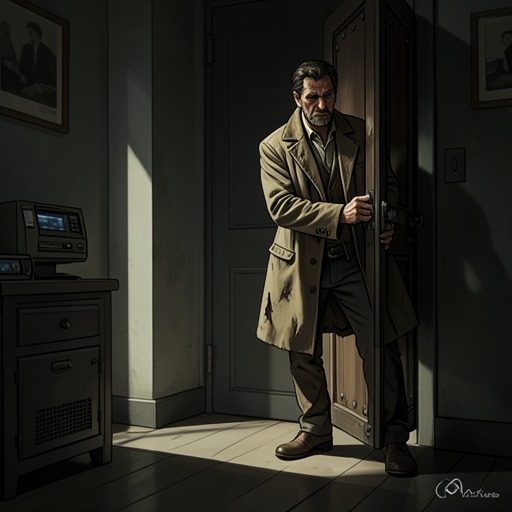
Franz is eventually released. The police warn that he will be watched outside, and his stored belongings are returned. He puts on his clothes again, including a jacket still marked by the earlier police beating, but declines the false arm and leaves the wig behind. The departure closes his stay in the secure ward without restoring the old Franz: the narrative presents him as profoundly changed, while the police continue to regard him as a person under scrutiny.
Narrative Significance
The ward’s physical exposure and Franz’s enforced isolation work together without making the setting a simple symbol of recovery. The weather presses upon the secure house, while the routines inside it—observation, feeding, examination, and questioning—attempt to classify and manage a man who cannot initially answer. The contrast between his silence and the institution’s continual activity gives the episode its tension: staff can intervene in his body, but they cannot immediately secure his cooperation or establish what his condition means.
The sequence also changes the meaning of Franz’s apparent madness. Suspicion that he is acting gives way, through medical observation and the return of speech, to a diagnosis of genuine collapse. Yet recovery does not erase the consequences of his earlier life: detectives resume their inquiries, and his release comes with the explicit prospect of surveillance. Buch secure ward is thus both a place of care and a custodial passage, marking a narrow return to the world rather than a simple restoration of his former identity.