Franz Biberkopf—Otto Lüders
Berlin AlexanderplatzFranz Biberkopf and Otto Lüders move from a shared livelihood into a relationship defined by betrayal. Their partnership begins with street sales and the trust of a companionable conversation, but Franz’s disclosure about a widow gives Lüders the opportunity to exploit both the woman and Franz. When the consequences become clear, Franz withdraws; later, he rejects Lüders at the door and throws water at him. The rupture marks a decisive collapse of their working alliance and personal trust.
Identity and Formation
As Christmas approaches, Franz changes his street business, selling inexpensive goods and, for several hours in the morning or afternoon, shoelaces. He begins alone and then works alongside Otto Lüders, a man brought to him by Lina, who is Lüders’s niece. Lüders has been unemployed for two years, while his wife supports the household by taking in washing. The account also recalls that, for a few weeks in summer, he wore a costume with tassels to appear as Mr. Peppermint Man in Rüdersdorf. The two men now go from street to street and enter houses to offer their wares, meeting again after canvassing separately.
This work gives their association a practical basis: both are trying to make money by going directly to customers, and Franz’s new success becomes something he wants to share with Lüders. One day in a pub, Franz is unusually buoyant. He eats Lina’s sandwiches, orders pigs’ ears and peas for the three of them, and squeezes Lina so insistently that she leaves, red-faced. Afterward, Franz turns his attention to Lüders and presses him to guess what has happened. The scene begins in the ease of shared food and company, but Franz’s teasing insistence also sets up the disclosure that will change their relationship.
Work, Confidence, and Disclosure
Franz proudly produces twenty marks and tells Lüders that he made the money in fifteen to twenty minutes. He insists that it was earned honestly, not through theft or sleight of hand. His story is of a shoelace sale at a woman’s door: she was a widow, still attractive in his description, and he spoke with her in the passage before she invited him in for coffee. He hints at an intimacy beyond the sale and explains that he left his goods at her home. The woman’s identity and address are now information shared between the two men, not merely part of Franz’s private success.
Franz says he will return to the widow’s house later, on Elsässer Straße, and boasts about the twenty marks. The pair eat and drink until three; Lüders gets five marks, though he does not become more cheerful. The narrative does not explain his mood or establish a motive for what follows. It does, however, place his later visit directly after Franz has described the widow, the money, and the stock left in her home. A workmate’s confidence has made the opportunity—and the means of reaching it—available to him.
Lüders’s Visit to the Widow
The next morning, Lüders carries shoelaces across Rosenthaler Tor and waits until he sees Franz coming down Brunnentrasse. He then goes to Elsässer Straße and rings the widow’s bell, presenting himself as a seller before saying he has come to collect Franz’s stock. Once she opens the door, he quickly enters and shuts it behind him. He takes the parcel, but does not leave. He asks for coffee, questions her about her husband and children, and presses the conversation even as she asks him to go and says she is busy.
As he moves toward the door, Lüders turns back and demands money, using what he knows about her encounter with Franz to intimidate her. She gives him the coins from her purse and then empties the purse into his hand. He returns to the sitting room, takes the embroidered tablecloth and two cushions, and searches the kitchen drawers. The woman is unable to speak; after he rummages through the house, she collapses. Lüders leaves slowly, closing the door behind him. The episode turns Franz’s boast about a profitable encounter into the occasion for a second, coercive visit: Lüders uses the confidence between the men to find the woman and what Franz left there, then takes money and household goods by threat and force.
Recognition and Rejection
For a day, Franz goes about sulking. The next morning, before he meets Lüders, the landlord gives him a letter from the widow. Franz asks whether anything else has been delivered and hears that the parcel of stock was fetched the previous night by a boy. Soon afterward, he sits by the display cabinet holding the letter limply, unable to get up. Lüders comes through the door, sees him sitting, and immediately turns away. The letter and Lüders’s sudden retreat bring the betrayal into focus without a confrontation between them: Franz understands what has happened, while Lüders avoids facing him.
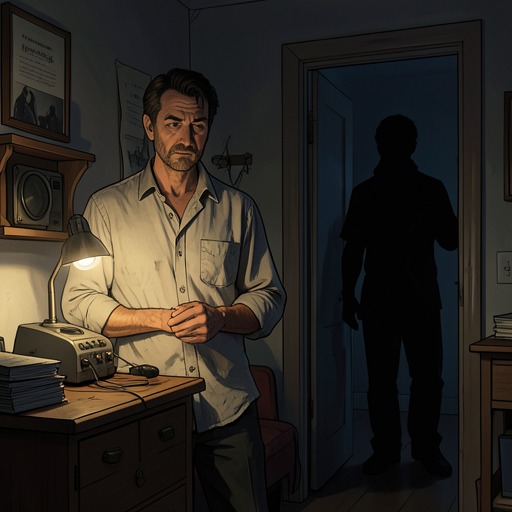
Later, after Meck has beaten Lüders, Lüders finds Franz in a room where he is lying on a bed with his boots on. Lüders has an open knife in his pocket and places a few marks on the table. He speaks about the beating, shows the bumps on his head and his swollen ears, and asks Franz to acknowledge his visit, or to let Meck or Lina come instead. Franz points to the door and tells him to get out. When Lüders lingers, Franz takes the washbasin and throws its water across the room at his feet, then throws the remaining water from the jug toward the doorway. Lüders slips out, soaked around the throat and mouth, and the door shuts behind him. Franz offers neither a hearing nor a return to their former partnership; the water enacts a blunt expulsion.
The Rupture
The relationship’s course links economic precarity to a failure of trust without reducing the betrayal to poverty alone. Lüders’s unemployment and Franz’s precarious street trade establish their shared circumstances, but the decisive breach occurs when Lüders turns a confidence into access to the widow and her possessions. Franz first treats his success as news to share and gives Lüders a portion of the proceeds; afterward, the same companion is recognized through his evasion and rejected at the door.
The repeated thresholds sharpen that reversal. The two men originally go from house to house together to sell shoelaces; later, Lüders crosses the widow’s threshold under a pretext, refuses to leave when asked, and takes her property. When he finally comes to Franz, he is the one driven across a threshold and out. Their connection therefore ends not in renewed cooperation but in Franz’s physical refusal of contact: the work partnership that began with shared street rounds concludes with a closed door and water thrown against the man who betrayed him.