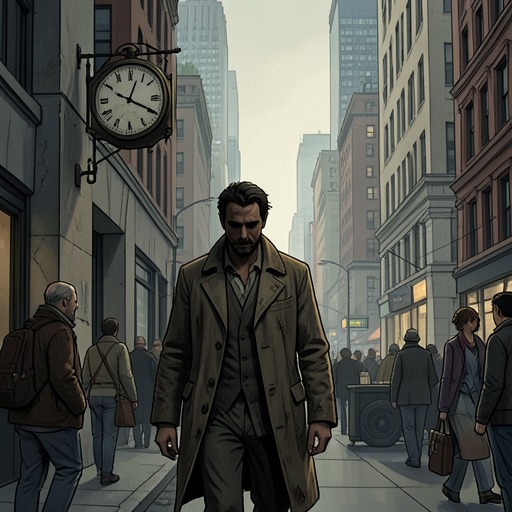
Franz Biberkopf’s one-armed disability
Berlin AlexanderplatzFranz Biberkopf’s one-armed disability shapes his bodily experience, his dependence on others, and his idea of what it means to be capable. The narrative repeatedly sets his conviction that he is helpless against evidence that he can still act with force and precision. The gap is not simply between injury and recovery: it is between a body altered by violence and the narrow measure of usefulness through which Franz judges that body.
The body and its daily limits
By August, Franz is described as one-armed and very fat, moving through a familiar rut rather than making a decisive new start. He can row with his left arm, a specific, practical adaptation that signals continued capacity without making the loss disappear. He has also stopped reporting to the police, and the narration notes that they have not come looking for him. His disability thus appears amid other conditions of precariousness and withdrawal, not as an isolated medical case. The police station’s summer inactivity leaves him undisturbed, while the streets remain the place where things happen around him.
The injury has ongoing physical costs. In conversation with Herbert, Franz draws attention to his empty sleeve and says that his shoulder hurts so badly at night that he cannot sleep. Herbert advises him to see a doctor, but Franz refuses, explaining that he has had enough of doctors in Magdeburg. The exchange establishes both persistent pain and resistance to medical care; it does not present the injury as a condition neatly resolved by treatment. Herbert proposes that Mieze take Franz out of Berlin for a change of air, but Franz asks instead to be left drinking. The proposed change of surroundings and the immediate choice of alcohol stand against each other, with neither removing the pain he describes.
Helplessness and the fear of violence
Franz interprets his lost arm as proof that he can do nothing. When Herbert urges him to stop drinking and questions his association with Willi and politics, Franz answers that he is a complete invalid. He casts the injury as something done to him and tells Herbert that they have been made cripples. Even the suggestion that he could start again sounds to him like a humiliating command to perform a trick, repeatedly rising onto a table and climbing down like a puppy. The comparison conveys how he experiences encouragement: not as recognition of his circumstances, but as pressure to demonstrate usefulness on demand.
His fear is bound up with the possibility that he might hurt someone again. Herbert warns him that his drinking and fits of rage could put Mieze in the same position as Ida. That warning makes the earlier violence against Ida an explicit measure of the danger Herbert sees in Franz, not merely a past episode unrelated to his present condition. Eva dismisses Herbert’s alarm, while Herbert persists. Franz’s disability does not itself explain or excuse violence; in this exchange, the injury, drinking, rage, and fear of repetition coexist in an unsettled conflict between those who try to restrain him and those who minimize the risk.
The arm as a social and intimate difference
A later meeting with Reinhold turns Franz’s altered body into the focus of a humiliating encounter. Franz watches Reinhold’s two hands and remembers that Reinhold threw him under a car. He is frightened and unable to answer the wish to see the stump with the defiance he had imagined. He opens his jacket and shows the empty sleeve; Reinhold reacts with disgust and continues to grin. The scene joins the physical evidence of the injury to the history of betrayal: the person who caused it now examines it, while Franz struggles to speak or act in response.
Reinhold’s questions about how Franz handles the sleeve, whether it is put into a pocket, and how he will manage an overcoat in winter make the disability a matter of ordinary dressing as well as spectacle. The discussion is practical in its details but cruel in its setting. Reinhold treats the missing arm as an occasion for teasing and even raises the possibility that the sleeve could make Franz easier to rob. Franz answers that nobody will rob him, but the exchange exposes how an altered body can be made visible, inspected, and interpreted by someone else. The attention to clothing also keeps the injury from remaining an abstract symbol: it affects how Franz gets dressed and anticipates the difficulty of cold-weather clothing.
Work and demonstrated capacity
The clearest counterweight to Franz’s account of himself comes during his first burglary with the gang. He stays above the opening cut through the floor and gathers bolts of cloth with one arm, passing them behind him to another man. The operation is carefully arranged: the crew has brought a rope ladder and an oxy-acetylene torch, uses a steel ladder only eight feet high, and works for roughly two hours. Within this coordinated task, Franz’s arm grips the cloth with such force that the narration compares it to a crane and a gigantic vice. Even Reinhold is amazed by what Franz can do.
That success does not erase the pain or dependence already shown. Rather, it contradicts the absolute claim that Franz is fit for nothing. His bodily capacity is specific: he rows with one arm, handles heavy bolts of cloth, and manages some tasks in a burglary, while still suffering shoulder pain and difficulty with clothing. The contrast matters because the scene neither turns him into an uncomplicated figure of triumph nor accepts his self-description as an invalid as the whole truth. Capability exists alongside impairment, and the circumstances determine whether other people recognize it.
Narrative significance
The narration sets Franz’s body against an animal comparison, imagining what a sow does in a sty and contrasting the animal’s existence, reduced to flesh, food, and eventual slaughter, with a human being burdened by awareness and thought. The comparison is harsh, but it makes Franz’s condition more than a physical inventory: he is a person who must think about what will happen to him. Elsewhere, he uses the idea of being a cripple to account for his inactivity, while the burglary makes his one arm an instrument of effective labor. Those competing images—helplessness, animal flesh, and powerful grip—prevent the disability from having a single stable meaning.
The episodes also connect bodily difference with other people’s judgments and demands. Herbert sees both Franz’s possible strength and the danger of his rage; Eva rejects Herbert’s warning; Reinhold turns the stump into an object of mockery; the burglary crew discovers Franz’s usefulness through the work itself. Franz’s disability is therefore neither a passing detail nor a simple metaphor for defeat. It is a continuing lived condition—painful, visible, and materially limiting—that the narrative tests against his relationships, his own shame, and his demonstrated ability to act.