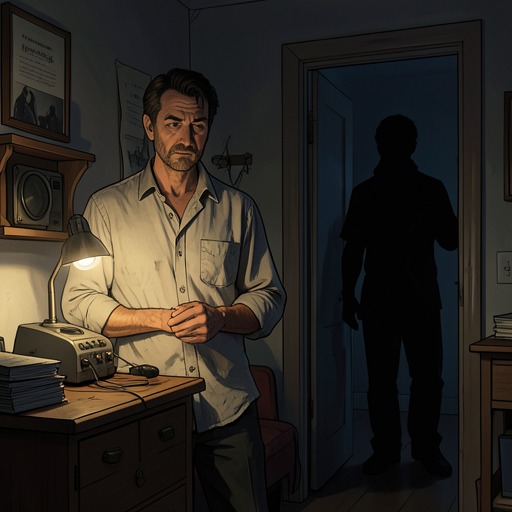
Franz drives Lüders away with water
Berlin AlexanderplatzFranz Biberkopf drives Otto Lüders away with water in a scene that makes refusal physical: rather than hear Lüders’s explanation or accept his money, Franz uses the washbasin and water jug to force him out. The action follows Lüders’s betrayal and Franz’s withdrawal from ordinary contact. Its aftermath extends beyond the shut door: Franz floods the room, speaks of cleansing and return to earth, and is gone by nightfall. The water expels a visitor, but it cannot restore the life from which Franz is trying to separate himself.
The Visit and the Refusal
Lüders finds Franz living close to his old flat, three houses farther along. People have seen Franz enter the building with a cardboard box and a pair of boots; he has been taken to a room upstairs across the back. When Lüders enters, Franz is lying on the bed with his boots still on and his feet hanging down. The lamplight makes the visitor recognizable, but recognition does not open the way to reconciliation: Franz knows who has come and watches him from the bed.
Lüders has an open knife in his left pocket, while he holds a few marks in his other hand. He lays the money on the table and talks around the matter, moving about the room with a hoarse voice. He shows Franz the bumps on his head left by Meck’s blows and dwells on the insults and resentment he has suffered. His visit is thus both an attempted explanation and a display of grievance; the money and request for acknowledgment do not erase the injury that brought Franz to this point.
Franz sits up. His face alternates between hardness and small, involuntary twitches. He points to the door and quietly orders Lüders to leave. Lüders asks for a note proving he has visited, fearing that Meck and the others will be watching for him; he also suggests that Meck or Lina Przyballa could come instead. That appeal for a witness or intermediary does not soften Franz’s answer. Franz rises abruptly, and Lüders slips toward the door with a hand on its handle.
Water as Expulsion and Cleansing
Instead of following Lüders directly to the door, Franz crosses to the washstand, lifts the basin, and sweeps its water across the room toward Lüders’s feet. The movement changes the exchange from pleading and explanation into an immediate bodily expulsion. Lüders jumps aside and reaches for the handle; Franz takes up the jug, still containing water, and throws its contents toward the doorway. The cold splash strikes Lüders on the throat and mouth. He slithers out, and the door shuts behind him.
The biblical language accompanying the action binds this practical gesture to death and bodily dissolution. As the basin is emptied, the narration invokes the return of dust to dust; as Franz throws the jug’s remaining water, it returns to the earth from which it came. The words do not turn the scene into a calm act of ritual purification: Franz’s violence is directed at removing Lüders from the room, and the water hits him as he tries to escape. Yet the imagery gives the expulsion a larger force. Franz treats the encounter as something that must be washed away, while the language of mortality makes clear that cleansing cannot simply undo what has happened.
Once Lüders is gone, Franz continues. He throws jugful after jugful into the room and splashes water through the air with his hand, insisting in his own thoughts that everything must be clean and go. He opens the window, pants, and looks at the floor. The scene slows over ordinary practical concerns: water might drip onto the people below and stain things, so he considers wiping it up, then closes the window. Having tried to drive out the contamination, he lies flat on the bed. The narration returns to the dust-and-earth image and calls him dead, joining the wash of water to an image of exhaustion and symbolic death rather than presenting it as a completed recovery.
Disappearance and the Limits of Explanation
That night Franz is no longer living in the room. Meck cannot discover where he has moved. The disappearance gives the outburst a consequence beyond Lüders’s immediate retreat: Franz has not merely ended a conversation but withdrawn again, leaving no known address through which his friends can reach him. The room’s attempted cleansing ends not in a restored home but in absence.
Meck takes the determined Lüders to the cattle traders at his local, hoping they will question him about what happened and about the letter the landlord received. Lüders remains adamant and looks so malicious that the traders let him go; Meck concludes that he got what was coming to him. Their intervention produces no clear account that can repair the break. The scene therefore sets Franz’s private, forceful refusal against the group’s effort to establish what happened through questioning, while leaving his whereabouts unknown.
Narrative Significance
The episode makes water carry two incompatible tasks. It is a concrete weapon with which Franz drives Lüders across the threshold, but after the visitor has gone Franz uses it compulsively, as though the room itself must be cleared of what the encounter has brought into it. His concern about the water staining the floor or dripping below briefly returns the scene to material consequences; it does not dispel the death imagery that has overtaken his thoughts. The sequence moves from an unmistakable act of control to a retreat whose destination Meck cannot find.
The scene also withholds a neat explanation for Franz’s condition. Lüders’s account, his visible injuries, Franz’s silent command, the splashing water, and the subsequent disappearance are shown as actions and consequences, while Meck and the cattle traders later speculate about what has affected Franz. Their uncertainty remains unresolved here. The event’s decisive turn is not a diagnosis or a reconciliation, but Franz’s refusal to admit Lüders and the further isolation that follows.