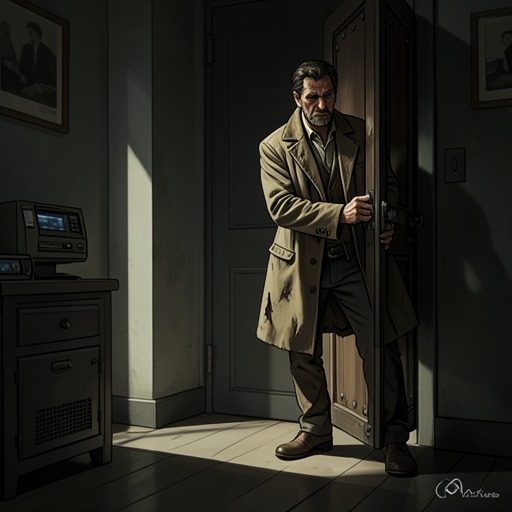
Karl Matter
Berlin AlexanderplatzKarl Matter is a tinsmith whose practical skills and criminal connections place him between Reinhold and Mieze in the events leading to her murder. Known to the police by the name Oskar Fischer, he first helps arrange a trip that becomes a trap; afterward, he assists in hiding Mieze’s body. The later return of this episode in Matter’s thoughts reveals a change in how he understands his participation: the man who helped Reinhold now condemns him, while recognizing that he himself helped conceal the crime.
Identity and Position
Matter is identified as a tinsmith, and the account notes that the police know him as Oskar Fischer. He is associated with Pums’s criminal circle, though the evidence does not describe his exact standing within it. His trade and his criminal associations meet in his own account of a patented invention: he says a former employer appropriated his work, and that he remains with Pums while developing a new model. The claim is part of his conversation with Mieze, not independently confirmed fact; it nevertheless presents him as someone who sees himself as both a skilled inventor and a worker cheated by a firm.
His position in the plot is similarly divided. He is a means by which Reinhold can approach Mieze without asking Franz Biberkopf directly, and he later becomes Reinhold’s accomplice in concealing her death. Yet Matter is not simply a silent instrument. The narrative gives him private grievances and, later, a sustained recognition of Reinhold’s responsibility and of his own involvement.
The Arrangement with Reinhold
Reinhold approaches Matter with questions about Sonja. Matter answers, and the exchange establishes that the woman belongs to Franz Biberkopf, not to Matter. Because Reinhold says he cannot approach Franz, he asks Matter to help secure the woman for a trip to Freienwalde. Matter initially resists the idea of handing her over, then agrees after Reinhold makes clear that it is to be a single outing and offers him ten marks. The bargain makes the trip possible through a personal connection rather than through a direct request to Franz.
Three days later, Matter arrives by car with Mieze, who has accepted the invitation. Her reason is to discover why Franz has been so low; she is concerned that he will not explain what is troubling him. Matter is therefore not merely transporting her. His familiarity with her and his invitation help give the journey an ordinary, reassuring appearance, even as Reinhold has already planned to get her alone. The difference between Mieze’s purpose and Reinhold’s intention gives the outing its tragic tension.
The Journey to Freienwalde
The party leaves the car in front of an inn in Freienwalde. Matter goes walking through the town with Mieze while Reinhold stays behind to sleep. The account gives the date and hour precisely: it is Saturday, September 1, at four in the afternoon. After six, Reinhold comes out of the inn, attends to the car, has a drink, and leaves. The separation of the men from Mieze during the walk helps establish the sequence of the afternoon without suggesting that Matter knows Reinhold’s plan.
In the woods, Mieze is happy in Matter’s company. He tells her about his alleged invention and about the firm that, in his account, took his earlier work and profited from it. He says his new model could change systems including trams, fire services, and rubbish disposal, but that he cannot disclose its details. He and Mieze also recall their earlier car journey after a masked ball. The conversation gives the outing the quality of a companionable excursion, while the contrast between that ease and Reinhold’s concealed purpose sharpens the danger surrounding it.
Complicity and Concealment
After Mieze has been killed, Matter is present when Reinhold returns to deal with her body. Reinhold leaves a handkerchief on a tree as a marker and goes to fetch Matter; about an hour later they return together with torches and spades from the car. They bury the body and cover the site. The account makes Matter’s role unmistakable: he is not shown as the killer, but he takes part in concealing the death and helping Reinhold leave no obvious trace.
Reinhold gives Matter a valid passport and money, tells him to go into hiding until the commotion passes, and directs him to Pums’s address. He also assures Matter that he has an alibi and that no one has seen him. These instructions place Matter within Reinhold’s effort to protect himself and his associate after the killing. Matter’s complicity is practical and consequential: he helps hide the body and accepts the means to disappear, rather than going to the authorities in the scene provided.
Remorse and Later Appearance
Later, Matter thinks through the losses and humiliations he associates with Reinhold. He recalls having had a business, his wife’s absence, and the way Reinhold took Mieze away from him. He describes her as having gone with him to a party and remembers the journey along the avenue; he then accuses Reinhold of killing her because she would not have him. Most tellingly, Matter acknowledges that he helped carry her and says he would have taken the blame for Reinhold. His anger therefore does not erase his own responsibility. The change is not a witnessed confession or a report to the police, but a shift in his private judgment: he now calls Reinhold a murderer and regards his own loyalty as foolish.
Matter next appears at the Alexanderquelle pub, opposite Tietz’s department store, looking for someone he can talk to. He sits near two boys from a reformatory and another young man, a wheelwright by trade who draws in a notebook. Matter notices the man’s skill, then goes to the bar. Police enter the pub and question the young men; the passage does not show Matter informing on Reinhold or otherwise taking action in the case. His presence there extends the portrait of a man seeking contact after the Freienwalde events, but leaves what he intends to say unresolved.
Narrative Role
Matter’s significance lies in the gap between what he does and what he later understands. His consent to Reinhold’s arrangement, his presence during the burial, and his acceptance of a passport and money make him an accomplice in concealment. His later thoughts expose the emotional cost of that complicity without turning remorse into redemption: he condemns Reinhold, but also remembers that he helped him. The episode’s precise timetable, from the afternoon walk to the return in darkness, contrasts an apparently ordinary outing with the concealed violence that follows. Matter stands at that boundary—as Mieze’s companion, Reinhold’s intermediary, and a participant who comes to recognize the crime while still bearing part of its burden.