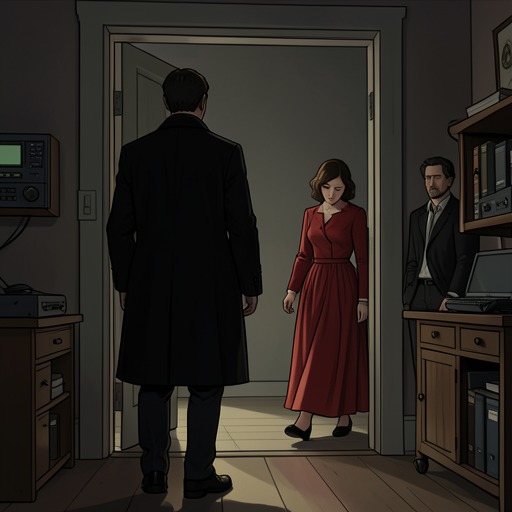
Karl the tinsmith
Berlin AlexanderplatzKarl the tinsmith moves between insecure work, burglary, and the criminal circle around Reinhold. His attempt to resist being coerced into Reinhold’s gang brings him into conflict with the men who need his skills; arrest then turns that conflict into a chain of accusations and disclosures. His later part in the investigation of Mieze’s murder, and his testimony at trial, expose both his entanglement in the crime and his complicated attachment to Franz Biberkopf and Reinhold.
Identity and precarious work
Karl the tinsmith is also called Karl the tinner and, at the trial, Matter the tinsmith, alias Oskar Fischer. The narrative introduces him in conversation with a wheelwright who has no steady work and is afraid of being turned out by his landlady. The two men recognize a connection through the Schönhauser district bowling club and learn that they had been in Brandenburg Prison together. That shared history opens the way to a loan of five marks and, almost immediately, to talk of doing business.
Neither man’s trade offers a secure living. The wheelwright admits that he takes whatever work he can get, while Karl the tinsmith says that he has also worked as a locksmith and got little from the job. The episode places their criminal activity against immediate economic pressures: the wheelwright needs money to keep his lodging and refuses the prospect of the St. Augustine hostel. The men are not presented as having a stable trade or income to fall back on.
Entry into burglary and conflict with Reinhold
The wheelwright, Karl the tinsmith, and another man from the bowling club form an independent group to carry out jobs. Contacts from the club pass on information about possible targets; the group first steals motorcycles so that it can travel farther and look for opportunities beyond Berlin. The work turns a loose network of acquaintances into a mobile burglary operation.
Reinhold later approaches Karl the tinsmith in a pub on Prenzlauer Street and insists that he join a gang that needs a fitter. Karl refuses to be bullied and says that his affairs are none of their business. Reinhold makes the demand harder to evade by insisting that Karl must either join or return money made with the gang; when Karl says he no longer has the money, Reinhold threatens him. Karl rejects the pressure, while Reinhold leaves the demand unresolved.
The confrontation is not only personal. Reinhold has orders from two fences and has managed to sideline Pums, making the timing useful for his own plans. The other gang members agree that Karl should be pressured because they need a tinsmith and regard him as a cheat who may be expelled from their club. Reinhold’s effort to recruit Karl is therefore part of a contest over skills, money, and control within the criminal organization.
Arrest and false accusation
Karl the tinsmith seeks out Franz Biberkopf, spends time at his flat, and hopes Franz will either let something slip or stand up for him. Franz instead blames Karl for having left the group exposed during the Stralauer Street burglary and refuses to accept his account of Reinhold. Franz calls Reinhold all right and warns Karl that things are going badly for him. The exchange leaves Karl without the support he had sought and shows how far Franz’s trust in Reinhold has taken him from Karl’s warning.
Two days later, a burglary in Friedenstrasse ends with Karl the tinsmith and the wheelwright arrested; their lookout escapes. At the station, the police connect Karl to the earlier Elsasser Strasse break-in through fingerprints on cups. Karl concludes that Reinhold informed on him out of spite for refusing to join. He secretly tells the wheelwright that Reinhold was involved in the burglary, then repeats the accusation to the examining magistrate. The claim is false: Reinhold is arrested that afternoon, but the magistrate establishes two days later that Reinhold’s alibi is true and that he had nothing to do with that job.
The mistaken accusation does not end Karl’s suspicion of Reinhold. Lying awake in prison, he recognizes that he may have made a grave error by trying to inform on him, while continuing to regard Reinhold as dangerous and blaming him for leaving others to take the consequences. His resentment and fear persist together; the narrative does not reduce his reversal to a settled judgment.
The journey to Freienwalde
Later, Karl the tinsmith gives the examining magistrate precise details, prompting the magistrate and two detectives to travel with him to Freienwalde. Karl is brought along with his hands tied. During the drive he thinks of Mieze and of Reinhold’s capacity to leave others to suffer, then the party reaches the forest. The sequence links Karl’s knowledge to the investigation’s movement toward the place where Mieze was killed, without making his earlier, false claim about the burglary true.
At the subsequent trial, Karl the tinsmith is identified as Matter, also known as Oskar Fischer, and is charged with connivance in the murder of Emilie Parsunke, known as Mieze. Reinhold faces the murder charge. The case is dated to September 1, 1928, and places the killing in Freienwalde near Berlin. Franz Biberkopf is not indicted. Public attention fixes on the one-armed man whose sweetheart has been murdered and who had been suspected of complicity; reports of his mental illness after her death contrast with the experts’ conclusion that he has recovered and is fit to be questioned.
Testimony and divided loyalties
In court, Karl the tinsmith says that Mieze was not having an affair with Reinhold and describes himself and Reinhold as good friends. He attributes the murder to Reinhold’s extreme compulsion around women, while making clear that he does not know whether Reinhold had sadistic tendencies. Karl suspects that Mieze resisted Reinhold in Freienwalde and that Reinhold killed her in a fit of rage. He cannot supply information about Reinhold’s youth and knows little about the extent of Reinhold’s drinking.
Karl then refuses to say more about Reinhold. His silence covers the history of Reinhold’s relationship with Franz Biberkopf, the conflict between the two men, and their fight. In the courtroom, Karl and Reinhold stare at one another. Karl shows no pity for Reinhold in the dock, yet the narrative registers a strange affection and the force of a bond that has survived betrayal and violence. His testimony gives the court his suspicion about Mieze’s death, but his silence leaves important parts of his knowledge and of his connection to Reinhold undisclosed. The evidence does not state the trial’s verdict, so Karl’s final legal outcome remains unresolved in this account.