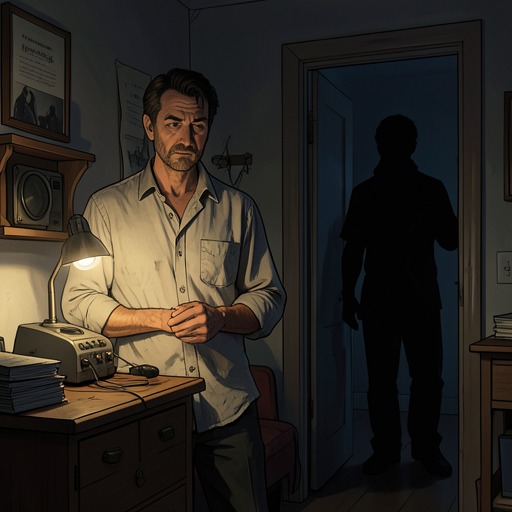
Lüders betrays Franz
Berlin AlexanderplatzLüders betrays Franz by using the details of Franz’s successful sale to a widow to return to her home, take the goods, and extort money and other belongings. The episode reverses the meaning of Franz’s small commercial success: what he presents as honest work becomes, in Lüders’s hands, an opening for coercion. Franz learns that the parcel is gone only after the theft has taken place; his shock, and Lüders’s quick retreat when he sees him, make the breach between the two men visible before either explains it.
Disclosure and opportunity
The betrayal begins with a boast. At a meal, Franz opens his fist to show Lüders the money he has made in a short time, insisting that it came through fair dealing rather than theft. He recounts ringing a widow’s bell to sell shoelaces, being invited in for coffee, and making a sale worth twenty marks. He also tells Lüders that he left his stock at her house and gives enough detail to locate her near Elsasser Strasse. The exchange is casual and companionable: the men eat and drink together, and Lüders receives a share of the money. But Franz’s confidence has supplied Lüders with both a destination and a pretext for returning.
Franz’s account mixes practical sales details with the private circumstances of the visit. He mentions the widow, the coffee, and the goods left behind, treating the encounter as an unusually profitable piece of street trading. Lüders listens closely. The next morning he watches for Franz, then goes to the address on his own. The contrast establishes the betrayal’s cause without requiring a separate confession: what Franz has disclosed as part of friendly conversation is converted into a plan to exploit the woman and dispossess her.
Lüders returns to the widow
At the widow’s door, Lüders presents himself as a shoelace seller and then claims he has come to collect the stock Franz left there. When she tries to shut the door, he wedges his foot into it and presses his way inside. He asks for the parcel, which she fetches, and thereby secures the goods Franz had left in her care. His stated purpose is collection, but he does not leave after receiving them.
Instead, Lüders prolongs his stay with requests and talk. He asks for coffee, comments on the warmth of the room, and questions the widow about her husband and children. She says she is busy and asks him to go. He notices her fear and imagines that the familiarity of the visit may give him an advantage, while his own nervous thoughts repeatedly return to the possibility of being discovered. The scene holds together his outward performance of ease and his private apprehension: he takes off his hat, drinks, and keeps the conversation going even as he listens for sounds in the building.
At the door, after taking the parcel under his arm and appearing to depart, Lüders turns back and demands money. He uses the widow’s visit from Franz to shame and intimidate her, implying that her prior hospitality gives him knowledge with which to threaten her. She holds out coins from her purse, then empties the purse into his hand. Lüders continues searching the home, taking the embroidered tablecloth and two cushions and opening drawers in the kitchen. The widow is unable to speak and eventually collapses as he leaves. The theft is thus not limited to the goods Franz had left: Lüders takes money and household items as well, turning a false collection into an extended act of intimidation and robbery.
Discovery and rupture
The following day, Franz receives a letter from the widow. In conversation with the landlord, he asks whether anything else has been delivered and learns that a boy collected the parcel the previous night. Franz’s response is not an immediate confrontation. He sits by the window holding the letter limply, his mouth tightened, staring across the table. The simple information that the stock has been fetched changes the meaning of Lüders’s absence and of the earlier visit: the parcel is no longer where Franz left it, and Lüders has been to the house.
Lüders enters, sees Franz sitting there, and immediately turns around and leaves. The movement supplies a second, unmistakable sign of the breach. Franz does not pursue him or call him back. The landlord wonders why Lüders has run off, while Franz remains seated and struggles to take in what has happened. He drinks brandy, then broods over the letter, unable to make sense of it; the narration describes him growing pale and heavy, his head falling forward as if he were asleep. His stillness contrasts with Lüders’s hurried escape and marks the immediate consequence of the betrayal as shock rather than retaliation.
Narrative form and significance
The episode is built around a delayed recognition. First comes Franz’s cheerful account of the sale; then the narration follows Lüders to the widow’s door and through the theft; only afterward does Franz receive the information that connects the missing parcel to Lüders. The reader sees the betrayal unfold before Franz fully understands it. That sequence makes the gap between confidence and knowledge central to the event: Franz’s openness is not merely misplaced in retrospect but becomes the practical means by which Lüders can reach the widow.
The account also shifts closely between outward action and the men’s private thoughts. Lüders’s polite requests and his pressure on the widow are set beside his anxious attention to the stairs and his fear of being caught. Franz’s later confusion is rendered through his arrested posture, repeated brooding, and inability to respond to the landlord. These changes in focus keep the episode from treating the theft as a bare transfer of property. The parcel, purse, tablecloth, and cushions register the material damage, while Franz’s failure to rise or confront Lüders registers the personal wound. The betrayal ends in an abrupt separation: Lüders withdraws, and Franz is left holding the letter without yet finding words or action for what it has revealed.