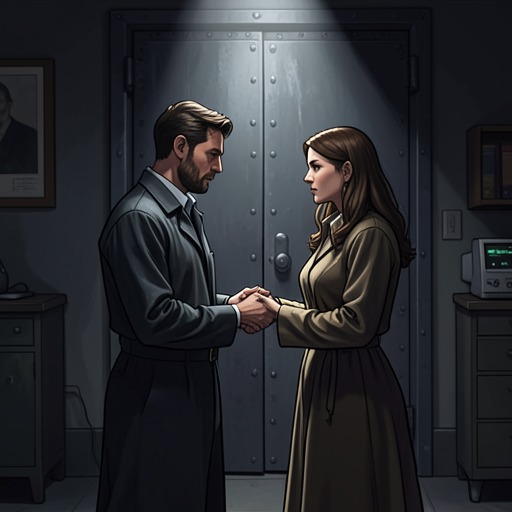
Letter to Mieze
Berlin AlexanderplatzThe Letter to Mieze is a misdelivered letter whose apparent promise of a secret affair unsettles Franz Biberkopf just as he is enjoying signs of Mieze’s care for him. Its importance lies less in what it proves than in what Franz fears it proves: discovered beside gifts she has left for him, it makes her hidden effort to earn money look like betrayal. Eva’s intervention and Mieze’s eventual dismissal of the letter redirect the episode from suspicion toward understanding.
The letter and its delivery
A few days after Mieze has gone to Aschinger’s, Franz comes home at lunchtime to an empty, tidy sitting room. A box of fine cigars and two bottles of Allasch kümmel have been left for him, with a note from Mieze. He is pleased by the gifts and by the care they imply. The letter arrives into this domestic scene as an apparent complication to that happiness: Franz goes to the passage, finds no postman, and takes the item from the mailbox himself.
The mail is layered and confusing. An open envelope contains a sealed letter, accompanied by a note saying it was delivered to the wrong address. That note is written in disguised handwriting, and the name on it cannot be made out. The enclosed letter is addressed to Sonja Parsunke, care of Mr. Franz Räcker. Its intimate salutation and a request for a reply suggest that a man is pursuing its recipient. The wording gives Franz enough to fear, but the letter’s route and address do not establish the whole story. The distinction between what the document says and what Franz concludes becomes the episode’s central tension.
Suspicion and mediation
The letter’s force comes from its timing. The cigars, schnapps, and canary cage are still before Franz when he reads it, so tokens of Mieze’s consideration become part of the scene of his alarm. He cannot continue reading. Instead, pale and shaken, he takes the letter to Herbert Wischow. The discovery has changed the meaning of the gifts for him: what had seemed an affectionate surprise now raises the possibility that Mieze has another attachment.
Eva becomes the letter’s first interpreter. After speaking with Herbert Wischow, she approaches Franz and insists on seeing the document. She then goes to Aschinger’s to speak with Mieze, leaving Franz to wait for her explanation. Her account overturns his first reading. Mieze, she says, was still waiting there and showed no distress when presented with the letter. She was more concerned with whether Franz liked the schnapps and the canary. Eva reports that Mieze does not regard a man writing to her as proof of cheating; one of the men who becomes attached to her may write, without that correspondence meaning what Franz imagines.
Eva also explains the economic circumstance Franz has not understood. Mieze wants to earn money rather than be kept by him, particularly because his damaged arm limits what he can do. She has concealed her work because she does not want him to wear himself out trying to provide for her. The letter therefore sits within a larger misunderstanding: Franz has interpreted Mieze’s independent effort as romantic disloyalty, while she has kept that effort from him out of concern. The letter itself cannot explain this arrangement. Eva’s conversation with Mieze supplies the context that Franz’s solitary reading lacked.
Mieze’s answer and the letter’s aftermath
Once Eva has explained, Franz declines to turn his renewed closeness with her into a return to their former relationship. He tells her to remain with Herbert Wischow, whom he considers a good man and in need of her. Eva sends him back to Mieze, warning that she may not come home if he does not want her. The letter has thus prompted a choice: Franz must decide whether to act on his suspicion or approach Mieze again.
He first sees her outside Aschinger’s on Alexanderplatz and follows at a distance rather than immediately speaking to her. He keeps the building-site fence between them for part of the way, watches her search, and waits for the moment to cross the road. A woman offers him flowers; he buys a bunch but still does not close the distance at once. The delayed approach gives the letter’s emotional effect a physical shape: Franz has received an explanation, yet must still take the steps that make reconciliation possible.
When they are together again, Mieze shows him the letter. She crumples it and throws it away, telling him that he had become worked up over nonsense and that she could produce a whole parcel of similar letters. The gesture does not identify the sender or explain every detail of the letter’s delivery. It does, however, make clear how little authority she grants this one document over their relationship. In the following days Franz is calmer, less invested in his shady business dealings, and often visits Herbert Wischow and Eva with Mieze. The letter’s immediate consequence is not a separation but a clarification of the arrangement Mieze had hidden from him.
Narrative significance
The object works as a misleading fragment rather than a complete account. Its address, concealed delivery note, and intimate opening invite Franz to assemble a story of infidelity before he knows why Mieze is earning money or how she understands the men who write to her. The episode does not make the letter meaningless: it exposes the gap between Franz’s assumptions and Mieze’s circumstances. But it shows that a written message, detached from its social context, cannot settle the question Franz brings to it.
Its passage through several hands also structures the revelation. Franz discovers and reads it alone; Herbert Wischow receives it as evidence of Franz’s distress; Eva carries it to Mieze and returns with an account; finally, Mieze herself disposes of it. The letter moves from private suspicion to shared interpretation, and its authority diminishes as the people implicated speak for themselves. That movement makes the object a hinge between misreading and renewed intimacy, while keeping the focus on the practical motive Franz had failed to see: Mieze wants to contribute to his support without making him feel obliged to destroy himself through work.