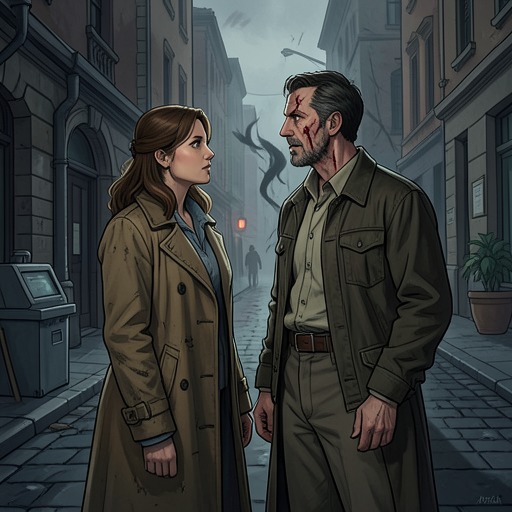
Mieze’s murder
Berlin AlexanderplatzMieze’s murder is the point at which Reinhold’s concealed violence becomes explicit: he kills Mieze in a forest hollow, reveals his role in the loss of Franz Biberkopf’s arm, and then organizes the concealment of her body. The scene makes the private threat against Mieze inseparable from the earlier attack on Franz, while its recurring language of seasons sets the killing within a grim, impersonal rhythm of violence.
The Encounter in the Hollow
Mieze is with Reinhold in the woods, but she does not want to remain with him. She tries to get away and calls for Franz. Reinhold catches her before she can escape and takes her back to the hollow. He alternates assurances that he will not force her with commands that she return and obey him. The contradiction is central to the scene: his claim to restraint does not change the fact that he controls her movements and refuses to let her leave.
The surrounding exchange establishes that Mieze is Franz’s companion and that Reinhold uses this relationship to demean and pressure her. She resists being treated as Reinhold’s possession, yet he insists on defining her through Franz and on deciding what she may do. The encounter therefore begins not as an equal meeting but as an attempt by Mieze to withdraw from a man whose threats and physical control make refusal dangerous.
Reinhold’s Account of Franz’s Arm
As he brings Mieze back, Reinhold recounts an earlier episode involving Franz and the criminal group Reinhold worked with. Franz had objected to working with them and presented himself as respectable; Reinhold says that he nevertheless made Franz go along in a car. He then describes forcing Franz out when another car appeared, ending with the fact that Franz lost his arm in that incident.
This account changes the meaning of Franz’s disability. It is not merely a misfortune in his past: Reinhold directly connects it to his own actions and to the group’s criminal work. The revelation comes while Mieze is trapped with the man responsible, and she recognizes him as a murderer. Her alarm is thus directed both at the immediate danger to herself and at Reinhold’s proven capacity for violence against Franz. The disclosure links the two attacks without suggesting that Mieze has any power to intervene in what happened to Franz.
The Killing and Its Seasonal Frame
Reinhold tells Mieze that he wants to deceive Franz and leave him with a lasting consequence. Mieze continues to resist and calls for Franz. Reinhold then kills her in the hollow. The narration marks the act through the repeated language of seasons: birth and death, breaking down and building up, and other opposed states recur as the violence unfolds. Rather than making the killing seem like an isolated outburst, this pattern gives it the weight of a recurring cycle whose language sounds larger and more inexorable than the people caught within it.
The scene also places the human act beside the routine of slaughtering an animal. That comparison is not an account of Mieze as less than human; it is part of the passage’s disturbing presentation of how Reinhold treats a person as something he can subdue, kill, and dispose of. The contrast between the calendar-like cadence and the specific struggle sharpens the horror: the language moves in repetitions, while Mieze’s attempt to escape and call for help remains particular and desperate.
Concealment and Consequences
After the murder, Reinhold leaves Mieze’s body beneath branches and marks the place with a handkerchief so he can find it again. He returns with Karl, and the two search the dark woods with torches. They bring spades from the car, bury the body, cover the place with sand and branches, and try to remove signs of their passage. The killing is followed not by confession or discovery but by practical efforts to hide both the body and the evidence of the men’s presence.
Reinhold then gives Karl a valid passport and money, telling him to go into hiding while the commotion dies down. He directs Karl to Pums’s address and says that Karl will have an alibi. This arrangement shows that the aftermath extends beyond the burial: Reinhold distributes resources and instructions to protect the accomplice and reduce the chance of exposure. The sequence closes on concealment in progress, leaving the murder’s discovery and its consequences for Franz outside this scene.
Narrative Significance
The episode joins three strands of violence: Mieze’s murder, the earlier attack that cost Franz his arm, and the criminal group’s continuing methods of coercion and evasion. Reinhold’s account makes him the connecting agent between the first two, while Karl’s assistance in burying Mieze shows that the killing is followed by cooperation rather than immediate resistance. The reference to Pums’s address further places the concealment within an existing criminal network.
The seasonal refrain gives the scene a formal counterpoint to its sequence of pursuit, killing, and burial. Its repeated oppositions—life and death, destruction and repair—do not undo the murder or soften Reinhold’s responsibility. Instead, they make the event feel like a terrible repetition within the book’s larger pattern of blows and reversals. Mieze’s calls for Franz remain present against that pattern: the event is at once a calculated crime carried out by Reinhold and the destruction of a relationship whose other half is absent from the hollow.