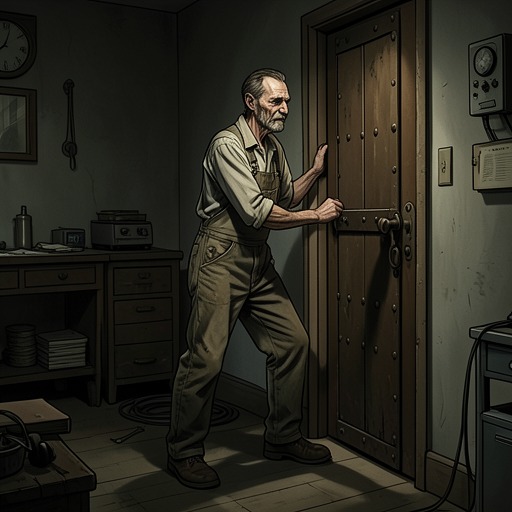
Nachum
Berlin AlexanderplatzNachum is the red-bearded Jewish storyteller who meets Franz Biberkopf during the ex-prisoner’s first bewildered hours back in Berlin. He responds to Franz’s distress not with force or interrogation but with patient company and stories. His account of Stefan Zannovich offers a model of a life shaped by risk and consequence; a later parable about a ball gives Franz a gentler warning that events may travel beyond anyone’s intentions.
Identity and First Encounter
Nachum first appears as a stranger who notices Franz groaning in a courtyard entrance. A small man in an overcoat and black velveteen hat, with a stick in his hand, he asks whether Franz is unwell or in pain. Franz tries to leave the entrance and escape the street, but Nachum encounters him again inside another building. His questions follow the sound of Franz’s groaning; they are an attempt to find out what is wrong, not a demand that Franz disclose it.
The exchange establishes a sharp contrast between Franz’s need to withdraw and Nachum’s effort to make contact. Franz is newly released and overwhelmed by the streets and crowds, while Nachum offers the simple reassurance that Berlin is large enough for another person. When Franz insists that he does not live there, Nachum does not treat his confusion as a reason to turn him away. His presence gives the scene a human counterweight to the city that Franz experiences as noise, movement, and pressure.
Companionship Through Story
In the room, Franz sinks from the sofa to the carpet and refuses to be pulled upright. He clutches the carpet and moans that he wants to go into the earth, away from the world above. Nachum first tries to coax him up, then changes course: unable to lift him, he closes the door and sits down beside him on the floor. He accepts Franz’s silence and allows him to keep groaning while he speaks.
Nachum’s response is distinctive because he does not make assistance conditional on an explanation. He tells Franz that people should listen to others and invokes Noah’s ark as an image of a world in which every kind of living creature, even the lice on a person’s head, has not been forgotten. The story redirects attention away from Franz’s isolation without denying it. Nachum then explains why stories matter to him: his late father told them to his seven hungry children when there was nothing to eat. Stories could not fill their stomachs, but they could make them forget their hunger. For Nachum, telling a story is practical care, offered in circumstances where material comfort alone is not available.
The Story of Stefan Zannovich
Nachum tells Franz about Stefan Zannovich, whose father came from Albania and went to Venice. The elder Zannovich first sold what he had brought with him, then made money by playing cards with townspeople who wanted entertainment and had little time. Nachum describes him as dishonest but clever: he understood how to turn the city’s appetite for diversion into profit. His success ended when someone believed he had been cheated. The dispute led to blows and police involvement, and the family had to leave Venice before its law could catch up with them.
The story does not make Zannovich’s conduct respectable. He is a cheat, and his departure follows a confrontation with the law. Yet Nachum also recounts his later return to Albania, where he acquired an estate and a village, sent his children to college, and eventually died peacefully as a respected old man. The peasants mourned him, although he had never been able to forget the hard life he had known among them. By holding deception, flight, success, and respectability together in one life, Nachum gives Franz a story more complicated than a simple lesson in virtue or punishment.
The Ball and Its Course
Four weeks later, Franz visits the Jews in Dragonerstrasse to thank them. He has spent the intervening weeks eating meat and potatoes and drinking beer, and now appears transformed. When Nachum and Eliser argue, Franz recognizes their familiar quarrelling and asks after the grandchildren who had been ill. Their conversation turns to work, money, and what Franz might do next; he recalls Zannovich with admiration, while speaking of marriage as a possible future.
Nachum answers with another story. A man throws a transparent celluloid ball containing small lead balls, believing that its weight will make it stop exactly where he intends. Instead, it bounces and rolls to one side. Nachum applies the image to Franz: a person can influence the direction of events, but cannot determine precisely where they will land. He urges him to proceed peacefully and patiently, since he cannot know what is within him or what God’s purpose may be. The story does not tell Franz that he has no agency; it distinguishes intention from control.
Narrative Role and Significance
Franz laughs, embraces Nachum, and treats the storyteller’s words as recognition that life has put him through much. Nachum, for his part, recalls that Franz sang sadly when he first saw him in the street. Franz insists that the sadness belongs to the past and imagines his fortune rising. The difference between Nachum’s caution and Franz’s confidence leaves the parable open: the ball’s unpredictable extra bounce may be a warning, but Franz hears possibility in it as well.
Nachum’s role is brief but structurally important. He meets Franz at a point when ordinary explanation cannot reach him, and he answers despair with attention, inherited stories, and an image of limited human control. The narrator later identifies Franz as a man who has sworn to remain decent, adding that he does so as long as his money lasts. Against that ominous account of the vow’s fragility, Nachum’s stories provide no guarantee of rescue. They offer instead a humane way of understanding that a life, like the ball, may go farther and farther aside from the course its owner meant to set.