National Association of Itinerant Tradesmen in Germany
Berlin AlexanderplatzThe National Association of Itinerant Tradesmen in Germany is presented through a Berlin trade meeting where working sellers debate the conditions of their livelihood and Franz Biberkopf joins the Berlin Regional Branch. The association offers him a certificate and the prospect of help earning a decent wage, but the scene leaves its practical benefits unproven: Franz’s membership is immediate, while his business, dues, and even the goods he will sell remain unsettled.
Identity and Public Purpose
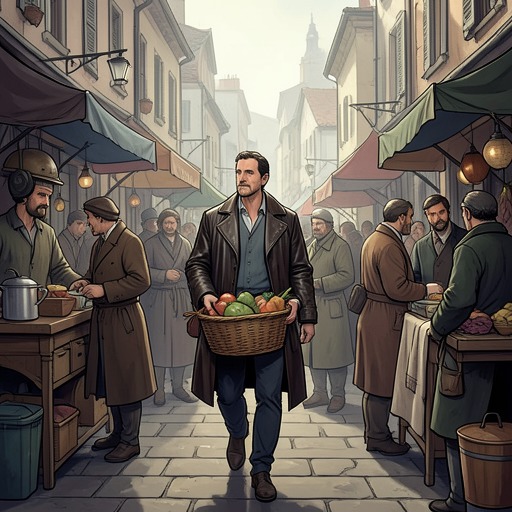
The association enters the narrative not through a formal account of its rules, but through a meeting organized around itinerant traders’ grievances. A speaker describes the Frankfurt (Oder) Trade Fair as badly situated, with particular attention to its pottery market. He argues that traders were moved from the Marktplatz to Magazinplatz shortly before the fair, on the stated grounds that the regular weekly market would be disrupted if both occupied the same space. In his account, the city’s decision disadvantages itinerant sellers while leaving the established market arrangements intact.
The speaker makes the issue collective rather than personal. He points to fruit sellers, grocers, and greengrocers as people who also suffer from the city council’s mistakes, and asks why the traders should bear the cost instead of the city providing a market hall. His case connects the location of a stall to the basic economics of keeping a small business going: in bad weather and mud, few customers came, takings were negligible, and some traders could not earn enough to cover the journey home with their trailers. Rail expenses, stall charges, attendance fees, and the movement of goods all press on the earnings that remain. The association’s public setting thus gives a voice to complaints about the terms on which independent sellers are allowed to work, without demonstrating that the organization has already remedied them.
Franz Biberkopf Joins the Berlin Branch
Franz attends the gathering with his friend Gottlieb Meck. Before the meeting, Gottlieb Meck advises him against both unemployment relief and factory work, and also dismisses digging work as too cold; trading, in Berlin or elsewhere, is his proposed route to a living. The meeting offers Franz a concrete opening. After listening to the speaker’s complaint about the fair, Franz approaches him, praises the argument, and presents himself as someone who shares the grievance. The speaker asks whether Franz belongs to the union. When Franz says that he does not, he is invited to join at once.
Franz sits at the committee’s table among red-faced men, drinks with them, exchanges greetings, receives a certificate, and promises to pay his dues by the first of the following month. He then shows the document to Gottlieb Meck, delighted that it identifies him as a member of the Berlin Regional Branch of the National Association of Itinerant Tradesmen in Germany. The speed of the transaction is striking: a brief expression of agreement at the meeting becomes formal membership, even though Franz has not yet established what he will sell or paid the dues he has promised.
The Certificate and the Uncertain Trade
The certificate records Franz as a dealer in textiles, a description he disputes. He says that he had named stockings and pinafores, but that the registration was entered as textiles; he accepts the discrepancy for the moment and reiterates that payment is not due until the first. Gottlieb Meck immediately turns the paperwork into a practical joke, asking what Franz’s textiles are and imagining him trading in other goods, from china plates and kitchen pails to cattle or small household pets. Franz has gained an official description before he has settled on a definite line of business.
The cattle dealers’ laughter makes the gap between the certificate and commercial experience public. One proposes that Franz test his prospects at a market in Meiningen, picturing him with his certificate at a stall while another seller calls out competing wares nearby. The joke is not evidence that the association itself is fraudulent; it shows instead that membership alone cannot guarantee customers, suitable goods, or income. The certificate makes Franz legible as a member, but the scene leaves open whether it can protect him from competition or the ordinary costs of trading.
Membership, Advice, and the Limits of Help
The association’s representative presents membership as more than a name on paper: he says that the union helps its members earn a decent wage. Franz, in turn, describes learning from clever people who talked to him and taught him, and stresses common sense and attention to what is happening around him rather than faith in money, brandy, or a few pence in dues. The exchange associates the organization with practical knowledge and mutual belonging, but it does not show a specific service being delivered to Franz or establish how the association’s assistance works.
The scene holds that promise beside both Meck’s friendly guidance and the traders’ mockery. The traders’ earlier account of meagre takings, travel costs, and a badly placed market has already shown how precarious a small seller’s livelihood can be; the later teasing tests Franz’s new confidence against that economic uncertainty. His handshake and certificate mark a real change in status, while his postponed dues and uncertain merchandise keep the change provisional. The association therefore appears as a setting where itinerant traders articulate shared grievances and where a newcomer can enter a professional community, but not as a guarantee that collective membership will produce a secure living.