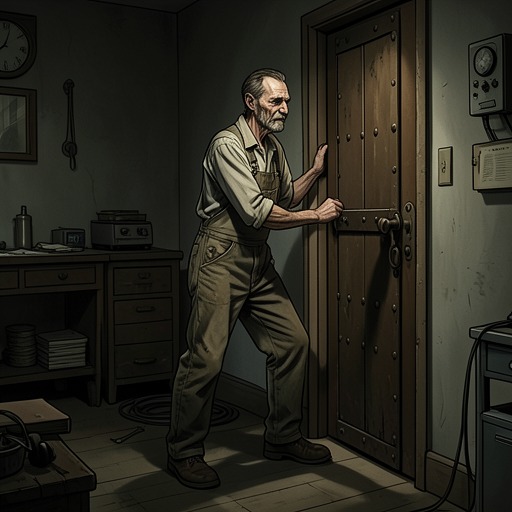
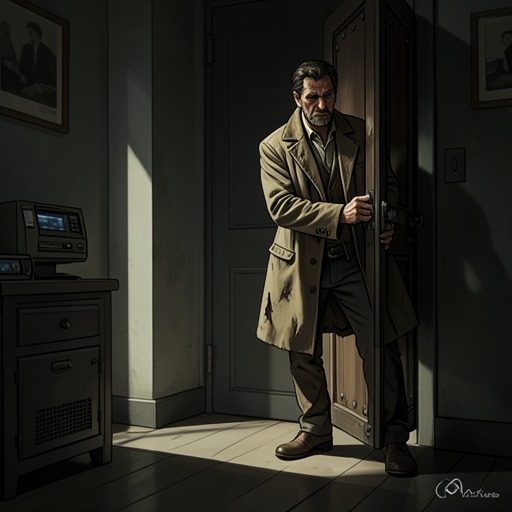
Otto Lüders
Berlin AlexanderplatzOtto Lüders begins as Franz Biberkopf’s fellow street seller: a long-unemployed man trying to get by who turns a confidence about a widow into an opportunity for theft. His betrayal is not a single concealed act but a chain of calculated intrusions, evasions, and failed attempts to manage the consequences; it helps drive Franz into hiding and leaves Lüders exposed to Gottlieb Meck’s violence and Franz’s cold refusal.
Identity and Circumstances
Lüders has been unemployed for two years, and his wife supports the household by taking in washing. They have children. The account gives him a history of precarious, improvised work: during part of one summer, he dressed in a tasselled costume as Mr. Peppermint Man in Rüdersdorf. When Christmas comes round, he joins Franz in selling inexpensive goods and shoelaces. These details make his material insecurity concrete, without making it an excuse for what he does to the widow.
Lina brings Lüders into Franz’s orbit as her uncle. At first, he is Franz’s working partner: the two go from street to street and into houses, ringing doorbells and meeting again afterward. Their trade depends on direct approaches to customers and the hope of small sales. Lüders’s old clothes, still the same outfit from the war, and his anxious reflections on work and health suggest how little security this livelihood offers. He thinks that the doctor finds nothing, though he feels something must be wrong with him; the narrative presents this as his own unease, not as a diagnosis.
Partnership and the Widow
Franz’s early success makes the partnership seem, briefly, like a way forward. In a pub, Franz is buoyant enough to eat Lina’s sandwiches and order pigs’ ears and peas for the three of them. He squeezes Lina until she turns red and leaves; after she is gone, he tells Lüders about making twenty marks in fifteen to twenty minutes. He insists that the money came honestly. The explanation is that he sold shoelaces to a widow, drank coffee with her, and had sex with her, leaving his stock at her home. He tells Lüders where she lives, behind Elsasser Strasse, and asks whether she has noticed that the goods are missing.
Lüders receives five marks from Franz that evening, but the payment does not make him more cheerful. The next morning, rather than simply continue their rounds, he watches for Franz and goes to the widow’s address. He presents himself as a shoelace seller and then as a friend sent to collect Franz’s stock. The parcel gives him a pretext to enter, but once inside he prolongs his visit, asks for coffee, and questions the woman about her dead husband and children. When she tries to end the encounter, he uses her previous intimacy with Franz to shame and intimidate her, insisting that there can be no secrets between friends.
The visit becomes a robbery. Lüders holds out his hand for money, takes the coins and then the contents of the widow’s purse, and searches the home for other valuables. He seizes a red embroidered tablecloth and two cushions and rummages through the kitchen drawers. The woman is frightened and unable to speak; after Lüders leaves, she keels over. His careful departure—closing the door slowly and going down the stairs—contrasts with the violation he has just committed. The ordinary acts of selling, collecting a parcel, and asking for coffee have been turned into a cover for coercion.
Betrayal and Flight
Franz learns what has happened through the widow’s letter. After a day of sulking, he is told that a boy collected the stock the previous night. The news lands as a personal shock: Franz sits holding the letter, and when Lüders enters and sees him, Lüders immediately leaves again. Franz does not confront or pursue him in that moment. He sits still, stunned by what he understands, while the landlord notices that Lüders has gone without collecting his own stock.
Franz soon disappears from his room, having paid, packed his belongings, and left instructions for the landlady to mark him as travelling. Lina searches for help, and Meck eventually decides that Lüders may know where Franz has gone. Lüders first claims that Franz has dumped him and owes him money. Meck does not believe the account. When Meck and Lina later confront him in a pub, Lüders denies knowing what happened and laughs at Lina’s fear that Franz may be missing. His evasions protect him from admitting what he did, but they also deepen the uncertainty around Franz’s disappearance.
Confrontation and Rejection
Meck draws Lüders away from the pub under the appearance of a private conversation and beats him in a dark street. When Lüders is down, Meck presses a handkerchief over his mouth and threatens him with an open blade, ordering him to search for Franz. The next night, Lüders reports that he has found him. His account reveals that Franz is staying only a few houses from his old flat, in a room across the back of the building. Lüders enters carrying a few marks, with an open knife in his pocket, and shows Franz the injuries Meck has inflicted. He is angry about the beating and asks for some written proof that he has visited, or for Meck or Lina to come themselves.
Franz answers with a quiet command to leave. When Lüders persists, Franz crosses to the washstand, takes up the basin, and sweeps its water across the room at Lüders’s feet. He then throws the remaining water from a jug at the door, splashing Lüders across the throat and mouth as he escapes. The gesture turns water into a forceful boundary: Franz will neither accept Lüders’s explanation nor resume their association. After Lüders has gone, Franz throws jugful after jugful around the room, saying that everything must be clean and must go. The episode ends with Franz lying flat on the bed, while Lüders returns to Meck and calls him mad.
Narrative Role
Lüders’s arc connects Franz’s tentative street-trading partnership to the betrayal that precipitates Franz’s retreat. His own circumstances are established alongside the work they share, but the plot does not treat poverty as a moral absolution: his choice to use Franz’s confidence, force his way into a frightened woman’s home, and take her money and possessions remains his responsibility. The narration follows his fear and resentment closely—his pounding heart before the door, his concern about his clothes and health, and his anger at Meck—while also making the consequences of his actions visible in the widow’s collapse and Franz’s disappearance.
His last appearance with Franz reverses the earlier partnership. At the widow’s home, Lüders exploits the intimacy Franz disclosed; in the hidden room, he needs Franz to acknowledge his visit and help him answer to Meck. Instead, Franz drives him out with water. The betrayal therefore produces no lasting advantage or renewed alliance: Lüders is left carrying the injuries of Meck’s beating and the knowledge that Franz has rejected him.