Pums gang
Berlin AlexanderplatzThe Pums gang is a criminal organization operating behind the appearance of a street-trading business, and its recruitment of Franz Biberkopf turns his attempt to earn an honest living into a trap. Led by Pums and supported by accomplices, the gang coordinates burglary, protects its members through intimidation and concealment, and presents its violence as an occupational necessity. Its cohesion is real but conditional: the gang can close ranks around shared danger, yet rival interests and Reinhold’s threat to expose its operations keep that solidarity under strain.
Leadership and Criminal Business
Pums occupies the gang’s center as its boss and public recruiter. In a smoke-filled pub, his small, searching eyes move across the room while three apparent business associates gather around him. The scene makes the organization’s atmosphere legible before its work is fully disclosed: an enclosed world of accomplices, watchfulness, and business conducted in the language of opportunity. Gottlieb Meck explains that Pums needs more people to sell his goods, and Franz has heard that Pums tried to recruit him. The goods are said to be fruit, but even Meck advises against asking too many questions. The vague explanation is part of the operation’s cover, not a transparent account of legitimate trade.
Pums offers Franz charge of a fruit or vegetable barrow, supplying the goods and promising a large profit. The offer gives the gang a respectable surface and a route into Franz’s livelihood: it seems to concern selling produce, not burglary. Reinhold joins the gang at the same time. Franz hesitates, distrustful of Pums’s men and concerned that they will cheat him; he neither accepts outright nor refuses, and says he will return to discuss how the goods will be collected, how accounts will be settled, and which area he would cover. The proposal thus depends on a mixture of plausible work, attractive earnings, and details left deliberately unclear.
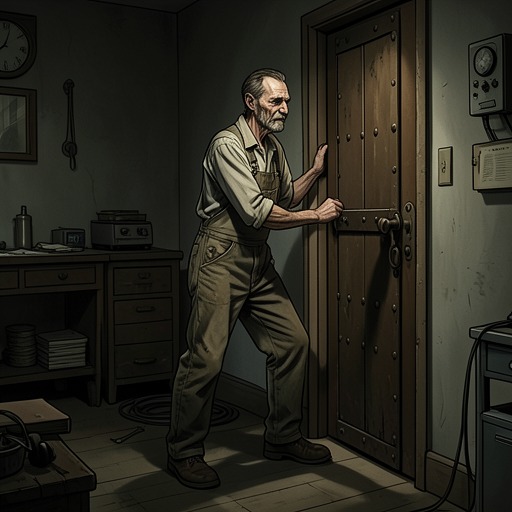
The gang also has an office, reinforcing its appearance of organized commerce. At a side wing on Alte Schönhauser Strasse, Franz waits with Pums in a room equipped with a telephone and typewriters. Pums’s wife, Clara, appears, and three men enter through a concealed door behind the wallpaper. The room’s ordinary office fittings and hidden entrance capture the organization’s double character: businesslike in its outward arrangements, secretive in its actual operations. Pums even arranges for Clara to deliver a postcard to Cilly, letting Franz believe that his personal errand can be accommodated within the new employment.
Franz’s Recruitment and the Burglary
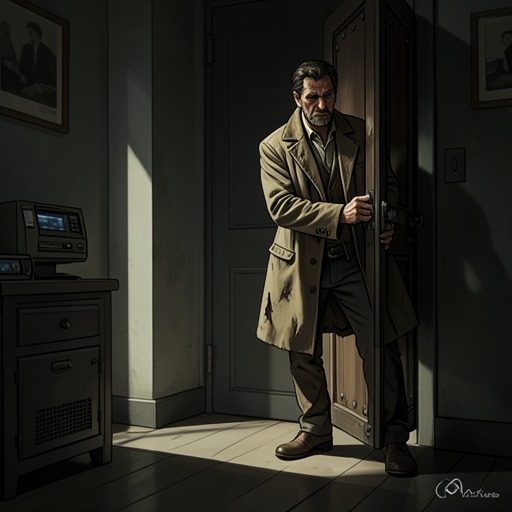
The distance between the gang’s sales pitch and its criminal work becomes unmistakable on the night Franz is taken out with the others. Two cars carry the party through Berlin; after a stop at Bülowplatz, the men proceed on foot in pairs. Near Kaiser-Wilhelm-Strasse and the S-Bahn station, the cars disappear from view, and Franz and a companion enter a dark passage. A man removes Franz’s cigar and leaves him behind. When Pums finds him with a torch, he orders him to the front of the building to keep watch, denying that Franz was meant to collect goods.
Franz has not been given an honest explanation of the operation or a meaningful choice about his role. The men are breaking in and stealing; what he thought was a produce business has revealed itself as organized burglary. Reinhold confronts him in the entrance hall and insists that he stand watch and whistle if anything happens. When Franz protests, Reinhold smashes his right arm so violently that Franz doubles over. The blow is both physical punishment and coercive discipline: it forces the bewildered recruit into the assigned position and makes clear that the gang’s authority rests on violence as well as persuasion.
Left alone at the entrance, Franz recognizes the gang’s structure and the danger of his situation. Pums is the boss; the others are stealing inside; Franz has been lured there and must keep lookout. He wants to leave, but after Reinhold’s blow he is transfixed and cannot move. The burglary is therefore not simply the first criminal job he undertakes: it is the moment when the gang’s hidden purpose, its hierarchy, and its capacity to immobilize a new member converge. His injury and entrapment expose the cost of accepting work whose terms have been concealed.
Cover Stories and the Gang’s Response
The gang’s interest in Franz does not end with the burglary. When he is found alive and receives care, his landlady reports that men from Pums’s gang and Reinhold have repeatedly asked after him. Eva, Herbert Wischow, and Emil connect the gang to what happened and react angrily that Franz had become involved with Pums’s people. Herbert and Emil settle the costs of his care, an arrangement that underscores how the consequences of the gang’s violence fall on those outside its circle.
The gang learns that Franz is staying with Herbert and considers him dangerous because he might inform on them. Members discuss the risk that the police could question people from Franz’s building, and they are angry at Reinhold for bringing Franz into the organization. Yet they are also afraid of Reinhold himself. His cold expression and threatening manner make even Pums reluctant to interfere with him. Reinhold dismisses the danger of Franz returning, while the organization remains uncertain whether the injured man might still expose it.
By the end of May, members meet in Berlin to discuss the story spreading about Franz’s injury. Herbert is said to be turning people against them, describing Franz as someone they forced into the gang and then threw from a car. The gang circulates a competing account: that Franz intended to betray them and that no one forced or struck him. Its members choose self-protection over openly challenging one another, since falling out with the organization could leave them without support and on the street. They nevertheless agree to collect money for Franz’s convalescence and hospital expenses, since, in their view, he ultimately behaved decently. The contribution is a limited gesture of goodwill, not an admission of responsibility: the cover story remains in place, and Reinhold refuses to contribute.
Internal Divisions and Exposure
The gang’s business depends on collaborators beyond its immediate circle. Reinhold has orders from two fences and has managed to sideline Pums in obtaining them. When the organization needs a tinsmith to serve as a fitter, Reinhold attempts to force Karl the tinsmith to join. Karl refuses to be bullied; Reinhold answers with threats of broken bones and starvation, then tells him to think it over. The gang’s demand shows how its labor needs become another occasion for coercion, while Karl’s refusal exposes a limit to its control.
The dispute also points to rivalry within the organization. Reinhold and the others discuss how to deal with Karl because they need a tinsmith and because Reinhold has the backing of the fences’ orders. They consider putting pressure on him and describe him as a cheat who might be expelled from the club. The gang’s unity therefore does not erase competition over work and authority: Reinhold can maneuver around Pums, while the group weighs whether to discipline a useful but resistant tradesman.
At Reinhold’s trial, members of the Pums gang sit in the public gallery alongside Eva and detectives. Reinhold considers exposing the whole organization if he is provoked, especially if Franz speaks against him, but reconsiders when he sees the gang present and thinks about relying on friends after release. His silence is not evidence that the gang is innocent; it is a choice shaped by continuing dependence and the expectation that its members may still matter to him. The organization remains a presence even as responsibility for the crimes is examined in court.
Narrative Significance
The Pums gang makes the boundary between legitimate work and criminal exploitation deliberately unstable. Its fruit-trading proposal offers Franz the language of wages and profit, while the concealed entrance, the nighttime burglary, and Reinhold’s blow reveal the coercive arrangement beneath it. The gang does not merely recruit a criminal; it captures someone trying to secure a livelihood by withholding information and then enforcing obedience with violence.
Its conduct after Franz’s injury extends that pattern from the street to the management of reputation. The gang disputes what happened, fears exposure, and offers money without abandoning its denial. Its members need one another, but that dependence is neither trust nor protection from harm: Pums can be sidelined, Karl can be threatened, and Reinhold can override the group’s wishes. The organization’s apparent business order thus conceals a brittle solidarity held together by shared interests, intimidation, and silence.