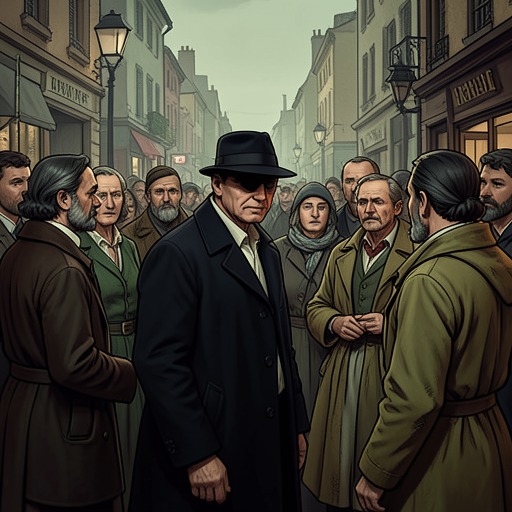
The confrontation at Henschke’s pub
Berlin AlexanderplatzThe confrontation at Henschke’s pub is the moment when Franz Biberkopf’s private code of order collides openly with the politics of the workers gathered across from him. A dispute that begins with songs and table manners becomes a challenge to his armband and beliefs; his answer is not a reasoned debate but a furious defense of order, followed by a sudden retreat from the scene.
The pub and the gathering
Franz arrives at Henschke’s late in the evening and finds Georg, young Richard, and several others at a separate table. Two of the men are strangers to him. The pub is nearly empty, but their table has been loud with talk and grumbling; when Franz enters, the newcomers fall quiet and look across at him. He notices their smoking partly because a small bird sits on its perch in the corner, and he worries that the smoke may harm it. His attention moves between the bird, the men, his meal, and thoughts of Lina: the immediate surroundings matter to him more than the political talk taking shape nearby.
The strangers begin singing The Internationale. Franz assumes their song is aimed at him, but he does not join in at first. He says he likes their voices and will sing after eating, having made a promise. He finishes his bread and cheese and beer while thinking about the cold, the bird, and Lina. The gap between the table’s political performance and Franz’s everyday concerns gives the scene its first tension: he treats the song as something he can answer on his own terms, while the others turn it into a public test of allegiance.
Songs become a test of allegiance
When the men call on him to keep his promise, Franz sings Der gute Kamerad, a song he learned in prison. The account connects the melody to his memory of standing in a prison yard and singing toward its walls. The song’s image of a comrade struck down in battle gives his performance a personal gravity, and the men across from him eventually join in, beating on the table. Franz, however, realizes that this is not the song he had meant to sing. He then launches into Die Wacht am Rhein, the patriotic anthem associated with his convictions, and ends by raising his beer mug in a toast to life.
The response is silence rather than shared celebration. Georg sits bowed forward, and Henschke leaves the bar to sit near Franz. One of the newcomers climbs onto Franz’s table and questions what he has eaten. Franz answers with insults and tells him to get down; when the man persists, Franz stands and tips the table over. Plates and the beer mug fall with it, and the plate breaks. Henschke stamps on the fragments and tries to prevent the disagreement from becoming a fight, insisting that anyone who cannot keep the peace must leave. The broken crockery turns the dispute into an immediate question of responsibility, but the political disagreement is already driving the encounter.
The challenge over the armband
A tall newcomer approaches Franz and demands the armband in his pocket, calling him a fascist and accusing him of belonging to the swastika group. Franz confirms that the accusation is true and says he has already explained his reasons to Georg. Georg distances himself from the confrontation and warns Franz to recognize what he is getting into. Henschke also urges Franz to go, while trying to hold the tall man back. Franz protests that he has been a regular and that the two newcomers are the ones who have brought the disturbance into the pub.
Franz defends his position by arguing that there must be law and order so factory workers, tradesmen, and other people can work and live. To him, the men across the table are not merely voicing an opposing political view: he sees them as stirring up disorder and provoking others into violence. His argument turns into an outburst. The narration links the surge of anger to the fact that he has been imprisoned in Tegel Prison and to his memories of Ida, which he tries not to dwell on. He invokes his experience of the trenches and denounces the men as people who are disrupting the world. The speech is less a reply to their political case than an attempt to drown out the fear and anger the confrontation has brought to the surface.
Withdrawal and immediate aftermath
The scene does not end in a brawl. The others fall quiet, and Georg tells Franz that he has said enough and should leave. At that point, Franz’s agitation ebbs: his face pales, his grip on the chair loosens, and his voice sounds coarse. He says he will go and dismisses the argument as none of his concern. The narration briefly sets the private confrontation beside reports of economic strain, including unemployment figures, and a fragment of political rhetoric. This shift places the pub’s argument within a wider field of social conflict without resolving the opposed claims.
Outside, Lina has just arrived. Franz walks away with her, still imagining that he could return and explain why he thinks the men are wrong. He also says he would like to smash the pub, but the flare of anger subsides as he holds on to Lina. He presents the men as hot-blooded and inexperienced, then rejects the expectation that he should involve himself in either the left-wing dispute or other groups he regards as none of his business. His withdrawal is therefore not a conversion or a reconciliation: he keeps his beliefs, but refuses to continue the political encounter.
Franz and Lina take a tram to Walterchens Ballhaus to go dancing. Lina has brought him a crumpled Sunday copy of the Peace Messenger, a paper he does not sell. He responds warmly to its name and to the headline, Unhappiness can lead to Happiness, and they read a poem about the comfort of friendship on the journey. The immediate movement from accusation and silence to companionship does not settle Franz’s politics; it changes the scene’s scale, carrying him away from the pub’s public confrontation into an ordinary evening with Lina.