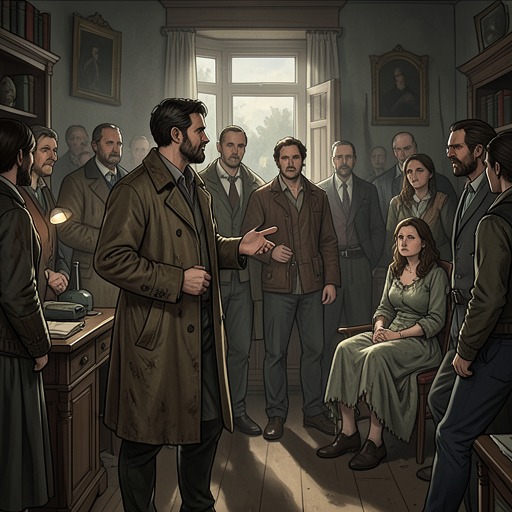
Willi
Berlin AlexanderplatzWilli is a quick-witted young man whose provocations pull Franz Biberkopf toward two apparent alternatives to respectable work: illicit trade and radical politics. At a crowded pub table, he turns an argument over war pensions into a challenge to accepted ideas of responsibility and legality. Later, he offers Franz a way to make money quietly, then leads him through political meetings where dissent becomes both spectacle and a means of finding targets for schemes. Willi’s importance lies in that double use of language: he can make authority look arbitrary, but he also uses that uncertainty to benefit himself.
Identity and First Impressions
Willi first appears in a large jockey cap, sitting on the same bench as Franz without a beer in front of him. The narration gives him the lower jaw of a prize fighter, a physical detail that matches the combative confidence of his talk. He is young enough for Franz to remark on the difference in their ages, yet Willi presents himself as more alert to the hypocrisies of adult life.
The conversation turns on the treatment of disabled veterans. One pubgoer recounts a father wounded in the chest whose pension has been reduced and may be withdrawn. Willi argues that disabled men should not receive money, then admits that he himself does no work and would continue doing nothing for as long as he was paid. The contradiction makes the table laugh at him as a windbag, but it also exposes the insecurity beneath the argument: he attacks the pension system while relying on an allowance himself. His bluster is not a settled political position so much as a way of taking control of the discussion.
The Pub Argument: Names, Law, and Ownership
When another patron questions a gold watch that Willi says he bought for three marks, Willi turns suspicion into a demonstration about naming. He asks the company to identify a beer mug and a girl’s walk, then insists that the acts remain visible whatever label people give them. The girl has walked, danced, or marched; the words vary, but the witnesses saw what happened. He applies the same reasoning to a watch taken from a pocket or shop: in his account, it has changed owners, and calling the transfer theft is only one possible description.
The argument is not a neutral exercise in semantics. Willi uses the gap between an act and its public name to evade responsibility for appropriation. The table falls quiet as his point lands, and he then directs the challenge at Franz’s one-armed condition. Franz had been compelled to serve in the war, Willi argues, but courts and police gave that compulsion the official name of national service rather than deprivation of liberty. By connecting Franz’s injury and military service to state power, Willi makes the law itself appear to be a naming system backed by force. His critique has real bite, even as his treatment of the watch shows how readily he turns that critique into cover for crime.
From Political Talk to Illicit Trade
Willi soon offers Franz a practical arrangement: he can supply goods each day for Franz to sell or dispose of quietly, provided that friends keep silent. Franz accepts the prospect eagerly. He wants money quickly and wants to stand on his own feet; ordinary work and newspaper selling now seem intolerable to him. The narration identifies his new occupation as that of a fence, marking a decisive turn from talk about legality to participation in the criminal economy Willi has opened up.
Willi’s own position in this arrangement is unstable. He is described as bright and sharp but inexperienced as a pickpocket, and he is also described as taking money from Franz. His political companionship is therefore bound up with personal advantage. He can supply Franz with an illicit opportunity while making himself appear like a guide to a larger understanding of society; the same quickness that exposes hypocrisy helps him recruit and exploit an older, vulnerable associate.
Meetings, Influence, and Withdrawal
Willi takes Franz to political meetings and gives him a running explanation of what is being said. Franz listens with curiosity, buys pamphlets, and puts them in his pocket. The meeting rhetoric condemns parliamentary politics, state power, property, and class inequality, and calls for direct action and the withdrawal of labor. Franz is touched by the ideas for a time, but the effect fades; he remains with Willi more consistently than he remains engaged with the politics itself.
Their association causes concern among Franz’s acquaintances. Eva warns that Willi is taking Franz’s money and regards him as no better than a pickpocket. Franz agrees with her assessment, promises to stop seeing him, and then goes out with him again, even taking him rowing. Mieze is also left waiting while Franz spends time with Willi and attends meetings. These reactions reveal the cost of the friendship beyond Franz’s own political uncertainty: those close to him see his money, time, and attention being drawn away, while his promises to change do not hold.
Willi’s political activity is itself opportunistic. He enjoys heckling at meetings, but he also uses them to identify people with whom he can do business or make fools of. His earlier arguments about state coercion and property thus coexist with calculated self-interest rather than leading him toward a consistent program. When Franz finally listens to an elderly joiner explain that he attends meetings because his sick wife needs the house quiet in the evening, the ordinary domestic reason cuts through the political performance. Franz leaves Willi at the bar, walks away alone, and decides that the meetings are doing him no good. The episode closes Franz’s brief political immersion, though it does not establish that he never sees Willi again. Willi remains a figure of restless persuasion: capable of exposing the violence hidden in official language, yet just as capable of making persuasion serve his own schemes.