
The Cosmic Scale of Time
Bhagavad GitaThis flow traces the expansion of the battlefield crisis into a vision of creation, destruction, and eternal time.
increasing Bearing strength in each event
 decreasing
Bearing strength in each eventdecreasingCycles of Creation
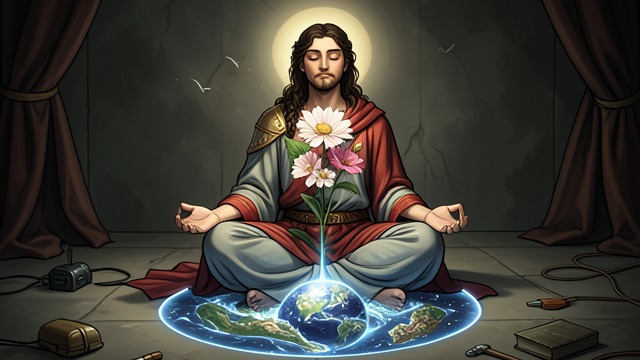
Cycles of Creation
Repeated Emergence
Krishna describes beings arising at the beginning of a Kalpa and returning to his nature at its close.
Impersonal Continuity
Individual events become moments within vast cycles of manifestation and dissolution.
Narrative Importance
The war is placed inside a universe that repeatedly creates and absorbs worlds.
Day and Night
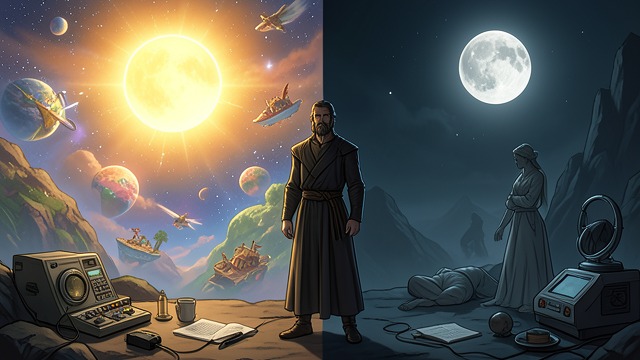
Day and Night
Cosmic Alternation
The Day of Brahma brings manifestation, while the Night of Brahma draws beings back into the unmanifest.
Relative Permanence
Even immense cosmic durations remain temporary beside the imperishable reality Krishna describes.
Narrative Importance
The doctrine diminishes worldly permanence without denying the significance of right action.
Universal Form

Universal Form
Total Vision
Arjuna sees gods, creatures, warriors, weapons, and worlds gathered within Krishna's immeasurable form.
Collapse of Boundaries
Creator, destroyer, future, and present appear simultaneously rather than as separate moments.
Narrative Importance
The personal teacher becomes the visible structure of reality itself.
Death as Time

Death as Time
Terrible Disclosure
Krishna identifies himself as Death, the destroyer of worlds, already consuming the assembled warriors.
Limits of Control
Arjuna's choice cannot prevent the larger destruction, though it determines whether he participates honorably.
Narrative Importance
Death becomes a cosmic function rather than merely a personal tragedy.
Return to Human Form

Return to Human Form
Fearful Reverence
Arjuna asks Krishna to resume the familiar form that allows affection and comprehension.
Restored Intimacy
Krishna returns to his gentle appearance and comforts the frightened warrior.
Narrative Importance
The book balances cosmic terror with the possibility of a personal relationship to the divine.
during the teaching on cosmic manifestation
during the teaching on Brahma's cycles
at the center of the cosmic revelation
immediately within the universal vision
after Arjuna's plea for reassurance
