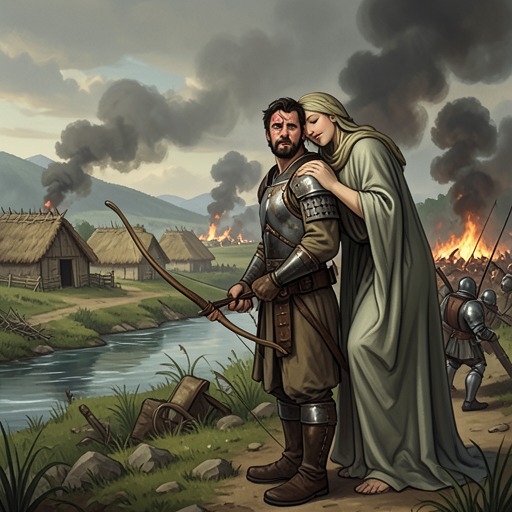
Arjuna lays down his weapons
Bhagavad GitaArjuna lays down his weapons at the opening of the Battle of Kurukshetra, and the gesture becomes the decisive interruption of the battle’s expected course. He has asked Krishna to place Arjuna's chariot between the two armies so that he can see those with whom he must contend. Once he recognizes that the opposing ranks contain not an abstract enemy but his own family, teachers, elders, and friends, the warrior’s confidence collapses into grief, pity, and refusal.
The Moment of Collapse
Arjuna’s crisis is presented through the body before it is argued through the mind. His limbs grow languid, his mouth dries, his body trembles, and his hair stands on end. His bow, Gandiva, slips from his hand; his skin burns; he cannot remain standing; and his thoughts seem to wander. The weapon is therefore not merely discarded as military equipment. Its release marks the failure of the identity that had carried Arjuna toward battle: the disciplined bowman suddenly cannot make his weapon serve an action he has come to regard as morally intolerable.
Sanjaya’s narration makes the physical act the visible consequence of an inward reversal. After seeing the kinsmen assembled and ready to fight, Arjuna casts aside his bow and arrows and sits down on his chariot, his mind overwhelmed by grief. The army remains drawn up and the throwing of missiles has begun, but Arjuna’s action suspends his participation at the very instant when action is expected. The battlefield becomes a place of paralysis rather than movement.
The Ethical Grounds for Refusal
Arjuna’s refusal is not explained by fear of death or by a desire for personal safety. He rejects victory, sovereignty, pleasure, and even life when they would be purchased by killing those for whose sake such rewards are desired. The opposing army includes preceptors, fathers, sons, grandfathers, maternal uncles, fathers-in-law, grandsons, brothers-in-law, and other kinsmen. Their presence changes the meaning of conquest: a kingdom won through their deaths would be bloodstained and empty.
He also argues that killing one’s own relatives would produce consequences beyond the battlefield. Even if the sons of Dhritarashtra are morally corrupted by greed and fail to recognize the danger of destroying a family, Arjuna believes that he and Krishna can see the damage clearly and must therefore abstain. The extermination of a race would destroy its eternal customs; the collapse of those customs would allow sin to prevail; corruption and intermixture of castes would follow; family rites would disappear; and ancestors would fall when the rites of pinda and water ceased. In Arjuna’s reasoning, the contemplated violence threatens the continuity of families, ritual obligations, social order, and relations between the living and the dead.
The argument culminates in self-condemnation. Arjuna admits that the desire for the sweets of sovereignty has led the warriors toward a great sin and declares that it would be better to be killed unarmed and unresisting by the armed sons of Dhritarashtra than to kill his own kinsmen. Laying down his weapons thus expresses a choice for suffering and dispossession over a victory that would destroy the moral world it was meant to secure.
From Refusal to Discipleship
Arjuna’s abandonment of the bow does not end the dialogue; it creates the condition for it. He asks how he can fight Bhishma and Drona, both worthy of worship, and says that living on alms would be preferable to enjoying pleasures stained by their blood. He cannot determine whether conquering them or being conquered by them would be better, because those whom he would not wish to survive stand before him in battle.
His refusal then becomes an explicit request for instruction. Arjuna says that compassion has affected his nature and that his mind is unsettled about duty. He asks Krishna to tell him what is certainly good, declares himself Krishna’s disciple, and seeks refuge in his guidance. Even an unconquered earthly kingdom or sovereignty of the gods, he says, would not dispel the grief that is destroying his senses. When he finally states that he will not fight and falls silent, the warrior’s silence hands authority to Krishna and turns the battlefield into a setting for the Krishna–Arjuna Dialogue.
Krishna’s first response is a direct challenge to the paralysis. He asks Arjuna where this despondency has come from at such a crisis, calls it unbecoming to a person of noble birth, and warns that it shuts one out from heaven and produces infamy. He tells Arjuna to shake off the weakness of his heart and rise. The command does not immediately settle the conflict; instead, it establishes the tension that the subsequent teaching must address: compassion appears noble to Arjuna, while Krishna treats surrender to that compassion as a failure to meet the demands of his position.
The Teachings That Reframe the Act
Krishna answers Arjuna’s fear of killing by distinguishing the imperishable soul from the perishing body. The soul is described as unborn, eternal, unchangeable, indestructible, and beyond the reach of weapons, fire, water, and wind. Bodies have an end, but the embodied soul is not slain when the body perishes. Krishna compares the soul’s change of body to a person casting off worn-out robes and putting on new ones. From this perspective, death does not destroy the enduring self, and mourning cannot alter the unavoidable sequence by which the born die and the dead are born again.
Yet Krishna’s argument is not limited to metaphysics. He directs Arjuna to the duty of his order and declares that a fair battle is the highest opportunity for a Kshatriya, an open gate to heaven. If Arjuna refuses this just battle, he will abandon both duty and fame. Great car-warriors will think that he withdrew from fear, enemies will disparage his prowess, and the dishonor will be worse than death for one previously respected. Krishna therefore places the personal shame of refusal beside the spiritual consequences Arjuna has emphasized, replacing the question of whether killing relatives is emotionally bearable with the question of whether abandoning one’s own duty is morally defensible.
The proposed resolution is disciplined action rather than attachment to victory. Krishna tells Arjuna to regard pleasure and pain, gain and loss, victory and defeat as equal and to fight for the sake of action itself; action performed in such equanimity does not bind him with sin. He later insists that no one can remain without work even for a moment, that mere non-performance does not produce freedom, and that action is better than inaction. Work becomes liberating when performed without attachment, without desire for its fruit, and as sacrifice rather than private acquisition.
The Refusal’s Lasting Significance
Arjuna lays down his weapons as a protest against the reduction of kinship, obligation, and life to the logic of victory. The act gives the book its governing dramatic shape: an apparently simple command to fight becomes the starting point for a sustained inquiry into the soul, duty, action, desire, self-mastery, and freedom. His refusal is neither treated as the final truth nor dismissed as meaningless. It is the crisis that makes higher discernment necessary.
The later teaching preserves an important part of Arjuna’s original concern even while redirecting it. Krishna does not recommend indiscriminate action; he distinguishes action from inaction, attachment from disciplined performance, and one’s own duty from the duty of another. The teaching declares that one’s own duty, even imperfectly performed, is better than another’s duty well performed, and that abandoning natural duty because it is tainted by difficulty is not the path to perfection. Arjuna’s personal horror therefore becomes the testing ground for a broader rule: moral life cannot be governed solely by anticipated pleasure, pain, gain, or loss, but requires discernment of duty and control of the motives that bind action.
The gesture’s ultimate consequence is to change Arjuna’s position within the narrative. He begins as a warrior who cannot act, becomes a grieving questioner, and is addressed as a disciple who must learn how to act without being possessed by the fruits of action. His laid-down bow remains the image of the unresolved crisis, while Krishna’s response supplies the intellectual and spiritual framework through which that crisis is to be overcome. The event thus stands at the boundary between Arjuna’s refusal to fight and the long instruction intended to lead him from grief toward steady understanding and responsible action.