Arjuna's Refusal to Fight
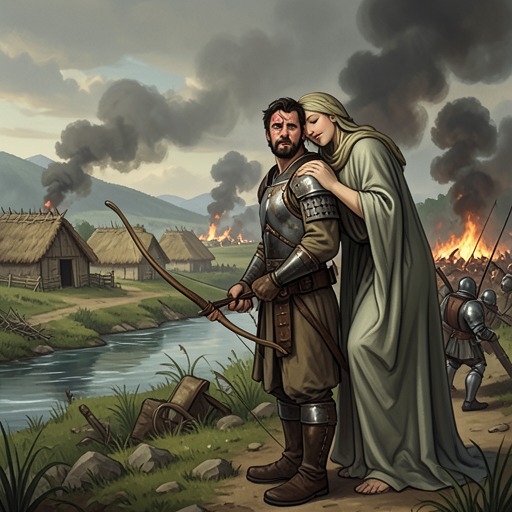
Bhagavad GitaArjuna's Refusal to Fight is the decisive opening crisis of the Krishna–Arjuna Dialogue. On the sacred plain of Kurukshetra, Arjuna does not recoil from an abstract enemy but from a battlefield densely populated by the relationships that give his life meaning: Bhishma and Drona stand among the opposing forces, while fathers, sons, grandsons, in-laws, maternal uncles, friends, and other kinsmen face one another beneath their banners. His refusal transforms the imminent Battle of Kurukshetra from a contest for sovereignty into a moral catastrophe, and his collapse gives Krishna the occasion to teach the path from grief and confusion toward disciplined action.
Causes and Battlefield Recognition
The crisis begins after Arjuna asks Krishna to place Arjuna's chariot between the two armies so that he can inspect those assembled for battle. Krishna positions the chariot before Bhishma, Drona, and the assembled kings, making the opposing host visible not merely as a military formation but as a network of personal obligations. The sight changes the meaning of the action Arjuna had been preparing to undertake: the campaign now appears to require him to attack the very people for whose sake victory, sovereignty, pleasure, and life would ordinarily be desired.
Arjuna's response is physical as well as intellectual. His limbs grow languid, his mouth dries, his body trembles, his hair stands on end, his skin burns, and he can no longer remain steady. The Gandiva slips from his hand, and his mind seems to wander. These details give the refusal the form of an embodied breakdown rather than a detached philosophical objection. He also perceives adverse omens and declares that he desires neither victory nor sovereignty nor pleasures if they must be purchased through the destruction of his own relations.
His argument proceeds from personal grief to a theory of social ruin. Even if the opposing warriors are treated as enemies, he reasons, killing them will bring sin upon those who perform the killing. The destruction of a race would extinguish its eternal customs and family rites; from that loss, sin would overpower the survivors, women would be corrupted, caste intermixture would follow, and the destroyers and the destroyed race would be led toward Hell. With ancestral rites of pinda and water discontinued, the ancestors would fall, while the rules governing families and social order would disappear. Arjuna therefore presents the battle as a chain of consequences extending beyond the battlefield into domestic, ritual, ancestral, and cosmic disorder.
The Refusal and Its Immediate Form
Arjuna's compassion is sharpened by the special status of the men before him. He cannot reconcile the killing of Bhishma and Drona, figures deserving worship, with the conduct expected of a warrior. He considers living on alms preferable to killing his preceptors, because any pleasure gained from such a victory would be bloodstained. He admits that he does not know whether conquering them or being conquered by them would be better; by killing those whom he would not wish to outlive, he would make victory itself uninhabitable.
The crisis becomes a request for instruction when Arjuna confesses that compassion has tainted his nature and that his mind is unsettled about duty. He asks Krishna to tell him what is assuredly good, explicitly placing himself in the position of a disciple and seeking Krishna's aid. Yet the request does not immediately restore his capacity to act. Having expressed his reasoning, Arjuna addresses Krishna once more with the declaration, "I will not fight," and then falls silent. The refusal is therefore both a judgment and a surrender: he rejects the action before him, but he also yields the unresolved question of duty to Krishna's teaching.
The physical conclusion makes the inner decision visible. After speaking on the field of battle, Arjuna, troubled by grief, casts aside his bow and arrows and sits down on his chariot. The warrior who had stood ready among the armies is now immobilized at the exact point where action should begin. The weapons are not merely equipment abandoned in panic; their dismissal marks the suspension of his public role and the interruption of the war's expected movement.
Krishna's Immediate Challenge
Krishna answers the collapse first by confronting its timing and character. He asks Arjuna where, at such a crisis, this despondency has come from and describes it as unbecoming a person of noble birth, obstructive to Heaven, and productive of infamy. He urges Arjuna to cast off what he calls the weakness of the heart and to rise as a chastiser of foes. The response does not deny that Arjuna suffers; it disputes the conclusion that suffering authorizes withdrawal from the prescribed action.
Arjuna presses the objection instead of yielding. He asks how he can fight Bhishma and Drona with arrows when they deserve worship, and repeats that it would be better to live on alms than to enjoy pleasures stained by the blood of preceptors. His uncertainty is not limited to fear of defeat. It concerns the possibility that victory itself may destroy the value of living, because the people whose presence would make sovereignty meaningful would have been slain.
Krishna then begins to separate grief for persons from knowledge of the soul. He teaches that the embodied soul is not destroyed when the body perishes, comparing the soul's passage between bodies to a man casting off worn robes and putting on new ones. Weapons cannot cleave it, fire cannot consume it, water cannot drench it, and wind cannot waste it. From this perspective, the unavoidable succession of birth and death cannot by itself justify mourning. Krishna also introduces the warrior's specific obligation: a fair battle that arrives as an open gate of Heaven is an opportunity for a Kshatriya, while abandoning it incurs sin and destroys fame.
Duty, Action, and the Reversal of Meaning
The refusal exposes a conflict between two moral languages. Arjuna measures action through its immediate human consequences: the death of elders, the violation of family continuity, the collapse of rites, and the suffering of those left behind. Krishna redirects judgment toward duty, intention, and disciplined relation to results. Arjuna is told to regard pleasure and pain, gain and loss, victory and defeat as equal and to fight for the sake of battle itself, without making its fruit the motive.
This teaching does not simply command violence without qualification. It establishes a contrast between action performed according to one's own duty and action abandoned through attachment to consequences. Krishna later states that one's own duty, even imperfectly performed, is better than another's duty well performed; performing the duty arising from one's nature does not incur sin, while adopting another's duty carries fear. In the framework presented to Arjuna, the problem is therefore not only whether killing is painful or morally frightening, but whether personal grief has caused him to abandon the role and responsibility assigned to him.
Krishna's argument also makes action unavoidable. No person can remain without work even for a moment, and freedom does not arise merely from refusing to act. Work binds the world when performed for private ends, but action performed as sacrifice and without attachment can become a path toward emancipation. The ideal is not passive escape from the battlefield. It is action without possessiveness, egoism, or craving for reward. Arjuna's refusal thus becomes the negative image against which Krishna defines disciplined action: withdrawal may look pure while still being governed by grief, aversion, and confusion.
From Collapse to Transformation
The later teaching repeatedly returns to the conditions that made Arjuna refuse. A steady mind is not one that never encounters pain, but one that is not agitated amid calamities, is free from attachment, fear, and wrath, and remains equal before agreeable and disagreeable objects. The senses must be restrained, desire must be observed before it becomes attachment and wrath, and the mind must be directed toward the self. In this account, Arjuna's initial reaction reveals precisely the chain Krishna seeks to interrupt: the sight of desired and feared objects produces overwhelming attachment, aversion, loss of discrimination, and paralysis.
Krishna's instruction nevertheless preserves compassion in transformed form. The best devotee is described as one who regards the happiness and misery of others as his own and who casts an equal eye everywhere. Arjuna's refusal begins with an intense recognition of the suffering that his action would cause, but that recognition is embedded in attachment to particular relations and in fear of social and personal consequence. Krishna seeks a wider equanimity, in which all beings are perceived through the same self and action is performed without abandoning responsibility.
The teaching also places Arjuna's decision inside a larger structure of nature and divine governance. All actions are performed in various ways by the qualities of nature, though the deluded person, influenced by egoism, considers himself the actor. Krishna warns that if Arjuna, through self-conceit, insists that he will not fight, the resolution will be vain: nature will compel him to perform the action he refuses. He ultimately commands Arjuna to dedicate all actions to Krishna, fix his thoughts on him, and seek refuge in him. The refusal therefore initiates not a simple return to combat but a reconstitution of agency, in which Arjuna is to act as an instrument rather than as an ego claiming sole authorship.
Narrative and Philosophical Significance
As the opening event of the Bhagavad Gita's teaching sequence, Arjuna's Refusal to Fight converts a military pause into the work's central scene of deliberation. The armies are ready, conches have sounded, and the throwing of missiles is about to commence; yet the narrative stops at the instant of decision. The battlefield becomes a chamber of instruction, and the chariot becomes the place where competing accounts of kinship, sin, duty, mortality, and liberation are tested.
The event's importance is confirmed by the scale of Krishna's later revelations. In the cosmic vision, Krishna declares, "I am Death, the destroyer of the worlds," and tells Arjuna that the warriors are already slain and that Arjuna should act only as an instrument. The earlier refusal had treated the warriors as irreplaceable persons whose deaths would make victory meaningless; the revelation places them within a cosmic process that exceeds Arjuna's individual will. Even so, the command returns responsibility to him: he must rise, fight, and gain glory rather than imagine that refusing to act will suspend the forces already in motion.
By the close of the teaching, Krishna states that a person reaches perfection through performing his own duty, dedicating actions to the divine, and relinquishing attachment. He offers Arjuna a final refuge in the command, "Forsaking all (religious) duties, come to Me as thy sole refuge," while also telling him to reflect fully and act as he wishes. The earlier words, "I will not fight," have therefore become the starting point for a transformed decision rather than the final verdict. Arjuna's refusal remains morally serious because it makes the cost of action visible, but its narrative function is to expose the confusion from which discernment, devotion, and purposeful action must emerge.